
Discover Peterborough · Bronze Age
c.850 BC · The Flag Fen Basin
Must FarmBritain's Bronze Age Time Capsule
Nearly 3,000 years ago, a newly built settlement stood on timber piles above a slow-moving Fenland river. Within a year it was engulfed by fire. Houses, pots, food, textiles, tools and personal possessions collapsed into the water below, creating one of the most extraordinary archaeological snapshots ever recovered from prehistoric Britain.
One year. One fire. Three thousand years of survival.
Must Farm lets us enter a Bronze Age home.
Archaeology usually gives us fragments: a post-hole, a ditch, a broken pot, a scatter of bone. Must Farm is different. The settlement's destruction was so sudden, and its burial environment so protective, that archaeologists could reconstruct not merely what people owned but where things sat inside their houses, what they ate, how they dressed and how they organised daily life.
Built in the mid-ninth century BC above a slow-moving freshwater channel near modern Whittlesey, the pile-dwelling settlement appears to have been occupied for only around nine months to a year. Then fire swept through it. Flexible floors failed, roofs collapsed and the contents of the houses dropped into the water and mud beneath.
The disaster that destroyed the settlement created the conditions that preserved it. Charring protected some materials; waterlogging protected others; vegetation and soft sediment cushioned falling objects. The result is one of the most complete prehistoric domestic assemblages ever systematically excavated in Europe.
A late Bronze Age settlement raised over a freshwater channel.
The settlement was astonishingly new when catastrophe struck.
Four large roundhouses and a square entrance structure.
Wood, textiles, pottery, metalwork, food remains, beads and more.
Before c.850 BC
A changing Fenland
The settlement belonged to a much older landscape.
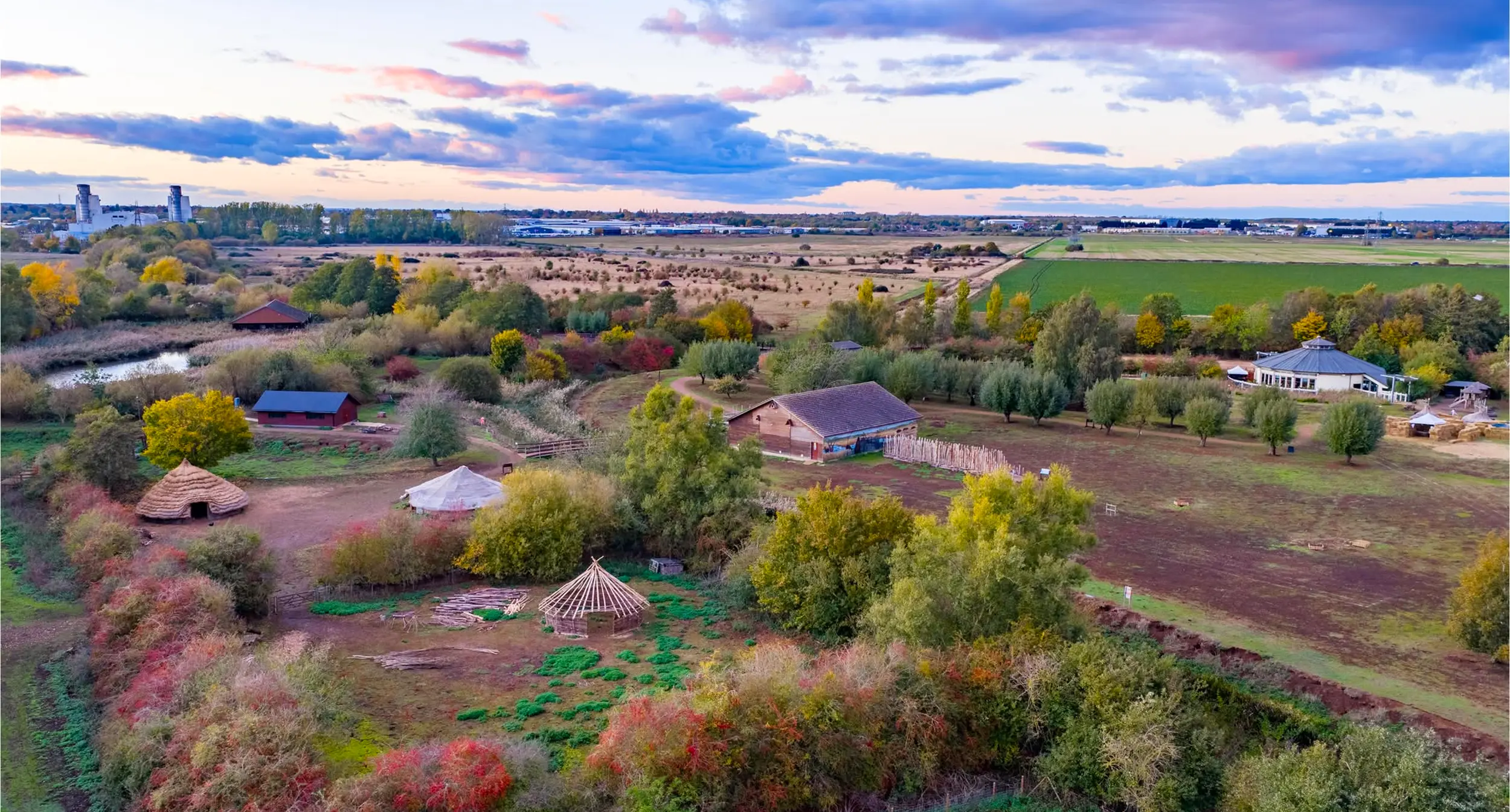
Must Farm sits within the Flag Fen Basin, one of Britain's most intensively studied prehistoric landscapes.
This was not an empty marsh suddenly colonised by people on stilts. Across millennia, the Lower Nene landscape shifted repeatedly between dry land, woodland, estuary, freshwater channels, reedbeds and peat. People adapted with it.
Earlier archaeology at Must Farm includes a substantial Middle Bronze Age timber causeway crossing the same palaeochannel later occupied by the pile-dwelling settlement. Excavations elsewhere in the channel have produced fish traps, fish weirs, metalwork and multiple logboats. The river was not simply an obstacle: it was a route, a resource and a place of repeated human activity.
The two sites belong to the same Bronze Age wetland world but tell different stories. Flag Fen reveals monumental construction and deposition over centuries. Must Farm captures the intimate organisation of everyday domestic life at one extraordinary moment.
Explore the Flag Fen landscape →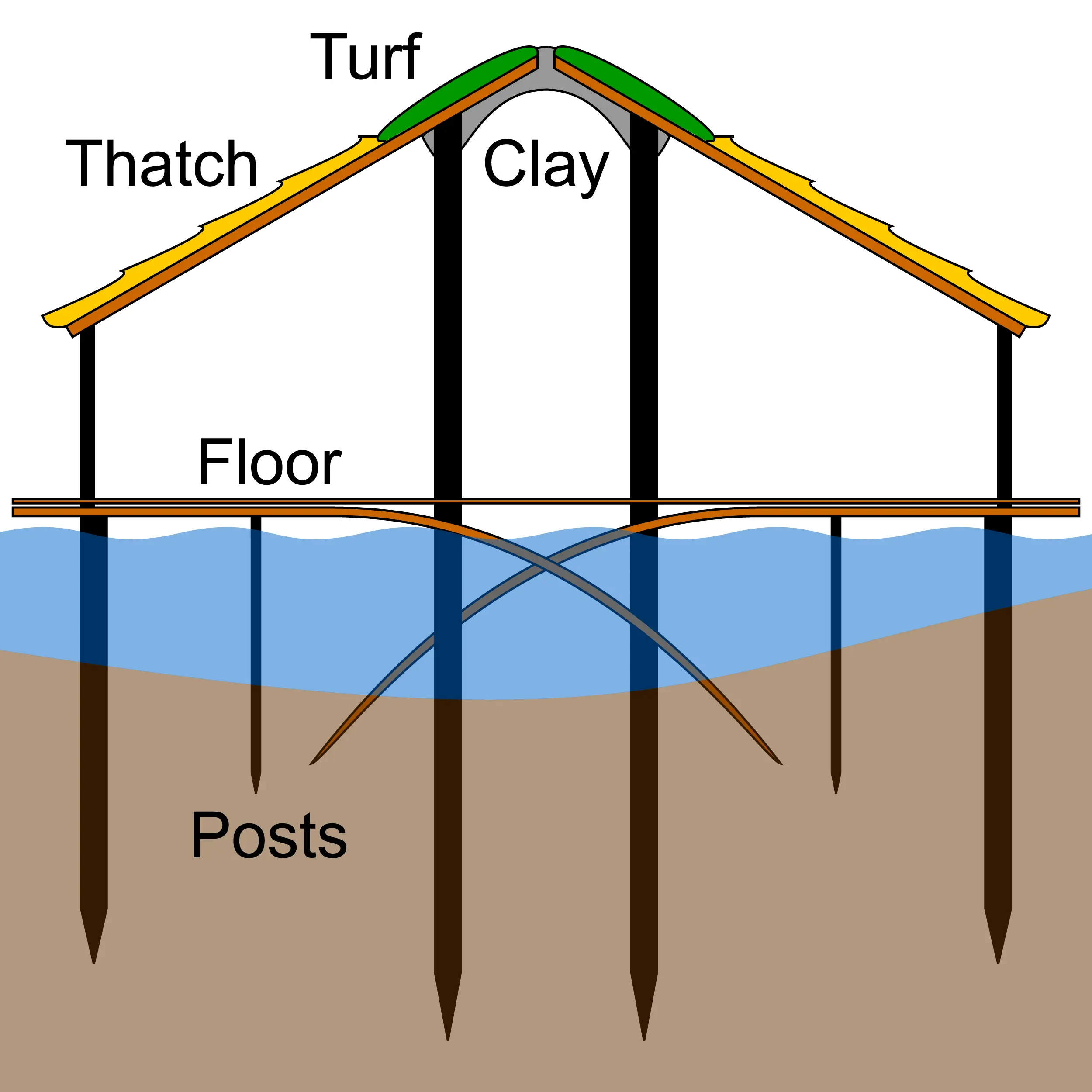
Architecture over water
A home built above a river.
The settlement's houses were circular timber buildings raised on piles. The entire hamlet stood roughly two metres above the riverbed. Walkways linked parts of the settlement, while a curving palisade of sharpened posts enclosed it.
Archaeology does not preserve a neat architectural drawing, but the collapsed timbers allow the construction sequence to be reconstructed in exceptional detail: piles and posts, flexible floors, walling, rafters and roofing materials all survived.
The pile-dwelling settlement
Five structures inside a timber boundary.
The excavated settlement included four large circular houses and a square entrance structure. Researchers believe quarrying had already removed part of the original settlement, meaning it may once have been roughly twice the excavated size.
Roundhouses
Large circular homes raised above the channel on timber piles, with carefully organised interiors.
Walkways
Raised connections allowed movement between structures without descending into the water below.
Palisade
A substantial curving boundary of sharpened posts enclosed the settlement and defined its edge.
Entrance
A square structure appears to have controlled or marked entry into the enclosed settlement.
The river
The channel beneath was part foundation, part route and part preservation environment.
A small community
The complete settlement may have accommodated several family groups, perhaps dozens of people.
Reading the settlement
A plan preserved by catastrophe.
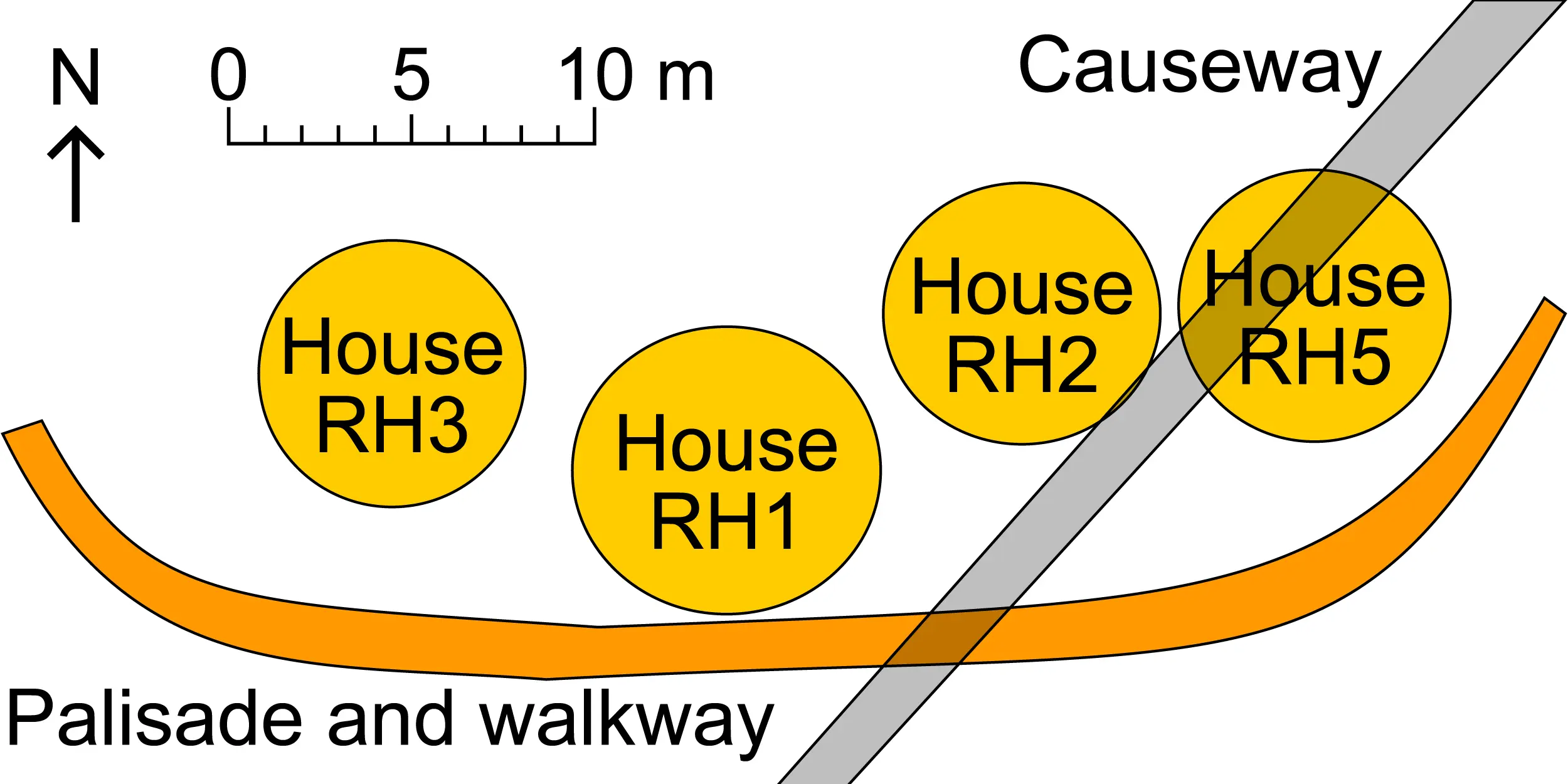
Within a year of construction
The night everything changed
Fire destroyed the settlement.
Water preserved it.
The blaze was catastrophic and fast. There is still no secure answer to what caused it.
As roof and wall structures burned, the raised floors lost support. Buildings and their contents collapsed into the river beneath. Because the settlement was so new, many possessions were still pristine. Because the collapse was sudden, people did not systematically clear their homes first.
The archaeology records destruction, but it does not give us a perpetrator. Deliberate attack has often been discussed, but accidental fire remains possible. The cause should remain an open question rather than being turned into a dramatic certainty.
Must Farm is exceptional not because people in the Bronze Age owned extraordinary things, but because ordinary things survived extraordinarily well.
River vegetation cushioned falling objects, while mud quickly sealed them. Carbonised timbers, waterlogged wood, fibre, food remains and complete vessels survived together. That combination gives Must Farm its remarkable archaeological resolution.
A household frozen in place
Where things fell
The archaeology preserves rooms without walls.
Objects fell from the houses broadly beneath the places where they had been stored and used.
This transformed interpretation. Archaeologists could map clusters of pottery, food, tools, textiles and animal remains across individual structures, revealing zones of activity within circular homes. Cooking, food storage and working areas could be inferred with a confidence rarely possible in prehistoric archaeology.
Cambridge researchers have compared the result to a domestic blueprint. The roundhouses were not undifferentiated spaces. Their inhabitants organised possessions and tasks spatially, and similarities between houses suggest shared expectations about how a home should work.
Many objects show little wear, reinforcing the evidence that the settlement was destroyed shortly after it was built.
A household inventory
The Bronze Age in extraordinary detail.
More than spectacular metalwork survived. Must Farm preserves the things usually missing from prehistoric sites: wooden containers, fibre, prepared food, tools and fragile evidence of daily routines.
Pottery vessels
Bowls, jars and cooking vessels survived, some still containing food residues or utensils.
Fibre & textiles
Exceptionally fine woven fabrics, cords and fibre objects reveal sophisticated textile production.
Wooden artefacts
Bowls, buckets, tools and structural pieces survive because waterlogging prevented normal decay.
Metal objects
Axes, sickles, spears and other bronzes show both household equipment and weaponry.
Glass beads
Blue-green beads connect this Fenland settlement to exchange networks reaching continental Europe and beyond.
Spear shafts
Long, complete wooden shafts survived with bronze spearheads, preserving weapons normally known only from their metal tips.
Dinner, 2,900 years ago
Meals survived inside the pots.
Animal bone, cereal remains, residues and cooking vessels allow researchers to reconstruct a diet combining farmed and wild resources. Sheep and cattle were important, but people also hunted red deer and wild boar and exploited fish from the wetland environment.
Some vessels retained charred cereal grains and prepared food. Analysis has encouraged evocative descriptions such as venison prepared with honey. These should not be mistaken for a written Bronze Age recipe, but they demonstrate something more important: meals can be reconstructed from direct evidence rather than guessed from isolated bones.
The settlement was built over wetland, yet much of its food economy remained connected to dry land. This challenges the idea that pile-dwelling communities were cut off in an aquatic world. They moved between water, grazing, woodland and cultivated ground.
Fine fibres in river mud
Clothed in the Bronze Age
Some of Europe's finest prehistoric textiles.
Textiles almost never survive on ordinary prehistoric sites. At Must Farm, they survive in abundance.
The assemblage includes finely woven fabric, thread, bundles of fibre and other textile-related material. Flax was worked into fine cloth, demonstrating technical control far removed from stereotypes of coarse prehistoric clothing.
Loom weights and associated equipment place textile production inside the domestic economy. The fabrics also allow specialists to study weave, thread diameter, preparation and repair — details usually erased completely by three millennia of decay.
A connected Fenland
Must Farm was local.
Its connections were not.
Glass beads found at Must Farm demonstrate participation in exchange networks extending far beyond the Nene.
Scientific analysis indicates that different beads had distant origins, with material linked to continental Europe and the eastern Mediterranean or Middle East. Their presence does not mean residents themselves travelled those distances. It shows that objects and materials could pass through many hands across interconnected Bronze Age networks.
Bronze itself represents connection. Copper and tin had to be brought together through supply networks whose raw materials lay far beyond the Fen edge. A household at Must Farm therefore sat inside systems of exchange operating at regional, national and continental scales.
The intimate and the unsettling
A human skull among household possessions.
One of Must Farm's most arresting finds was part of a human skull. Its surfaces had become smooth, suggesting repeated handling before it entered the archaeological deposit.
Archaeologists have considered whether it could have been a curated ancestral or personal object — perhaps the remains of someone remembered by the community. That interpretation is plausible, but not certain. The strength of Must Farm is precisely that it gives us intimate evidence without always giving simple explanations.
This sits alongside surprisingly familiar household behaviours: repaired objects, stored tools, prepared meals, organised workspaces and material kept for reuse. The inhabitants feel simultaneously recognisable and profoundly distant.
Movement through the Fens
Road, river and wheel
Must Farm was part of a mobile landscape.
The wider Must Farm archaeology has transformed understanding of Bronze Age transport. Nine logboats were recovered from the palaeochannel during earlier investigations, demonstrating repeated river travel over many generations.
A remarkably complete wooden wheel discovered during the pile-dwelling excavations added another mode of movement. Its presence beside a water-based settlement is a reminder that wetland communities were connected to dry land and terrestrial transport as well as boats and raised walkways.
Must Farm should therefore be imagined not as an isolated village marooned in marsh, but as one node in a landscape crossed by channels, causeways, boats, paths and exchange routes.
From quarry to archaeology
How Must Farm was discovered.
Bronze weapons from the area
A rapier and sword were among early signals of the extraordinary prehistoric archaeology beneath the quarry landscape.
The site's significance becomes known
Prehistoric archaeology at Must Farm is recognised as quarrying continues to expose deeply buried deposits.
Cambridge Archaeological Unit investigations
Successive projects begin to reveal the palaeochannel, timber structures and exceptional preservation.
Channel archaeology and logboats
Investigations reveal fish traps, metalwork and a remarkable group of prehistoric logboats.
The pile-dwelling settlement excavated
A 53-week excavation by Cambridge Archaeological Unit records and removes the vulnerable settlement archaeology.
The definitive publications
Two major open-access monographs publish the landscape, architecture, occupation and specialist analysis of the settlement.
My Must Farm
Peterborough Museum develops a permanent gallery, digital collection and community-led interpretation around the internationally important archive.
Why Must Farm matters
Prehistory stops being abstract.
Must Farm collapses the distance between archaeological period and human life. We can see storage, cooking, clothing, building, repair, trade, transport and family-scale domestic organisation in one tightly dated moment.
Its importance is not simply that objects survived. It is that relationships between objects survived. Pots remained beside food. Tools remained in working areas. Structural timbers lay in the order of collapse. Context — the thing archaeology values most — survived at extraordinary resolution.
That is why Must Farm has become internationally significant. It is not a treasure hoard or a monumental royal site. It is something rarer: the material texture of ordinary Bronze Age life.
See the story in Peterborough
The excavation is over.
The collection is coming home.
The Must Farm excavation site itself is not open to visitors. The settlement archaeology was excavated, recorded and removed because of its vulnerable quarry setting.
Peterborough Museum & Art Gallery is now developing My Must Farm, a two-year National Lottery Heritage Fund-supported project leading to a new permanent Must Farm exhibition. Rotating objects can already be encountered in the First People Gallery, while digitisation and community interpretation continue.
Research sources
Evidence behind the story.
This page is grounded principally in the final Cambridge Archaeological Unit / McDonald Institute publications and Historic England research, with current museum information used for the modern interpretation and display story.
- Knight et al. — Must Farm pile-dwelling settlement, Volume 1: Landscape, architecture and occupation (2024)
- Ballantyne et al. — Must Farm pile-dwelling settlement, Volume 2: Specialist reports (2024)
- Knight et al. — “The Must Farm pile-dwelling settlement”, Antiquity
- Historic England — Must Farm dendrochronological and radiocarbon dating
- Historic England — Must Farm Bronze Age Timber Platform: landscape context
- Cambridge Archaeological Unit — Must Farm 2010 palaeochannel investigations
- Cambridge Archaeological Unit — Must Farm Timber Platform post-excavation assessment
- University of Cambridge — 2024 synthesis of the final Must Farm publications
- Peterborough Museum & Art Gallery — My Must Farm project and collection access
Image Credits
Photography & licensing.
Open-licence images and diagrams used on this page are credited below. Where files have been resized, cropped or converted to WebP, the underlying licence remains in force.
- Must Farm archaeological site / hero
Richard Humphrey / Geograph Britain and Ireland / Wikimedia Commons. Creative Commons Attribution-ShareAlike 2.0 (CC BY-SA 2.0). - Must Farm excavation / opening image
Photograph by Dr. Colleen Morgan, York, UK / Flickr. Image supplied via Discover Peterborough; creator credit retained. - Must Farm house profile
Cmglee / Wikimedia Commons. Creative Commons Attribution-ShareAlike 4.0 (CC BY-SA 4.0) / GFDL. - Must Farm excavation plan
Cmglee / Wikimedia Commons. Creative Commons Attribution-ShareAlike 4.0 (CC BY-SA 4.0) / GFDL.
Discover Peterborough
From Flag Fen to Must Farm.A Bronze Age landscape without equal.
Continue through Peterborough's history, from Jurassic seas and prehistoric wetlands to the Cathedral, queens, railways, bricks and engineering.
Discover more Peterborough history →