
Discover Peterborough · The Definitive History
Peterborough
Cathedral.
Stone. Fire. Kings. Queens. Rebellion. Survival.
More than 1,350 years of worship on one site. A monastery destroyed and reborn. One of Europe’s great Norman churches. A medieval painted ceiling without equal in Britain. The burial place of queens, the workplace of chroniclers and the building around which Peterborough itself grew.
One Site · Thirteen Centuries
The building at the centre of Peterborough’s story
Before Peterborough was a city,there was the monastery.
Peterborough Cathedral is not simply the oldest great building in the city. In important ways, it is the reason the city is here.
The present Cathedral is the monumental survivor of a religious community whose origins reach back to the conversion of Anglo-Saxon Mercia in the seventh century. Around that community grew a fortified settlement, market, streets, bridges, schools and ultimately Peterborough itself.
The church seen today is overwhelmingly the product of rebuilding begun in 1118 after a catastrophic fire. Its huge Norman nave, extraordinary Gothic west front, medieval timber ceilings and late Perpendicular east end preserve more than four centuries of medieval building in one structure.
But the story beneath and around it is older still: Roman archaeology, Anglo-Saxon sculpture, a Benedictine abbey of national importance, royal visits, relics and manuscripts, the Norman Conquest, the Black Death, the Reformation, two queens, the Civil War, Victorian restoration, wartime firewatchers and a devastating modern fire.
“To understand Peterborough Cathedral is to understand how Peterborough became Peterborough.
Before the monastery
The story begins below the Cathedral
The ground was alreadypart of an occupied Roman landscape.
Archaeology beneath and around the church shows substantial Roman activity on this site.
Excavations have identified a major boundary ditch and pieces of monumental stonework. Their original building is unknown. A temple or monumental arch has been suggested, but the evidence is not secure enough to say what stood here.
Roman occupation is archaeological fact. The precise function of the monumental masonry remains uncertain.
c.654–655
Medeshamstede
A monasteryin the water meadows.
The traditional foundation belongs to the first great generation of Christian foundations in Anglo-Saxon Mercia.
Peada, son of the pagan Mercian king Penda, had converted to Christianity in connection with his marriage to Alhflæd of Northumbria. A monastery was founded in his territory and completed under his brother Wulfhere. Bede later identifies Saxulf, who became Bishop of Mercia, as a leading founder and builder.
The first buildings may have been timber before later rebuilding in stone. The early name Medeshamstede is generally understood as a settlement or homestead in the meadows, an appropriate description for its position beside the River Nene.
This was not yet Peterborough. But it was the beginning of the institution around which Peterborough would grow.
c.870 → c.970
Destruction and rebirth
Vikings?Then a second foundation.
Later tradition says the monastery was destroyed by the Great Heathen Army around 870. The episode is plausible but disputed, so it should be treated as tradition rather than certainty.
The monastery disappears from the record for a period. In the later tenth century it was refounded as a Benedictine house during the major monastic reform associated with King Edgar and Bishop Æthelwold of Winchester.
Between roughly 966 and 970, the religious community was re-established and a settlement developed beside it. A ditched and embanked burh enclosed the precinct and town. The terminology evolved from Medeshamstede to Burh, then Burgh St Peter and eventually Peterborough.
c.1000
Guildenburgh · The Golden Borough
Relics, wealthand a stolen arm.
Peterborough became one of England’s richest Benedictine monasteries.
One of its most prized relics was said to be the incorrupt arm of St Oswald, the seventh-century Christian king of Northumbria. Peterborough tradition says a monk obtained it from Bamburgh around the year 1000.
The arm was kept in a silver shrine and guarded day and night. Relics brought pilgrims, gifts and status. The abbey’s growing wealth helped earn Peterborough the nickname Guildenburgh, the Golden Borough.
The relic disappeared during the Reformation, but its story reveals the scale of medieval Peterborough’s ambitions.
1066–1071
Peterborough meets the Norman Conquest
Hastings. Hereward. Fire. Occupation.
Abbot Leofric goes south
Leofric accompanied Harold’s forces after the northern campaign. He died before Hastings; members of his party were killed in the battle.
Hereward raids Peterborough
Hereward and Danish allies attacked the town and monastery as Norman control tightened. The Peterborough Chronicle describes fire and the removal of immense quantities of treasure.
William imposes military power
The abbey was required to support sixty knights and a motte-and-bailey castle was established beside the precinct. Tout Hill survives in the Deanery garden.
The fire that created the Cathedral we know
Disaster becomes architecture
Peterborough burns.Again.
A catastrophic fire devastated the monastery and much of the town. This time, the event was recorded close to the moment by the Peterborough Chronicle.
The Chronicle records that almost the entire minster and most of the town burned on Friday 4 August. Only limited monastic buildings escaped.
Two years later, under Abbot John de Sais, rebuilding began. The church created after that fire is the architectural core of the Cathedral today.
1118 → c.1200
Building one of England’s great Norman churches
Stone onan enormous scale.
The rebuilding moved from east to west, generation by generation.
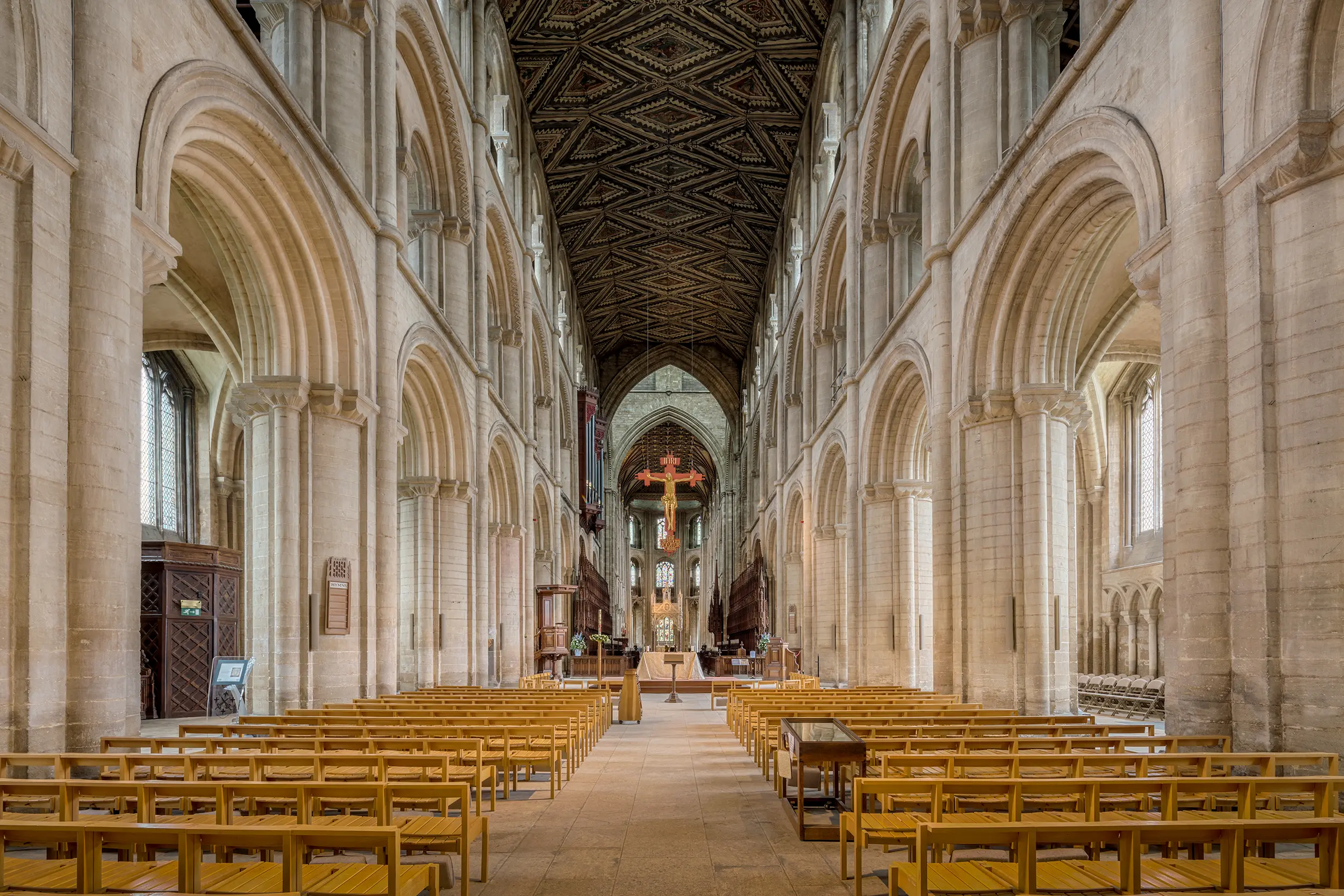
The surviving Romanesque church is largely constructed from pale Barnack limestone. Massive cylindrical piers, round arches and deep wall arcades create the extraordinary rhythm of the nave.
The work remained remarkably consistent over decades. Historic England describes the result as one of the great Norman cathedrals of England.
The central tower was completed in the twelfth century but repeatedly caused structural problems. Its weight would lead to major alterations in later centuries.
The Painted Ceiling
One of medieval Europe’s great survivals
Look up.You are looking into the 13th century.
Peterborough’s painted wooden nave ceiling is unique in Britain and one of only four surviving wooden ceilings of its period in Europe.
The roof structure
Tree-ring analysis shows much of the nave roof belongs to the late twelfth-century building campaign.
The painted scheme
Lozenge-shaped fields contain kings, queens, saints, animals, monsters and symbolic figures.
Changed, not replaced
The decoration was repainted in later centuries but retains the organisation and character of the medieval design.
Modern conservation
Conservators, archaeologists, art historians and dendrochronologists recorded and stabilised the ceiling in exceptional detail.
c.1200–1238
The Great West Front
Three arches.One unmistakable silhouette.
The west front marks the moment Peterborough’s builders embraced Early English Gothic.
Three giant pointed arches stand in front of the older west end, producing one of the most recognisable medieval façades in England. The composition was substantially complete by the church’s consecration in 1238.
A Galilee porch was inserted into the central arch in the later fourteenth century. The result is architecturally complicated but visually unforgettable.
1238
The church is consecrated
Not a Cathedral.A Benedictine powerhouse.
For almost three centuries after the great rebuilding, this was Peterborough Abbey: a monastery of St Peter, St Paul and St Andrew.
The monastic day
Benedictine life revolved around repeated daily offices, Mass, devotion, reading and work.
A vast estate
The abbey controlled manors, farms, mills, fisheries, rights and property across a wide region.
Abbey and town
The monastery shaped markets, streets, bridges and the economic geography of medieval Peterborough.
Books and archives
Peterborough’s monks copied chronicles, charters and cartularies that remain internationally important.
Peterborough Writes History
Chronicles, charters and Magna Carta
The Abbey did not just witness history.It wrote it down.
Peterborough’s manuscripts make the monastery important far beyond architecture.
The Peterborough Chronicle, preserved as Bodleian Laud Misc. 636, is the Peterborough version of the Anglo-Saxon Chronicle. Its continuations are exceptional evidence for England after the Norman Conquest and for the transition from Old English towards Middle English.
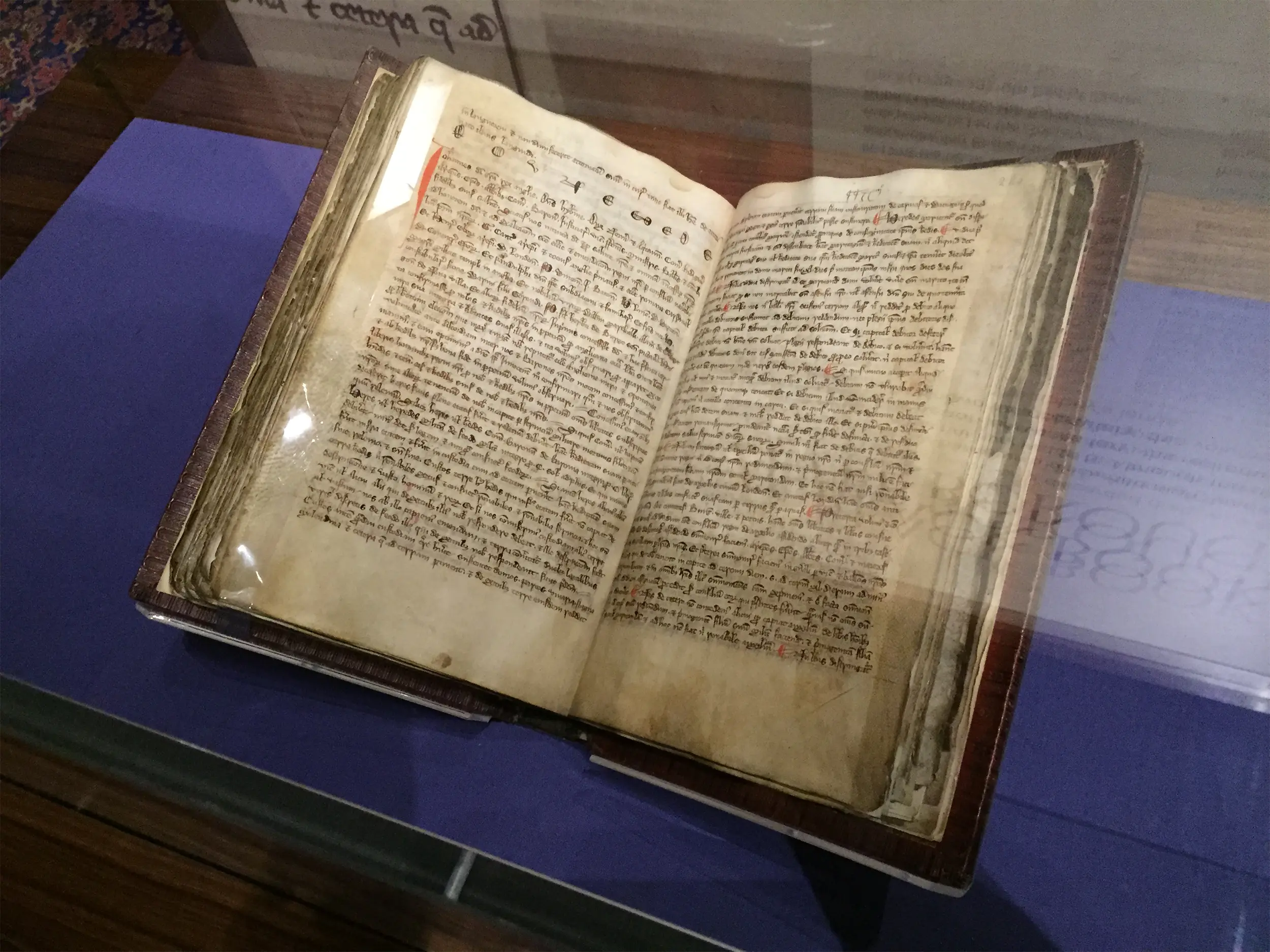
The Black Book of Peterborough, now at the Society of Antiquaries, contains a near-contemporary text of Magna Carta preserving details important to historians of the Charter.
The fourteenth-century monk Walter of Whittlesey also compiled a great chronicle and cartulary combining abbey history, royal charters, estate records and papal privileges.
A Royal Abbey
Kings did not merely pass Peterborough
They stayed here.
Stephen
Visited and granted a market charter.
Henry II
Visited with Thomas Becket.
King John
Used Peterborough as a base in his final campaign.
Edward I
Stayed for several days with a costly royal entourage.
Edward II
Stopped before the Bannockburn campaign.
Edward III
Spent Easter here and returned repeatedly.
Henry VI
Visited the monastery on pilgrimage.
Henry VII
Visited after the establishment of the Tudor dynasty.
Half the monastic community dies
The Black Death killed 32 of the abbey’s 64 monks according to the Cathedral’s historical record, alongside approximately a third of Peterborough’s townspeople.
Building continues
The central tower was altered and a new Galilee porch inserted into the west front. Surviving medieval tower timbers have been studied by Historic England.
1496–1508
The New Building
Medieval Peterborough’sfinal masterpiece.
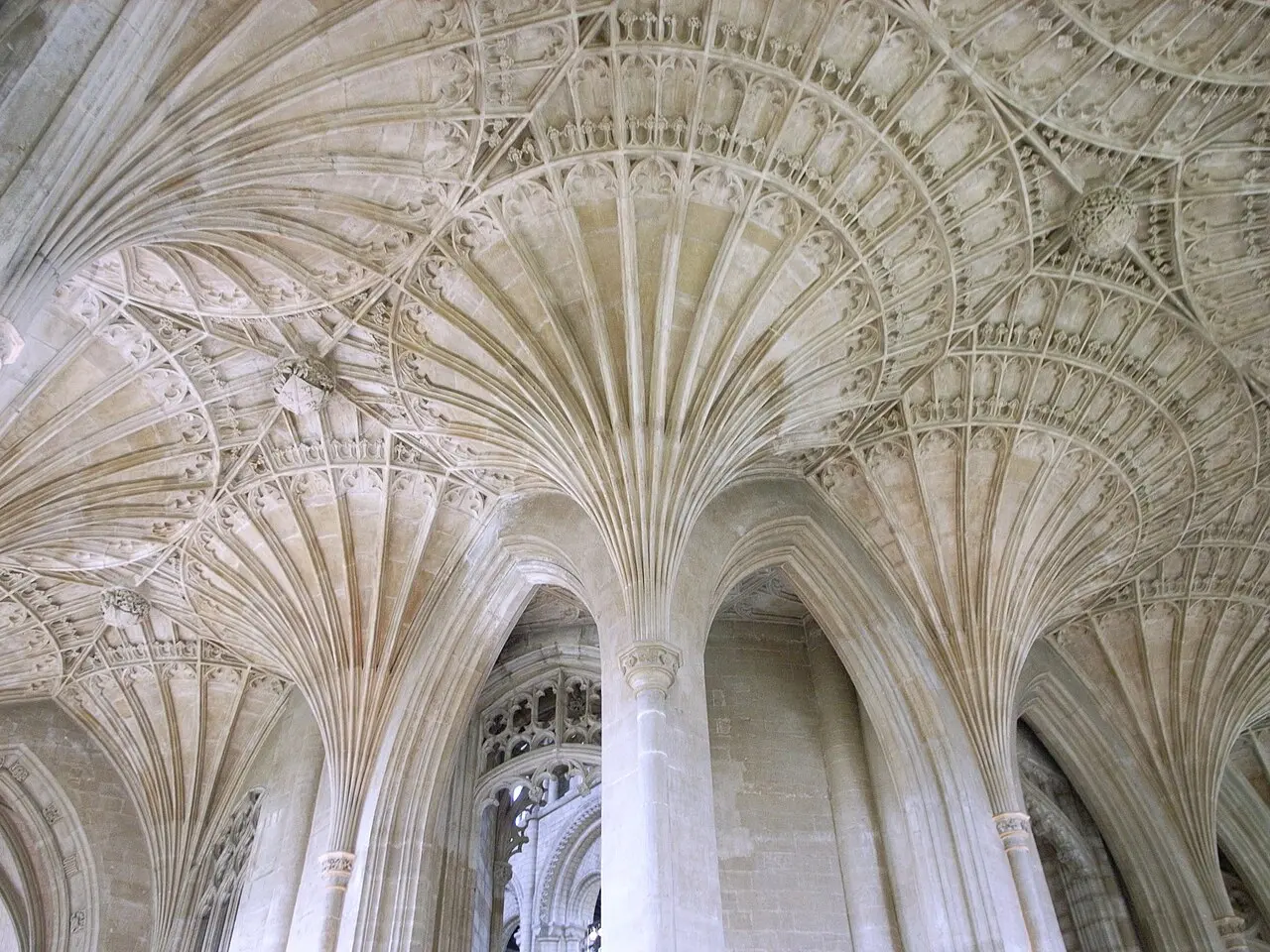
At the very end of the monastic Middle Ages, the east end was transformed in spectacular Perpendicular Gothic.
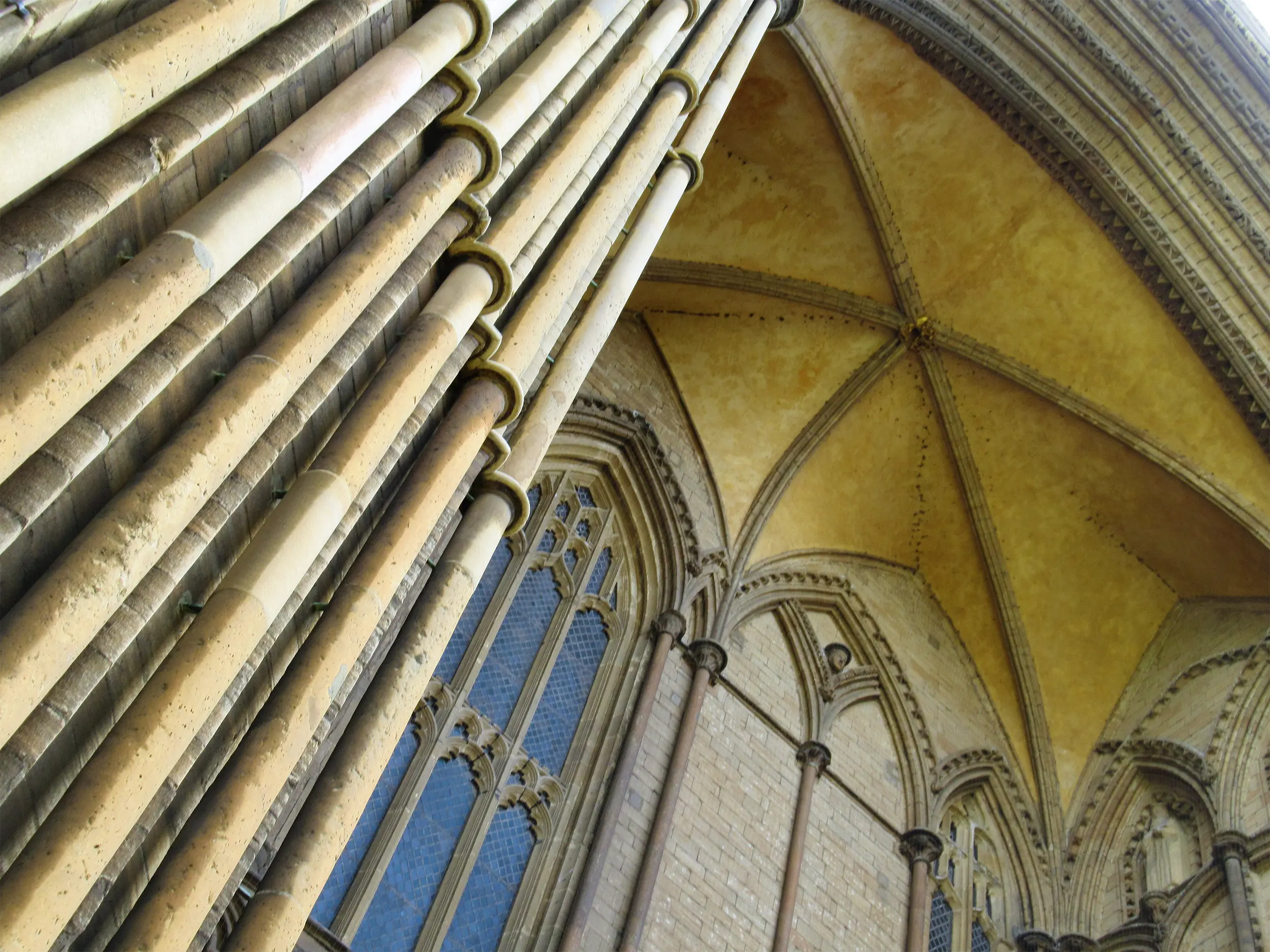
The structure known as the New Building or retrochoir wraps around the older Norman apse. Large traceried windows flood the space with light while slender shafts rise into intricate fan vaults.
Historic England notes that the vault may have been designed by John Wastell, later associated with the celebrated vaulting of King’s College Chapel, Cambridge.
The Reformation
Abbey → Cathedral
The monastery ends.The great church survives.
Peterborough’s survival was not inevitable.
In 1536, while the church was still monastic, Katharine of Aragon was buried here. In 1539 the Benedictine abbey was dissolved and its lands passed to the Crown.
In 1541 Henry VIII created the Diocese of Peterborough. The last abbot, John Chambers, became the first bishop. The new foundation included a dean, canons, singing men, choristers, scholars and almsmen, while a grammar school in the precinct became the ancestor of today’s King’s School.
Read the full story of Peterborough’s Two Queens →The Queen who stayed.
Henry VIII’s first wife was buried while Peterborough was still an abbey. Her grave remains one of the Cathedral’s best-known historic landmarks.
The Queen who left.
Mary was buried here after her execution at Fotheringhay and remained until James I ordered her transfer to Westminster Abbey in 1612.
Beyond the Church
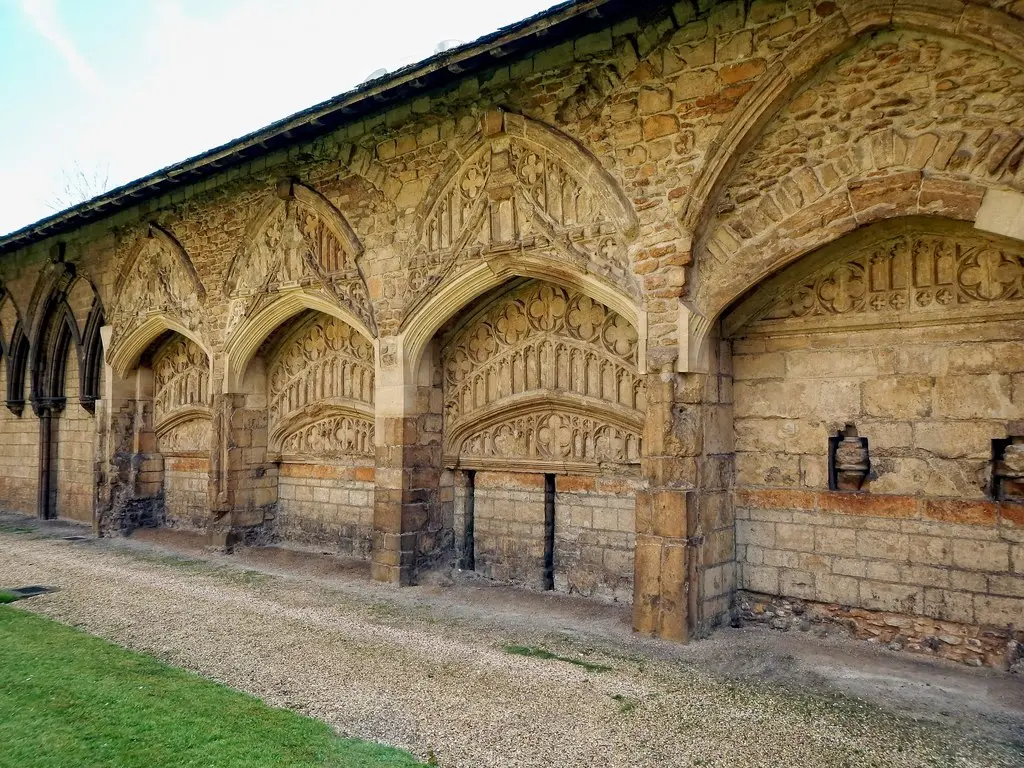
The surviving medieval precinct
A monasterywas a town within a town.
At its height the complex contained cloisters, chapter house, dormitory, refectory, kitchens, infirmary, guest accommodation, workshops, cemeteries, gardens, orchards, vineyards and lodgings.
Historic England records that the modern precinct landscape still preserves the medieval pattern beneath later Victorian garden character. Medieval gates, walls, the Bishop’s Palace, Deanery and infirmary remains all survive as parts of that longer story.
Tout Hill, the surviving mound of the Norman castle, adds another layer: monastery, town and military occupation overlap within one landscape.
The English Civil War
The most destructive episode in the later history
Glass smashed.Images destroyed. Books burned.
Peterborough had strong Royalist sympathies. Parliamentary troops under Oliver Cromwell entered the city and subjected the Cathedral to severe iconoclastic destruction.
Stained glass was smashed, the organ broken, religious furnishings attacked, the Lady Chapel demolished, parts of the cloister destroyed and books from the Cathedral library burned.
Contemporary Royalist accounts are highly partisan, but the physical losses were real and permanent. In 1646 the defeated Charles I was himself briefly held within the precinct while being moved under Parliamentary custody.
1650s
The Abbey is dismantled twice
What war did not destroy,builders reused.
Large areas of ruined monastic fabric became a convenient stone quarry after the Civil War.
The most famous destination was Thorpe Hall, built for Lord Chief Justice Oliver St John. John Evelyn later described it as constructed from ruins of the Bishop’s Palace and cloisters; archaeological work has confirmed reused medieval masonry.
The Cathedral church survived. Much of the medieval monastery around it did not.
1822 → 1895
Restoration — and reinvention
The medieval Cathedralthrough Victorian eyes.
Dean Monk
James Henry Monk led a substantial campaign repairing accumulated damage, including the long aftermath of the Civil War.
J. L. Pearson
The great Gothic Revival architect directed a major restoration that remains fundamental to the Cathedral’s modern appearance.
The central tower
Structural concerns forced another rebuilding of the crossing tower.
New medievalism
Choir stalls, cathedra, pulpit, marble pavement and high altar transformed the interior.
Katharine’s tomb
A public appeal led by Katharine Clayton renewed the Queen’s memorial.
Restoration is history too
The Cathedral is not a medieval building frozen in 1238. Every restoration altered what later generations inherited.
A Layered Interior
Medieval structure · Victorian furnishings
What looks ancientis not always medieval.
Learning to read the Cathedral means learning to separate its layers.
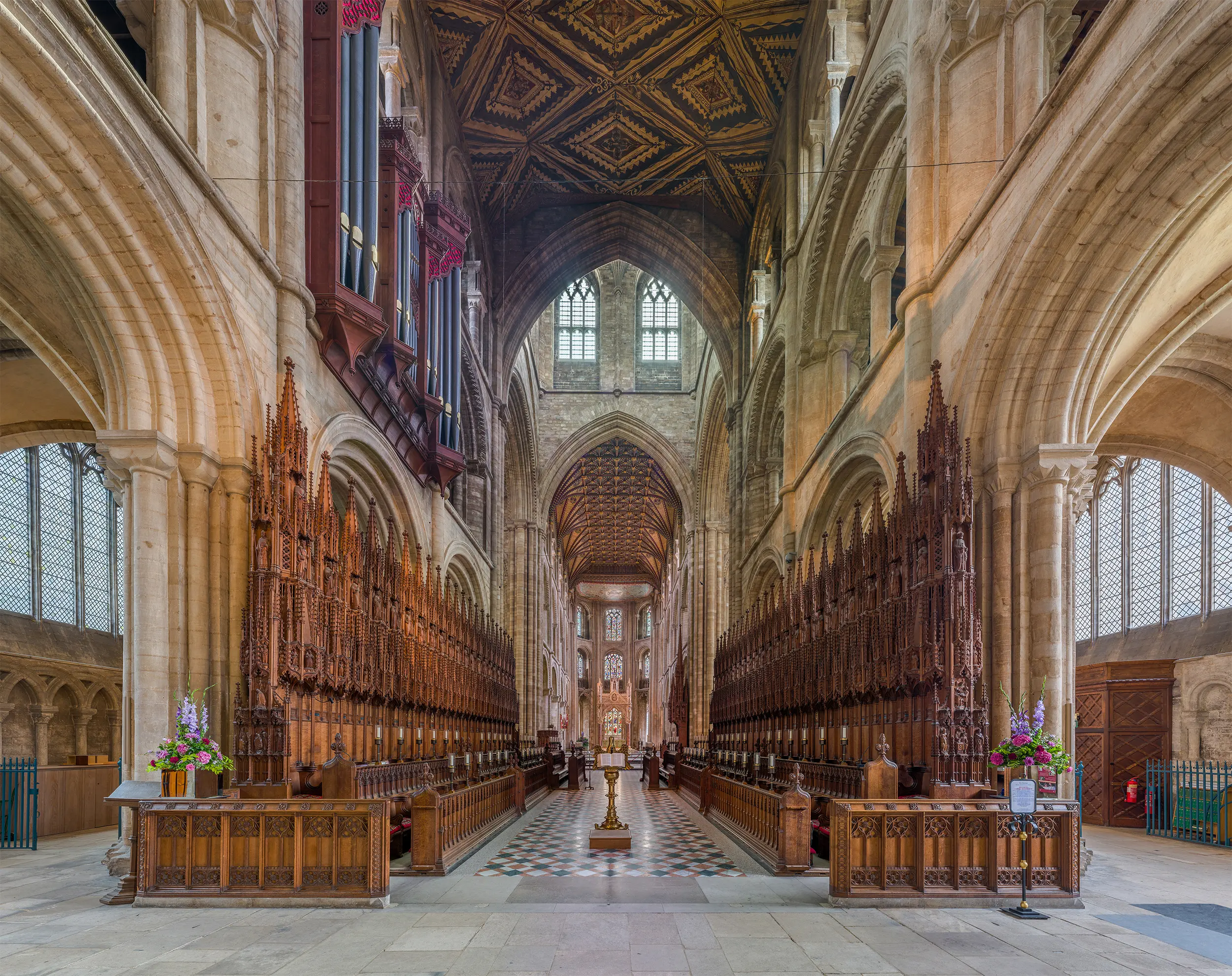
The great arcades are Norman. The fan vault is late medieval. The nave ceiling is medieval but has been repainted. Much of the choir’s carved woodwork and liturgical furnishing belongs to the nineteenth century.
The hanging rood is later again: George Pace designed the cross in 1975 and Frank Roper created the figure of Christ.
Peterborough Cathedral is therefore not one moment in architectural history. It is a physical conversation between generations.
1941–44
The firewatchers
The Cathedral survivedbecause people stayed on the roof.
Incendiary bombs posed a terrifying threat to the Cathedral’s medieval timber roofs.
Volunteer firewatchers maintained patrols and access routes. In August 1942, six incendiaries fell on the Cathedral during a raid in which hundreds were dropped across Peterborough. They were extinguished before major damage developed.
A memorial inside the Cathedral remembers the people who guarded the roofs during the war.
A modern catastrophe
The Cathedral catches fire again
Eight hundred years after the nave was built,fire threatened it once more.
A fire started among stacked plastic chairs close to the choir and organ, filling the Cathedral with dense oily smoke.
A major medieval-ceiling conservation programme was nearing completion. Smoke residue spread through the building, the organ suffered serious damage and extensive cleaning became necessary.
Rapid detection by a verger and the response of firefighters prevented a much greater disaster. The roof and painted ceiling survived, and detailed conservation records proved invaluable during recovery.
Read the Building
Eight things that explain the architecture
A field guide to the Cathedral.
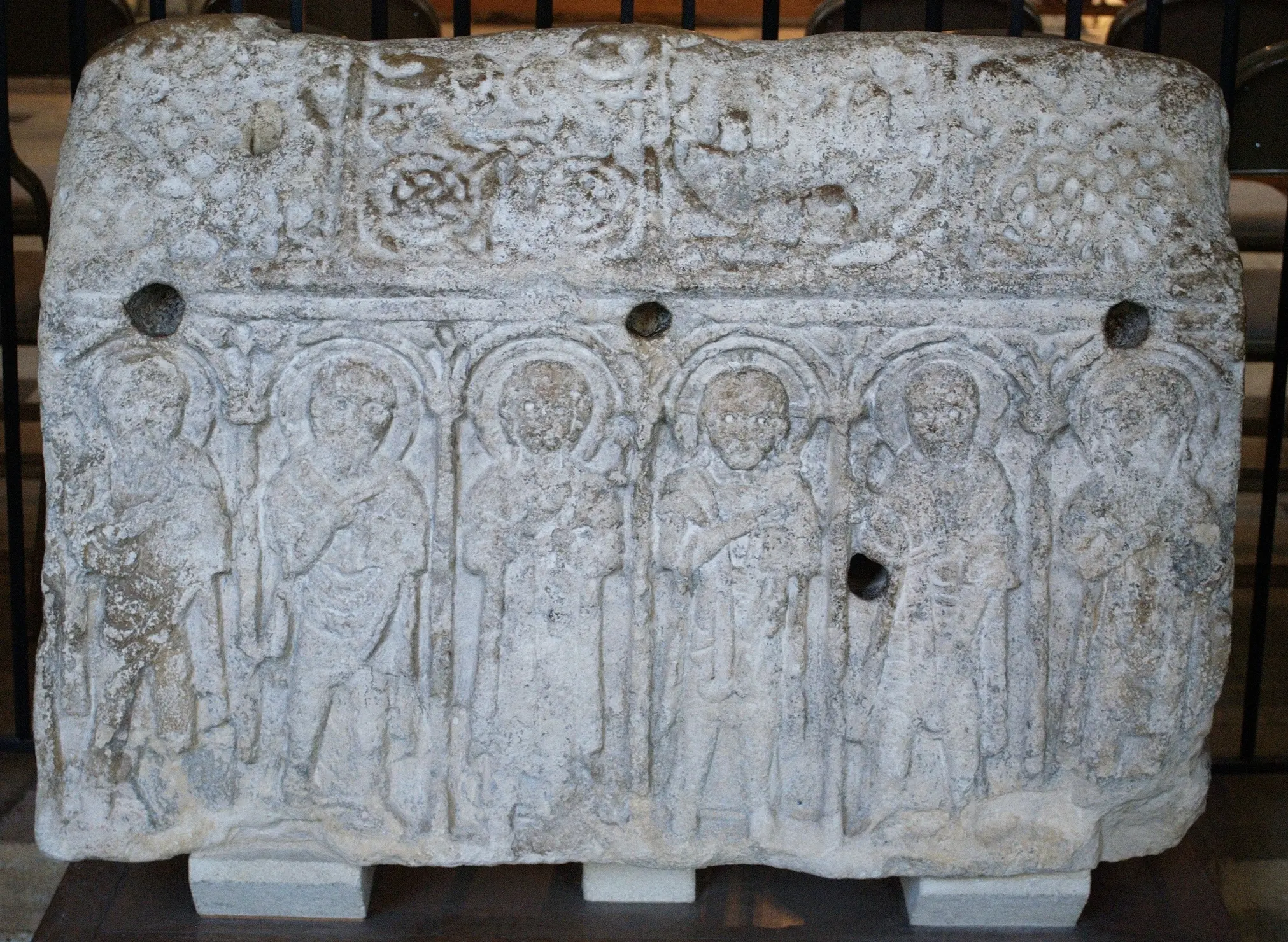
Hedda Stone
Anglo-Saxon sculpture surviving from the world before the Norman church.
Norman east end
The earliest major surviving fabric of the present Cathedral.
Norman nave
Massive round-arched arcades rising through three levels.
Painted ceiling
Britain’s unique surviving medieval painted wooden nave ceiling of its type.
Great West Front
Three colossal Early English Gothic arches.
Crossing & Galilee
Structural alteration at the tower and a new porch.
New Building
A luminous Perpendicular retrochoir with fan vaulting.
Restoration layers
Pearson, Victorian carving and modern artistic interventions.
What Survives Today
The Cathedral as an archive in stone
More than a thousand years are visible in one visit.
Hedda Stone and archaeology beneath the later building.
Apse, transepts, nave, arcades and the architectural skeleton.
Painted ceiling, west front and the mature medieval church.
Crossing alterations, Galilee porch and New Building.
Katharine’s burial, Cathedral foundation and Mary’s former grave.
Memorials, repairs and scars of religious and political change.
Structural restoration, choir furniture, paving and renewed monuments.
War memorials, modern art and conservation interventions.
The Long View
Peterborough Cathedral in 27 moments
One site. Constant change.
Monumental Roman activity
Substantial archaeology lies beneath the later precinct.
Medeshamstede founded
A Christian monastery is established in Mercia.
Possible Viking destruction
Later tradition associates the monastery’s destruction with the Great Heathen Army.
Benedictine refoundation
The monastery returns during the English monastic reform movement.
St Oswald’s arm
The relic helps create Peterborough’s “Golden Borough” reputation.
Hereward’s raid
Resistance to Norman power devastates monastery and town.
Norman military control
Sixty knights and a castle signal the new order.
The great fire
Monastery and town burn on 4 August.
The present church begins
Abbot John de Sais starts the Norman rebuilding.
Becket Chapel
A chapel and hospital are built in the cult of Thomas Becket.
King John
The abbey becomes a royal base in the king’s final campaign.
Consecration
The rebuilt church and west front stand substantially complete.
Lady Chapel
A major Marian chapel is constructed.
Licence to crenellate
The precinct gateway and royal lodging are strengthened.
Black Death
Half the monastic community and many townspeople die.
Tower and Galilee
The crossing changes and a new porch reshapes the west front.
Wars of the Roses
A Lancastrian army sacks town and monastery.
The New Building
The fan-vaulted east end completes the medieval architectural story.
Katharine buried
Henry VIII’s first queen is buried in the abbey church.
The Abbey closes
The Benedictine monastery is dissolved.
The Cathedral is founded
Henry VIII creates the Diocese of Peterborough.
Mary, Queen of Scots
Mary is buried here after her execution.
Civil War destruction
Parliamentary troops devastate glass, imagery, furnishings and library.
Pearson restoration
A major Victorian campaign transforms the central and eastern church.
Firewatchers
Volunteers defend the roofs from wartime incendiaries.
Fire
A serious interior blaze triggers another conservation campaign.
A living Cathedral
Daily worship continues in a building whose history remains unfinished.
The Cathedral Precinct
A medieval landscape beneath a modern city
The history does not stopat the Cathedral door.
Historic England records a precinct whose plan still reflects medieval monastic organisation beneath later alterations.
The monumental entrance from Cathedral Square.
Successor to medieval abbatial and royal lodgings.
Developed from the prior’s medieval lodgings.
Surviving fabric from the monastery’s care complex.
Fragments of the monastic circulation and communal world.
The surviving mound of the Norman castle.
A history you can physically walk through
Do not just read it.Stand inside it.
Start outside
Read the great west arches before entering.
Look down
Remember the Saxon and Roman archaeology beneath the floor.
Look up
Spend time beneath the painted medieval nave ceiling.
Walk east
Watch Norman architecture become Perpendicular fan vaulting.
Find the queens
Katharine’s tomb and Mary’s former grave.
Walk the precinct
The medieval monastery survives in fragments all around the church.
Continue the Story
The Cathedral connects almost every era of Peterborough history
Go deeper.
Research & Further Reading
Building the evidence.
This article combines statutory heritage records, archaeological and conservation research, surviving medieval manuscripts and institutional historical sources. Where traditions are debated, the text identifies the uncertainty.
- Historic England: Cathedral Church of St Peter, St Paul and St Andrew, Grade I List Entry
- Historic England: Peterborough Cathedral Precincts
- Historic England: tree-ring analysis of Cathedral structural timbers
- Historic England: late fourteenth-century crossing tower timber frame
- Archaeology Data Service / Historic England: Nave Ceiling Conservation Project
- British Library: Chronicle and cartulary of Peterborough Abbey, the Book of Walter of Whittlesey
- Society of Antiquaries: Black Book of Peterborough and Magna Carta
- Production and Use of English Manuscripts 1060–1220: Peterborough Chronicle
- Peterborough Cathedral historical timeline
- Peterborough Cathedral Conservation Plan, Volume 1
Early medieval dates can vary by a year between modern accounts, so the first monastery is described here as founded c.654–655. The traditional Viking destruction is explicitly qualified because its historicity has been debated.
Image Credits
Photography & licensing.
Selected historic and architectural photography used on this page is reproduced from open-licence collections. Where an image has been cropped, resized or converted to WebP, the underlying photograph remains subject to the licence shown below.
- Peterborough Cathedral — West Front (hero)
Photograph by Poliphilo / Wikimedia Commons. CC0 1.0 Public Domain Dedication. - The Hedda Stone
Photograph by NotFromUtrecht / Wikimedia Commons. Creative Commons Attribution-ShareAlike 3.0. - Peterborough Cathedral — Norman Nave
Photograph by Michael D Beckwith / Wikimedia Commons. CC0 1.0 Public Domain Dedication. - Medieval Painted Nave Ceiling
Photograph by NotFromUtrecht / Wikimedia Commons. Creative Commons Attribution-ShareAlike 3.0. - Great West Front — architectural detail
Photograph by Poliphilo / Wikimedia Commons. CC0 1.0 Public Domain Dedication. - Black Book of Peterborough
Photograph by Jacklee / Wikimedia Commons, photographed at the Society of Antiquaries of London. Creative Commons Attribution-ShareAlike 4.0. - Fan Vaulting in the New Building / Retrochoir
Photograph by Steve Cadman / Wikimedia Commons. Creative Commons Attribution-ShareAlike 2.0. - The Cloisters, Peterborough Cathedral
Photograph by Julian Dowse / Geograph Britain and Ireland. Creative Commons Attribution-ShareAlike 2.0. - Peterborough Cathedral Choir
Photograph by David Iliff / Wikimedia Commons. Creative Commons Attribution-ShareAlike 3.0.
Creative Commons licences permit reuse subject to their individual terms. Attribution-ShareAlike images require appropriate creator credit and licence/source information. CC0 images are credited here as a matter of good practice.
Discover Peterborough
1,350 years.And the story is still being written.
Peterborough Cathedral has outlived kingdoms, dynasties, fires, invasion, Reformation, civil war and repeated reconstruction. It remains what it has been for most of Peterborough’s recorded existence: a living place at the centre of the city.
Discover more Peterborough history →