
Discover Peterborough · Peterborough People
The Queen who came by night
Mary, Queen of Scots & Peterborough · 1587–1612
For twenty‑five years, one of history’s most famous queens lay not in Westminster, not in Edinburgh — but here, beneath the stones of Peterborough Cathedral. This is the story of how she arrived, and why she left.
%20-%20Mary%2C%20Queen%20of%20Scots%20(1542-87)%20-%20RCIN%20403429%20-%20Royal%20Collection.jpg?width=760)
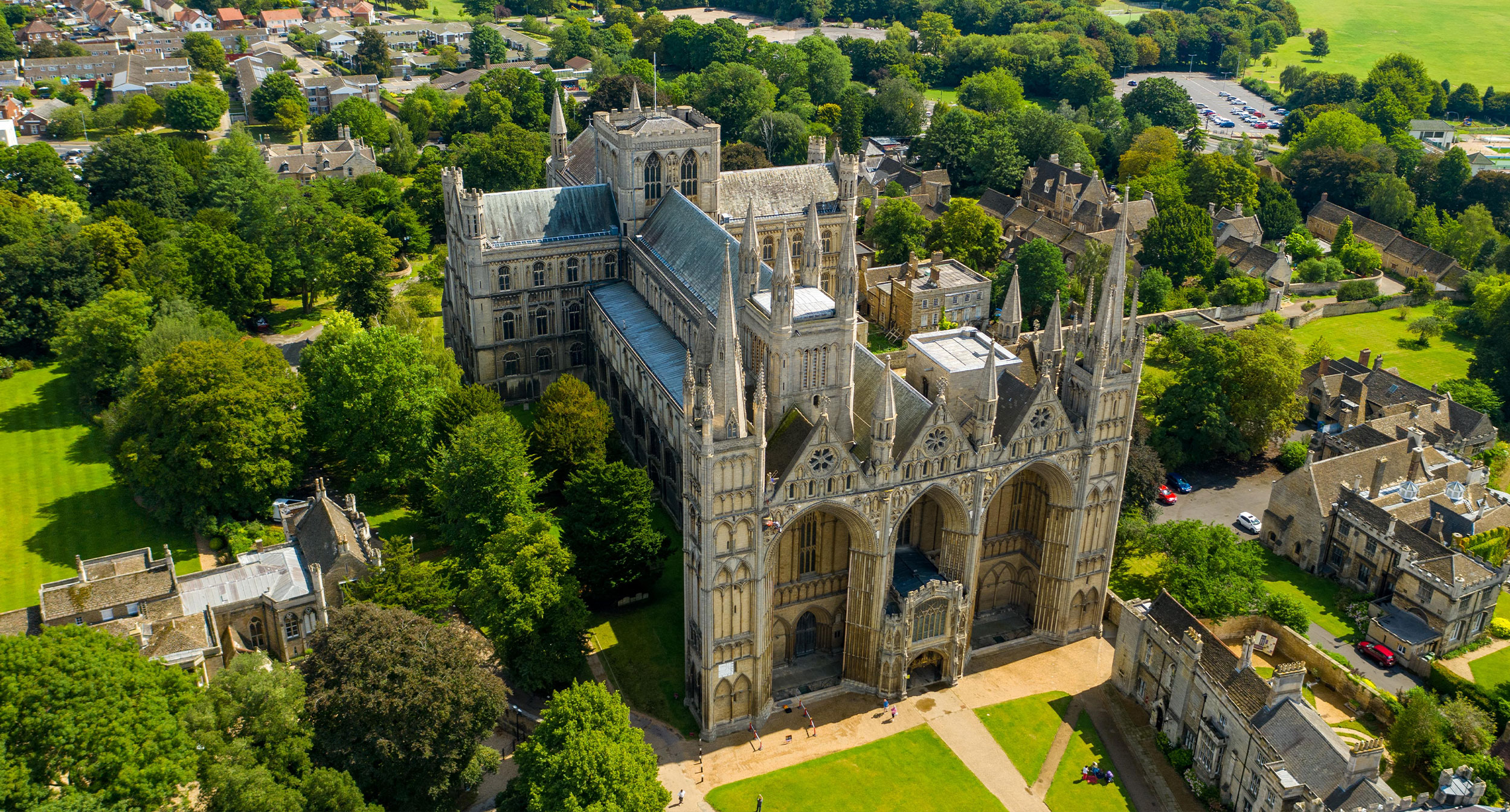
Nine miles west of the city, on a quiet bend of the River Nene, stood Fotheringhay Castle. What happened there on a February morning in 1587 shocked Europe — and it made Peterborough Cathedral, for a quarter of a century, the resting place of two queens.
- 25 years
- Mary lay in Peterborough Cathedral, from 1587 to 1612
- Two queens
- Mary and Katharine of Aragon were buried in the same church
- 9 miles
- From the scaffold at Fotheringhay to her Peterborough grave
Fotheringhay → Peterborough → Westminster
Her final journey

October 1586
The trial at Fotheringhay
After nearly nineteen years as Elizabeth I’s prisoner, Mary was brought to Fotheringhay Castle to stand trial, accused of plotting against the English queen. She defended herself alone, without counsel, in the castle’s great hall. The verdict was never truly in doubt.
8 February 1587
The execution
On a winter morning in the great hall, Mary went to the block with extraordinary composure, dressed in a bodice of deep red — the colour of Catholic martyrdom. She was forty‑four. Afterwards, her devoted little Skye terrier was found hiding in her skirts, refusing to leave her.
30 July 1587
The torchlit procession
Nearly six months later, under cover of darkness, a coach draped in black velvet carried Mary’s lead coffin the nine miles from Fotheringhay to Peterborough. Heralds and mourners rode by torchlight through the summer night, arriving at the Cathedral’s west front between one and two in the morning — a queen entering the city while it slept.
1 August 1587
A royal funeral in Peterborough
Days later, the Cathedral held a full heraldic funeral, paid for by Elizabeth herself. Mary was laid in a vault in the south aisle of the presbytery — almost directly opposite Katharine of Aragon, buried there half a century before. No other English church has ever held the graves of two queens at once.
1612
Her son calls her home
When Mary’s son became King James I of England, he ordered his mother’s body brought from Peterborough to Westminster Abbey, where he raised her a magnificent white marble tomb — grander, pointedly, than Elizabeth’s own. Peterborough had kept her for twenty‑five years. Every British monarch since is descended not from Elizabeth, but from Mary.
A Peterborough original
The man who buried two queens
Mary’s grave was dug by the Cathedral’s sexton, Robert Scarlett — “Old Scarlett” — who had buried Katharine of Aragon fifty‑one years earlier. He outlived them both, dying in 1598 at the remarkable age of 98. His portrait, spade in hand, still watches over the Cathedral’s west door, and generations of Peterborough visitors have looked up to meet his eye.
Look for his painted portrait above the west door on your visit.
“En ma fin gît mon commencement”
In my end is my beginning
— the motto Mary embroidered during her captivity

Autumn 2026 · Peterborough Cathedral
Mary Queen of Scots:
The Exhibition
Her story, told in the very place it ended. This autumn, Peterborough Cathedral — Mary’s original burial site — hosts a major new exhibition tracing her extraordinary life through original artefacts, striking visuals and immersive scenes, from crowned infant to enduring legend.
- Dates
- 21 September –
15 November 2026 - Tickets
- £8 adults · £6 children & students
Under‑2s free - Included
- Your ticket covers the whole Cathedral — exhibition, grave site and all
Walk the story
Where to find her today
Peterborough Cathedral
Mary’s original burial place is still marked in the south presbytery aisle, where Scottish Saltire flags hang above the spot. A few steps across the church lies the tomb of Katharine of Aragon — still dressed with pomegranates left by visitors.
Plan your Cathedral visitFotheringhay
The castle itself is long gone — only a grassy mound beside the Nene remains, with plaques left in Mary’s memory. It is one of the most quietly atmospheric places in the region: wide fen skies, the river below, and four centuries of silence.
More things to do nearby