


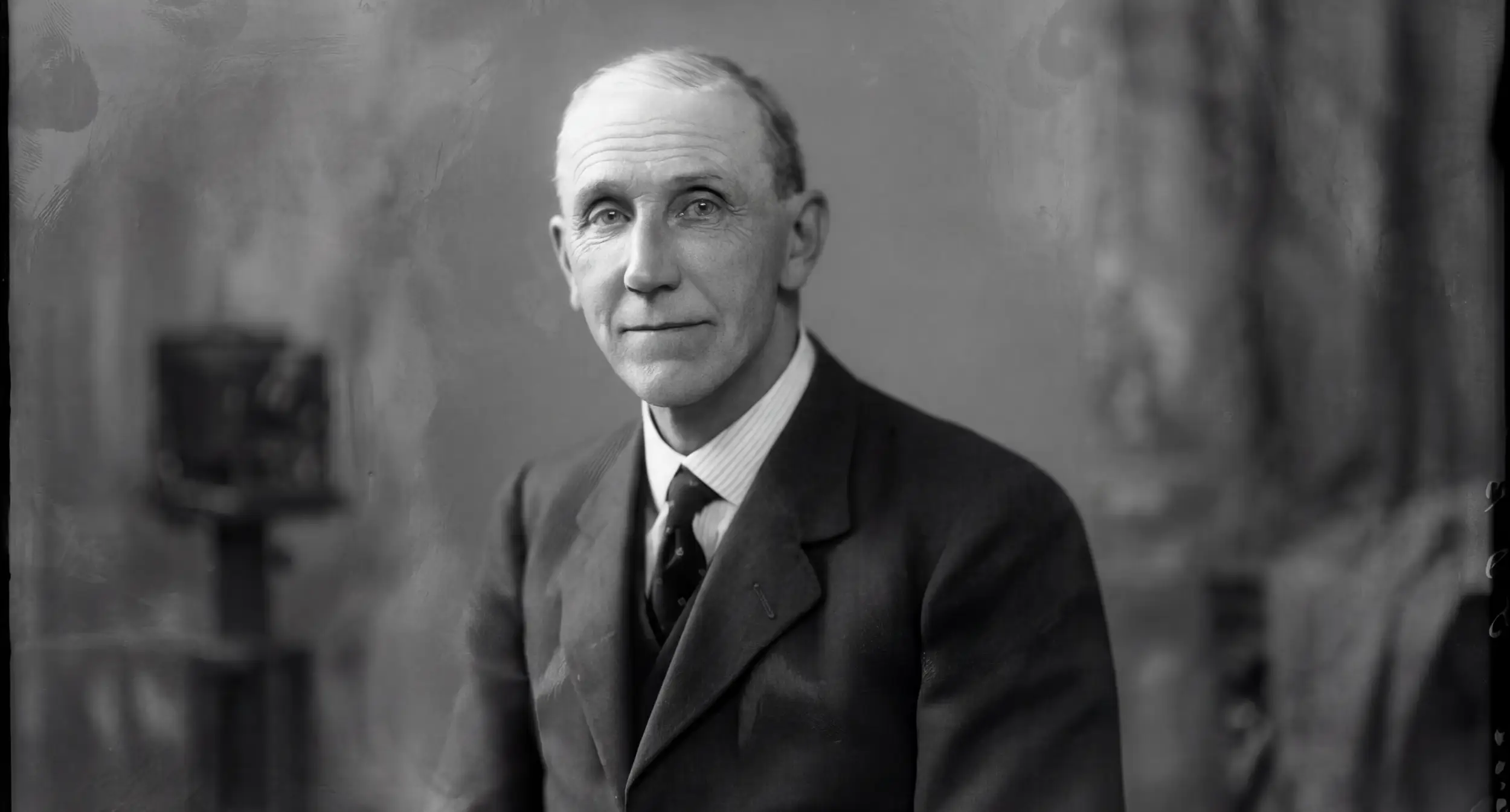
Born at Castor Rectory and educated partly in Peterborough, John Davys Beresford became a prolific novelist, critic and speculative writer whose imagined superchildren, pandemics and dystopian societies helped shape early British science fiction.
Life and career in dates
- 1873Born at Castor Rectory near Peterborough
- 1880sAttends Oundle and The King’s School, Peterborough
- 1895–1903Works as an architectural draughtsman for Edwin T. Hall
- 1908Contributes to Punch and develops his journalistic career
- 1909Publishes the early supernatural story “Cut-Throat Farm”
- 1911Publishes The Early History of Jacob Stahl and The Hampdenshire Wonder
- 1913Publishes Goslings, later known as A World of Women
- 1915Publishes the first sustained critical study of H. G. Wells
- 1918Publishes the speculative story collection Nineteen Impressions
- 1921Publishes Revolution and Signs and Wonders
- 1933Returns to faith, healing and the miraculous in The Camberwell Miracle
- 1944Publishes The Riddle of the Tower with Esmé Wynne-Tyson
- 1947Dies in Bath; his final collaboration, The Gift, is published
- 2022MIT Press republishes A World of Women in its Radium Age series
A childhood in Castor
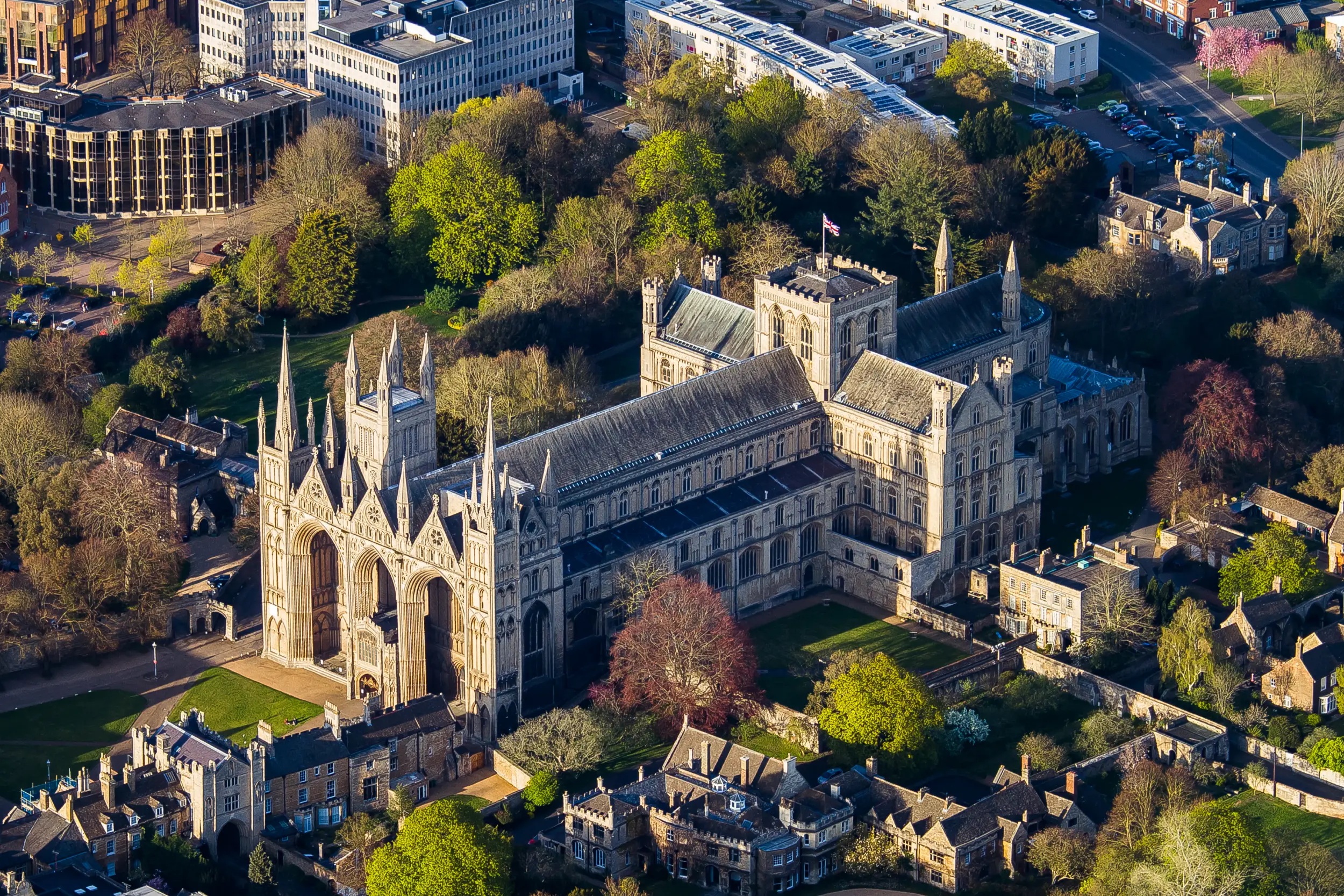
John Davys Beresford was born in 1873 at Castor Rectory, in the historic village west of Peterborough which now lies within the city’s unitary authority area. His father, the Reverend John James Beresford, was Rector of Castor and also served as a minor canon and precentor of Peterborough Cathedral.
Beresford therefore grew up within the distinctive religious and historical landscape surrounding Castor’s parish church and Peterborough Cathedral. The beliefs of the rectory shaped him, although not always in the way his father may have expected.
As a young man, Beresford rejected conventional Christianity and described himself as an agnostic. Questions inherited from his clerical upbringing nevertheless remained central to his imagination: whether human life had a purpose, whether consciousness could survive death, whether miracles were possible and whether humanity might evolve into something greater.
These questions would later appear in forms ranging from realistic family novels to ghost stories, utopian speculation and some of the earliest modern fiction about superhuman intelligence.
Disability, education and architecture
A childhood illness, generally identified by later biographers as infantile paralysis, left Beresford with a lasting physical disability. The experience affected his education, confidence and relationship with the wider world.
He was educated through a combination of extensive private reading and formal schooling. Contemporary biographical material records periods at both Oundle and The King’s School in Peterborough, which he attended until approximately the age of sixteen.
Physical difference became a recurring subject in his fiction. Several of his characters live outside accepted ideas of normality, and his books repeatedly ask whether society can recognise intelligence or human worth when it appears in an unfamiliar body.
After leaving school, Beresford trained in architecture. He was initially apprenticed to a provincial architect before moving to London, eventually working as a draughtsman for the architect Edwin T. Hall between 1895 and 1903.
Architecture gave him professional discipline and an understanding of how complex structures are assembled. Although he abandoned it as a career, images of buildings, enclosed communities and carefully planned societies would later recur in his speculative fiction.
Becoming a writer
Beresford did not move directly from architecture into full-time authorship. He worked in an insurance office and later for W. H. Smith & Son, where he became involved in advertising and bookselling.
He had been writing stories since his teens but destroyed much of this early work. By 1908 he was contributing to Punch, and he subsequently became a reviewer for the Westminster Gazette. His journalism and criticism later appeared in publications including the Manchester Guardian, the New Statesman and The Spectator.
His first major published novel, The Early History of Jacob Stahl, appeared in 1911. It began a trilogy completed by A Candidate for Truth in 1912 and The Invisible Event in 1915.
The Jacob Stahl books drew heavily upon Beresford’s own experience. Their central character is physically disabled during childhood, struggles with limited opportunities and enters architectural employment before trying to establish himself as a writer.
Beresford treated these ordinary frustrations with psychological seriousness. George Orwell later described him as a natural novelist, particularly admiring his willingness to take the difficulties of everyday people seriously.
The Hampdenshire Wonder
Published in the same year as the first Jacob Stahl novel, The Hampdenshire Wonder established Beresford as an important early speculative writer. It remains the book most closely associated with his name.
The novel concerns Victor Stott, a child possessing an intelligence so advanced that he appears to represent a new stage in human evolution. Victor is not simply a conventional child prodigy. His abilities separate him from ordinary society and expose the limitations, vanities and prejudices of the adults who encounter him.
Instead of presenting extraordinary intelligence as an uncomplicated gift, Beresford asks whether existing humanity could tolerate a person who saw through its customs, religious certainties and social hierarchies. The novel’s power lies in the conflict between an apparently superior mind and a community unable to understand it.
The book is now frequently identified as one of the first important novels about the modern superhuman or evolutionary child. Its ideas anticipated later science-fiction treatments of advanced intelligence and helped prepare the ground for works such as Olaf Stapledon’s Odd John.
Beresford was writing before science fiction existed as a clearly defined publishing category. His work belonged to the tradition then described as scientific romance, using imagined developments in biology, psychology and society to question the assumptions of the present.
Goslings: A World of Women
Beresford followed The Hampdenshire Wonder with another striking speculative novel. Published in Britain as Goslings in 1913 and in the United States as A World of Women, it imagined a pandemic that killed most of the world’s male population.
As institutions collapse and London becomes uninhabitable, a group of women travels into the countryside and attempts to establish a communal agricultural society. The survivors must overcome not only the immediate disaster but an education system which has deliberately denied many women practical, political and economic independence.
The novel reverses conventional gender arrangements and examines what might happen when women inherit a civilisation created and controlled largely by men. It combines apocalyptic adventure with satire, domestic realism and arguments about work, sexuality, class and social equality.
Some of its assumptions remain unmistakably Edwardian, but its central questions were unusually bold for 1913. It asks whether a crisis should be followed by an attempt to restore the old world or used as an opportunity to construct something more equal.
The book gained renewed relevance during the twenty-first century. In 2022, MIT Press republished A World of Women as part of its Radium Age series, bringing Beresford’s pandemic novel to a new international readership.
H. G. Wells, psychology and belief
H. G. Wells was one of the strongest literary influences on Beresford. Both writers used speculative situations to expose the inequalities and contradictions of contemporary Britain, moving between realistic social observation and imagined futures.
In 1915 Beresford published H. G. Wells, regarded as the first sustained critical examination of Wells’s early writing. It was more than an expression of admiration: Beresford examined how Wells combined scientific ideas, social criticism and narrative entertainment.
Beresford’s own interests extended beyond physical science. He was fascinated by psychology, telepathy, psychical research and the possibility that consciousness might not be limited to the body. Frederic W. H. Myers’s study Human Personality and Its Survival of Bodily Death had a particularly important influence upon his thinking.
His speculative stories explored telepathic links with the past, altered states of consciousness, supernatural visitations and worlds governed by unfamiliar spiritual laws. Collections such as Nineteen Impressions, Signs and Wonders and The Meeting Place and Other Stories demonstrate the breadth of this imagination.
The tension between scepticism and belief became one of Beresford’s defining characteristics. He could approach an apparently miraculous event as a rational investigator, yet he remained open to the possibility that material explanations were incomplete.
Later speculative fiction and pacifism
Beresford continued to combine social questions with speculative ideas throughout the interwar years. Revolution, published in 1921, examined the possibility of a socialist uprising in near-future Britain. The Camberwell Miracle explored faith healing, while What Dreams May Come followed a man transformed by visions of a possible utopian future.
His beliefs developed over time. The agnosticism of his early adulthood gave way to a growing engagement with spiritual and theosophical ideas. He was also a committed pacifist, a position which became particularly important as Europe moved towards another world war.
During his later years, Beresford collaborated with writer and peace campaigner Esmé Wynne-Tyson. Their books included Men in the Same Boat, The Riddle of the Tower and The Gift.
The Riddle of the Tower, published in 1944, presented a future society organised around an immense, hive-like structure. Efficiency and automation have become more important than freedom until individuality, emotion and ultimately humanity itself are threatened.
Written during the Second World War, the novel reflected fears about authoritarianism, mechanised society and the sacrifice of individual conscience to collective systems. Its questions about automation and dehumanisation continue to give it contemporary resonance.
Literary legacy
J. D. Beresford died in Bath on 2 February 1947, aged 73. His career encompassed more than speculative fiction: he produced realistic novels, plays, journalism, literary criticism, supernatural stories, philosophical writing and political fiction.
His work attracted the attention of major contemporaries including George Bernard Shaw, Virginia Woolf, Dorothy L. Sayers, John Betjeman and George Orwell. Graham Greene later identified The Hampdenshire Wonder as one of the outstanding neglected novels of its period.
His literary influence also continued through his family. His son Marcus Beresford wrote novels and television scripts under the name Marc Brandel. His daughter Elisabeth Beresford became a successful children’s writer and created The Wombles.
For many years, Beresford remained known mainly to specialists in early science fiction. Renewed interest in pre-Golden Age speculative writing has restored attention to his treatment of superhuman intelligence, pandemics, feminism, dystopia and the relationship between psychology and belief.
His Peterborough connection is unusually substantial. He was born at Castor Rectory, grew up within the orbit of Peterborough Cathedral and received part of his education at The King’s School. The ideas that occupied his writing – faith, difference, social restriction and the possibility of transformation – can all be traced back to experiences rooted in this local landscape.
From Castor Rectory, Beresford imagined minds beyond ordinary humanity, societies transformed by catastrophe and futures in which progress might liberate people or erase what made them human.