

A Latvian Childhood
Walter Cornelius was born in 1923 into a Latvia that was, for a brief and precious moment, at peace. The country had declared independence in 1918, and the years that followed brought a fragile but genuine stability. For Walter’s family, life on a Latvian farm was defined by the rhythms of agriculture and the keeping of hundreds of animals. It was, by all accounts, a secure and settled existence.
He could not have known how short-lived that security would be.
Latvia in the 1930s was a small nation sandwiched between larger, increasingly dangerous powers. The geopolitical trap was sprung in August 1939, when Nazi Germany and the Soviet Union signed the Molotov–Ribbentrop Pact — a non-aggression agreement that secretly divided Eastern Europe into spheres of influence. The Baltic states — Estonia, Latvia, and Lithuania — were assigned to the Soviet sphere. The following summer, on 17 June 1940, the Red Army marched into Latvia. Within weeks, a rigged parliamentary election installed a Soviet-aligned government, and by 5 August 1940 Latvia had been formally absorbed into the USSR.
Walter was seventeen years old.
What followed was what historians would come to call the “Year of Terror.” Soviet authorities arrested and deported thousands of Latvians — politicians, military officers, professionals, landowners, even members of the Boy Scouts. On the night of 13–14 June 1941, in a single sweeping operation, more than 15,000 men, women, and children were rounded up and transported to camps and remote settlements in Siberia. Around a quarter were children. Mortality in many of those deportation destinations exceeded fifty per cent.
Walter’s family, with their farm and their animals, were exactly the kind of people Soviet authorities viewed with suspicion.
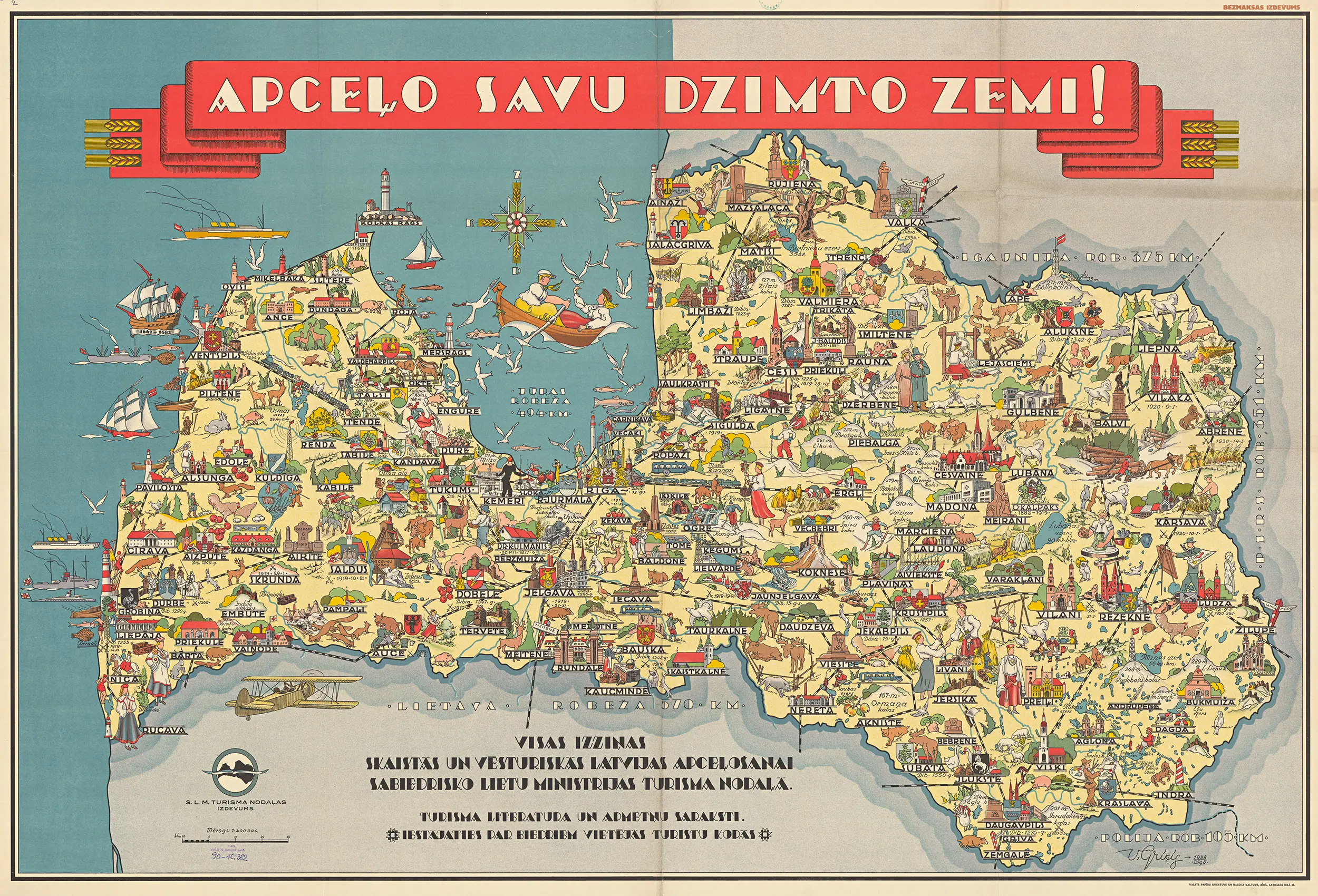
1930s Latvian tourism map:
Caught Between Empires
Less than a fortnight after the June deportations, everything changed again. On 22 June 1941, Nazi Germany launched Operation Barbarossa, its invasion of the Soviet Union. German forces entered Riga on 1 July 1941, and by mid-July all of Latvia was under German occupation. The country had been through two successive foreign seizures in barely a year.
For many Latvians, the Germans initially appeared as liberators from Soviet terror — an understandable but tragically mistaken hope. Nazi Germany had no intention of restoring Latvian independence. Latvia became part of the Reichskommissariat Ostland, a vast German civilian administrative zone covering the Baltic states and western Belorussia. The occupation brought its own violence, forced labour, and mass killing, including the near-total destruction of Latvia’s Jewish population.
For Walter, now a teenager, there was no safe ground. The occupying machinery of the Third Reich was indifferent to the age or wishes of those it conscripted into its purposes.
He was among approximately 2,000 schoolchildren forced into service, driving more than 6,000 horses eastward into Ukraine — livestock mobilised for the German war effort. From there, he was put to work digging trenches near Leningrad, one of the most gruelling and deadly assignments the Germans could impose. The conditions were appalling. Disease spread quickly through the labour gangs. Food was scarce, clothing inadequate, the cold relentless. Many of those labouring alongside Walter did not survive. At night, the lice were so numerous that, as he later recalled, clothes left on the floor seemed to move of their own accord.
It was in this setting — humiliated, exhausted, stripped of any dignity — that Walter’s endurance reached its breaking point.
The Moment That Changed Everything
A German officer, known among the workers for his cruelty, struck Walter to the ground with a rifle butt and kicked him as he lay there. Something inside Walter broke — or perhaps, more accurately, something snapped into focus. In an instinctive surge, he grabbed a knife and leapt at the officer. The man died instantly.
It was an act not of calculated rebellion but of raw human reflex. Walter was seized, beaten savagely, and placed before the expectation of summary execution. Yet, for reasons he would never understand, the death sentence did not come. Instead, he was transported by convict train to Berlin. After a year, he was sent near Moscow to work on road and railway construction.
Eventually, he found himself placed within a German-controlled Latvian military division — one of the units formed under coercion from Latvian men caught in the machinery of occupation. Across the Baltic states, tens of thousands of men were incorporated into German auxiliary units or the Waffen-SS not through willing allegiance but through the absence of any alternative.
Walter was not simply going to submit.
One night, he slipped away and joined the Latvian partisans — the scattered resistance networks fighting against occupation, at immense personal risk, in the forests and margins of their occupied homeland. It was a brief freedom. He was recaptured.
Escape Across the Baltic
As the war ground toward its end and the German lines began to collapse before the advancing Red Army, Walter and a group of other Latvians found themselves encircled by Soviet forces. Attempting to break out, he was shot in the back. Even then, he survived, making it back to German lines and receiving surgery.
Still weakened and recovering, Walter made his most audacious escape yet. Together with two companions, he obtained a small rowing boat. Their destination: Sweden, neutral throughout the war and separated from the Baltic coast by hundreds of miles of open water.
They rowed across.
It was an act of desperation and extraordinary will. Across the final months of the war, tens of thousands of Latvians and other Baltic nationals attempted similar crossings, fleeing the approaching Soviet reoccupation. Many did not make it. Walter and his companions did.
They had reached neutral ground — but safety, it turned out, was not guaranteed.
Sweden: The Razor's Edge
In Sweden, Walter and the Baltic refugees around him soon learned something that threatened to destroy the fragile hope they had just risked everything to secure. Sweden, under enormous diplomatic pressure from the Soviet Union, had agreed to hand back a number of Baltic soldiers who had served in German-controlled units. In January 1946, in what became one of the most controversial episodes in Swedish post-war history, 146 Latvian, Estonian, and Lithuanian soldiers were extradited to the USSR. Many of those returned subsequently faced imprisonment; several were sentenced to death.
For those in the camps who learned of this decision, the response was desperate. Reports from the time describe mass suicide attempts among soldiers awaiting extradition — men who had survived years of war and flight, now facing the prospect of being handed back to the system they had crossed an entire sea to escape.
Walter, facing the same fate, made his choice. He slashed his wrists with a razor blade and sat down, prepared to die rather than be returned to the Soviet Union.
He survived. Swedish authorities rushed him to hospital. By the time he recovered, the immediate danger had passed. Once again, death had arrived and been outpaced.
Through Denmark to England
With the worst of the danger behind him, Walter moved again. Together with around fifteen others of different nationalities, he found a route to Denmark, where, in one of the story’s stranger turns, he found employment as a lorry driver for the British Army — the fugitive become a participant in rebuilding a fractured continent.
In 1948, he emigrated to England.
He eventually settled in Peterborough — a city he had no particular reason to choose, and which had no particular reason to expect him. But there he stayed, and there he would make his mark.
Peterborough: A New Life at the Lido
Peterborough in the late 1940s was a working city, marked by brickworks, engineering, and a straightforward kind of community life. Walter found work in a brickyard, later as a plasterer’s labourer. He also took a job as an attendant at the Peterborough Lido — the handsome Art Deco outdoor swimming pool that had opened on the banks of the River Nene in 1936, one of the finest surviving lidos in England.
It was a job that would define the rest of his life in Peterborough, and the city’s memory of him.
In those years — the 1960s and 1970s particularly — the Lido was the heartbeat of the city’s summer. On busy days, up to 2,500 people would pass through its gates. Walter became a lifeguard there, and then something more than a lifeguard: a fixture, a character, a presence that people planned their mornings around. He taught thousands of children to swim, and he had a way with them that went beyond the mechanics of strokes and breathing. They were spell-bound by him — a pied-piper of a man who combined patience in the water with outrageous spectacle outside it.
In his spare time, Walter also worked at the Odeon cinema and later rose to become chief of staff at the Gaumont, where his reputation as a strongman followed him into that world too. He was challenged publicly to feats of strength, including a nail-breaking contest staged at the Gaumont itself.
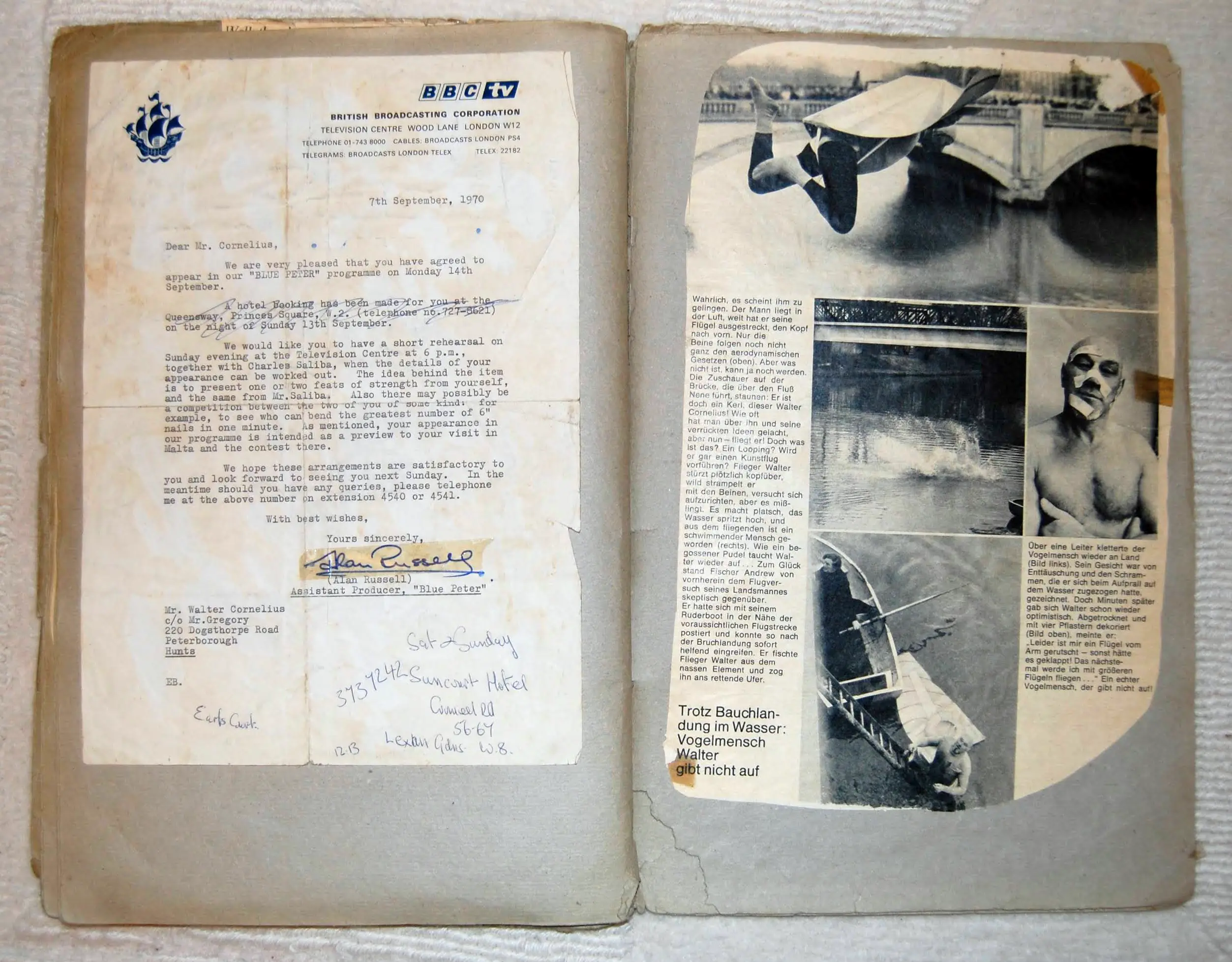
The Strongman
Walter had taken up bodybuilding in 1950, shortly after arriving in England. By the standards of later decades — of televised weightlifting and chemically assisted mass — he did not cut an enormous figure. But those who saw him perform understood immediately that raw size was not the point. He was extraordinarily strong, and in extraordinary control.
He could snap an eight-inch nail in half using only his hands, in under a minute. He bent coins in his teeth and gave them back as souvenirs — years later, people came forward to say they still had theirs. He performed his strongman act dressed as a Cossack, doing a human bridge supported by his neck and feet, while men with sledgehammers brought a metal plate loaded with knives crashing down onto his chest.
He worked briefly in a circus. He appeared on Blue Peter. He competed on Opportunity Knocks — the television talent show that was the era’s equivalent of prime-time public auditions — performing his muscle control act and winning. That evening almost killed him: he had painted himself gold for the show, without knowing that a patch of skin must be left uncovered to breathe. He collapsed afterwards and had to be taken to hospital.
Walter was the world champion of Maxalding in 1964. Maxalding — the physical culture system built around precise, conscious control of individual muscle groups — had been developed in the early twentieth century by the German strongman Max Sick and his partner Monte Saldo. By the 1960s it was a worldwide discipline with its own championship structure. The trophy for Walter’s 1964 title was presented to him by Elizabeth Taylor.
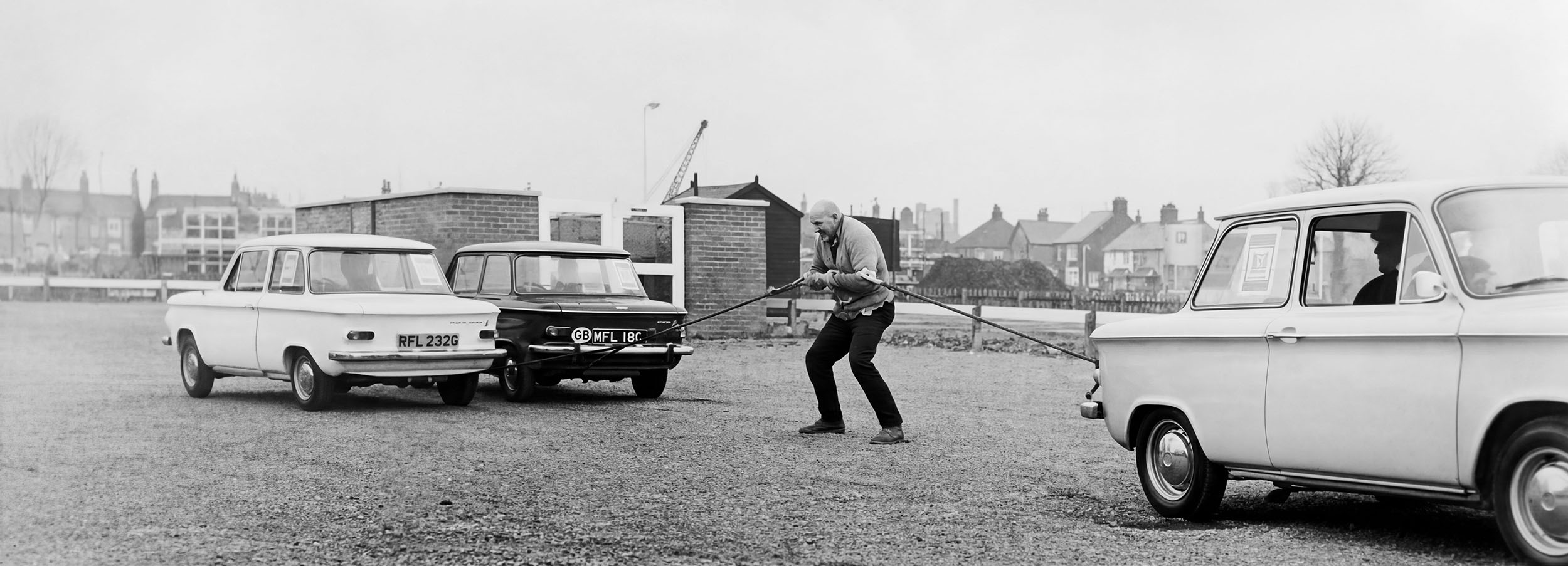
The Stunts
What set Walter apart was not simply what he could do, but what he was prepared to do for others — specifically, for charity and for laughter. He understood, with the instinct of a born performer, that spectacle could move people, and that if people were moved, they would give.
The feats he undertook were extraordinary. From his personal scrapbook, kept over the years, a partial inventory includes: pulling two fully-loaded double-decker buses with his teeth for 700 yards; lifting a 650cc motorcycle and a nine-stone girl simultaneously, using his teeth; having a double-decker bus driven over his chest; being buried five feet underground for thirty-three minutes without breathing apparatus; walking on his hands for 153 miles; running backwards for 340 miles; pulling a 45-ton locomotive along rails with his teeth for 140 yards; and holding four cars pulling in opposite directions, two on each arm.
He ate 47 raw sausages in eight and a half minutes. He ate grass for six days. He drank three yards of Guinness. He skipped for an hour and a half using a chain weighing 48 pounds. He poured two gallons of petrol over himself and set it alight. He broke a four-inch wall with his head and an eight-inch wall with his bare hands in 23 seconds.
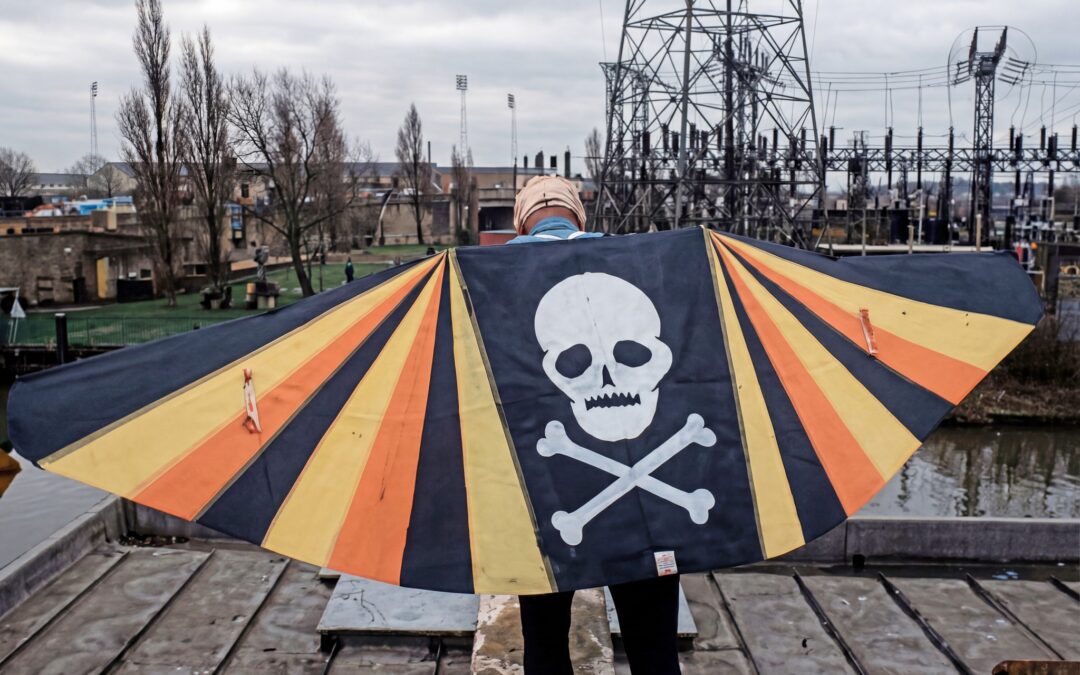
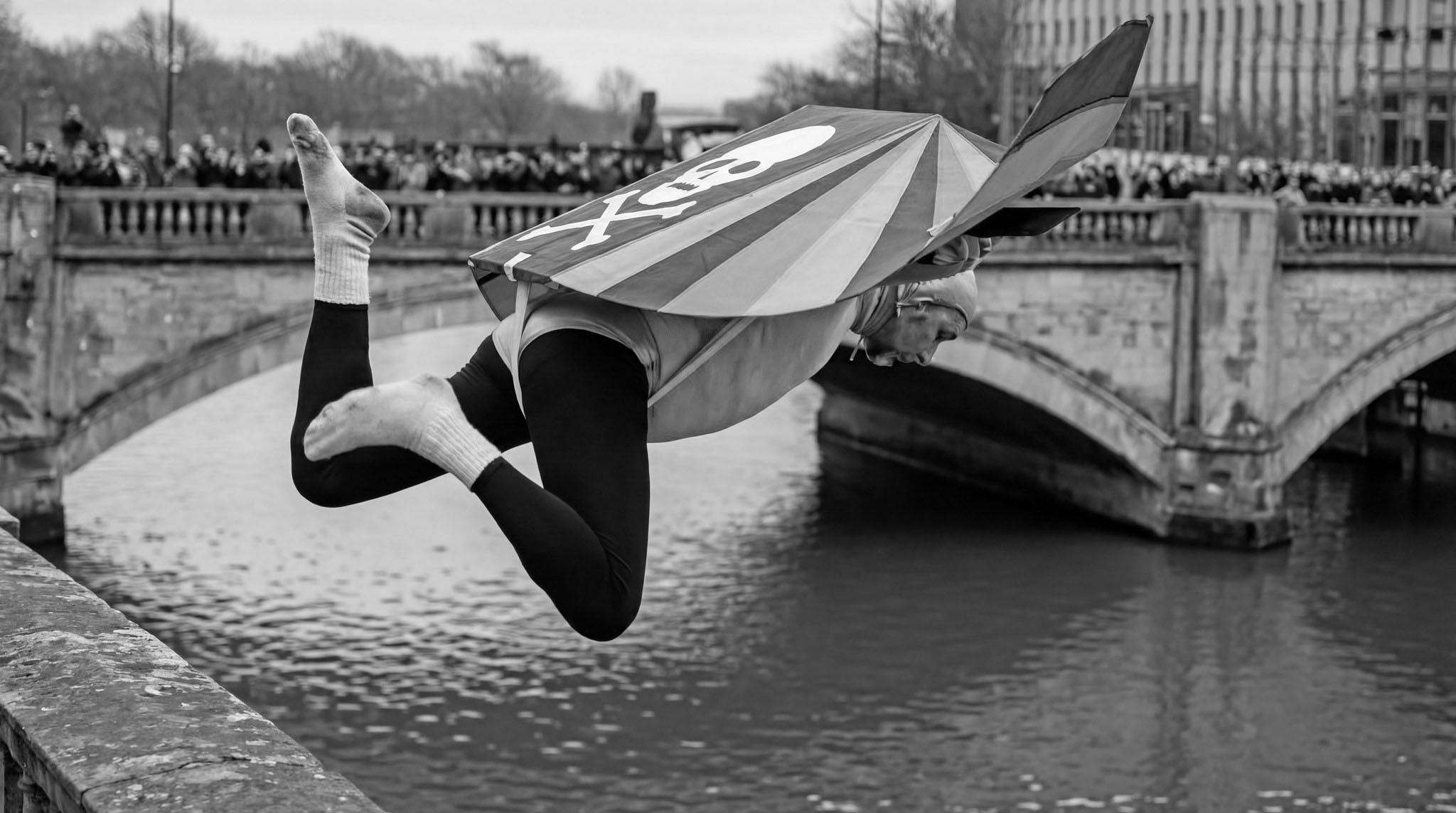
His most famous moment — the one that circled the globe — was his attempt to fly across the River Nene using homemade wings. He was always clear-eyed about this particular stunt: he knew perfectly well he was never going to fly. The wings were heavy, handmade, and impractical in every engineering sense. The point was the attempt itself: the image, the absurdity, the crowd gathered on the bank, the money raised for charity. On the way down, he struck a piece of driftwood. What everyone remembered, what the cameras captured, was Walter mid-air above the Nene — wings spread, committed entirely to the moment, a Latvian refugee turned Peterborough legend, briefly and gloriously suspended between earth and sky.
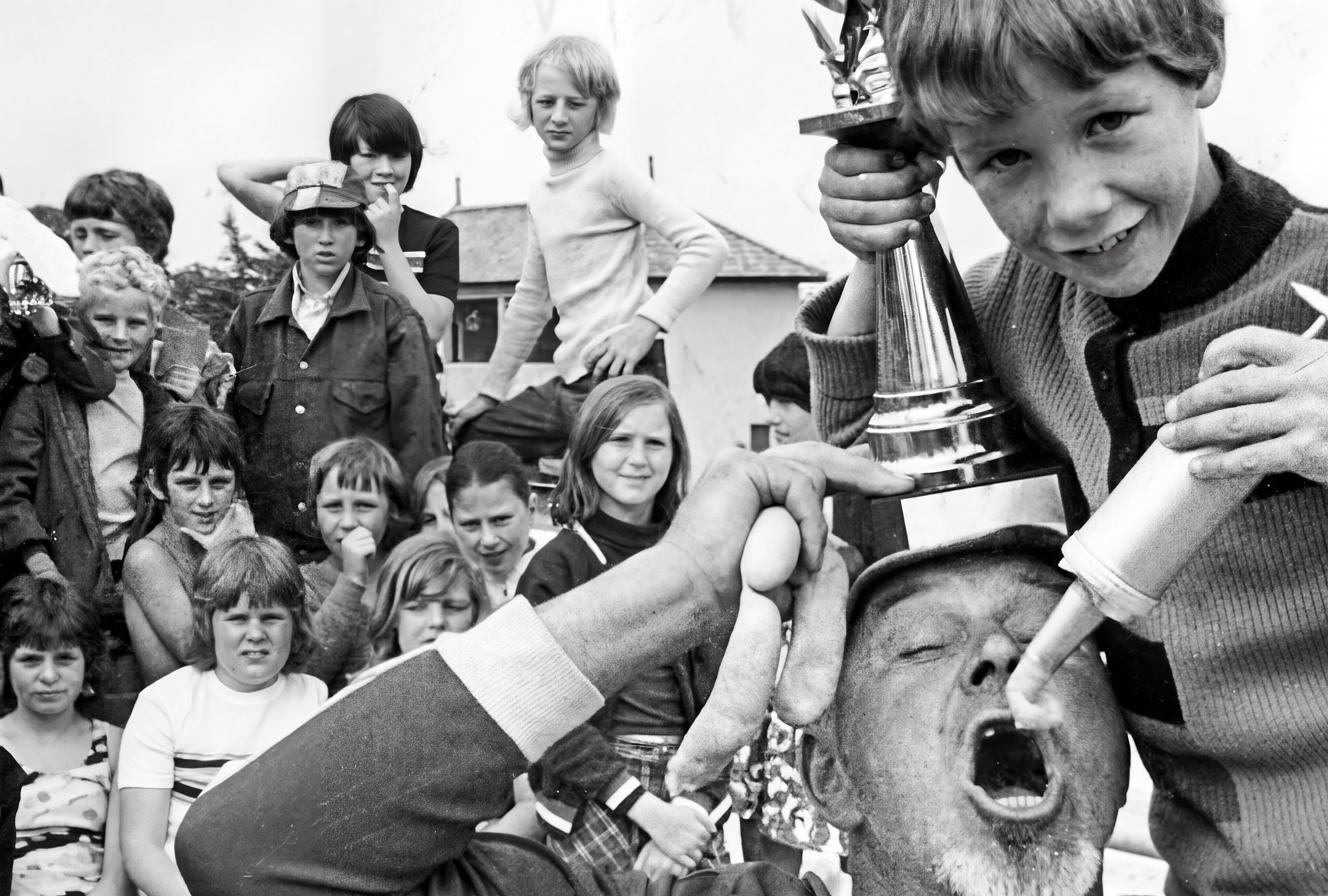
When he pushed a pea along the ground with his nose for charity, he took the skin clean off and could barely walk afterward. When he broke the world record for eating raw sausages, he prepared by drinking olive oil so he could swallow them whole — and then had to go to hospital to have his stomach pumped. He was asked, occasionally, whether he was sure about what he was about to attempt. His answer was invariably the same: “Yeah, yeah, it’ll be all right.”
From a list in Walter’s personal scrapbook, owned by Graham Plumb.
- Made the world laugh in one day by jumping off a supermarket roof in Peterborough whilst wearing wings.
- Balanced a 12 stone dumbbell on his forehead whilst drinking a pint of beer.
- Hopped on one leg for 1 hour 30 minutes.
- Had 1,000 lb steel plate laid on his chest and three balls beneath his back whilst 4 men hit plate with sledge hammers.
- Lifted 650cc motor cycle and 9 stone girl with his teeth.
- Was buried 5 ft underground for 33 minutes with no breathing apparatus.
- Ran backwards for 340 miles.
- Ate grass for 6 days and drank 20 cups of coffee on each of the days.
- Walked on his hands for 153 miles.
- Lifted 30 pints of beer and drank at the same time.
- Pulled two double decker buses, full of people, with his teeth for 700 yards.
- Lifted mini with 26 girls inside on his back.
- Ate 47 raw sausages in 8 minutes 30 seconds.
- Held 14 motor cycles (7 on each arm) pulling in opposite directions.
- Swung and pulled 123 ton barge along the river for 440 yards.
- Held 4 cars (2 on each arm) pulling in opposite directions.
- Pulled 45 ton locomotive along the rails with his teeth for 140 yards.
- Broke down 4″ wall with his head.
- Had a double decker bus run over his chest.
- Had a 28 stone man jump from an 8 ft ladder onto his stomach.
- Pulled a mini with 26 girls inside with his teeth whilst walking on his hands.
- Ate 18 raw eggs at one sitting, 36 in 15 seconds.
- Walked on top of 2 tractor tyres for 25 miles.
- Crawled for 4 miles with 3 girls sitting on his back.
- Played largest clackers in the world.
- Had a rope tied round his neck whilst 10 men on each end of the rope pulled in opposite directions.
- Pushed a pea with his nose up a hill for 1,400 yards.
- Swam under water and breathed fire.
- Was used as a human roundabout.
- Poured 2 gallons of petrol over his body and set it alight.
- Broke an 8″ wall with his hands in 23 seconds.
- Skipped for 1½ hours with a chain weighing 48lb.
- Balanced a 12 stone dumbbell on his forehead whilst playing harmonica and spoons.
- Nine men sitting on 1 750cc motorcyle rode over his stomach.
- Had 3″ thick concrete slab layed on his head, then had the slab smashed with 16 lb sledge hammer.
- Drank 3 yards of Guinness.
- Performed tug of war against 100 children.
- Carried 4 bags of cement (each weighing ½ cwt) on his head for ½ mile.
- Pushed a bus with his head for ½ mile.
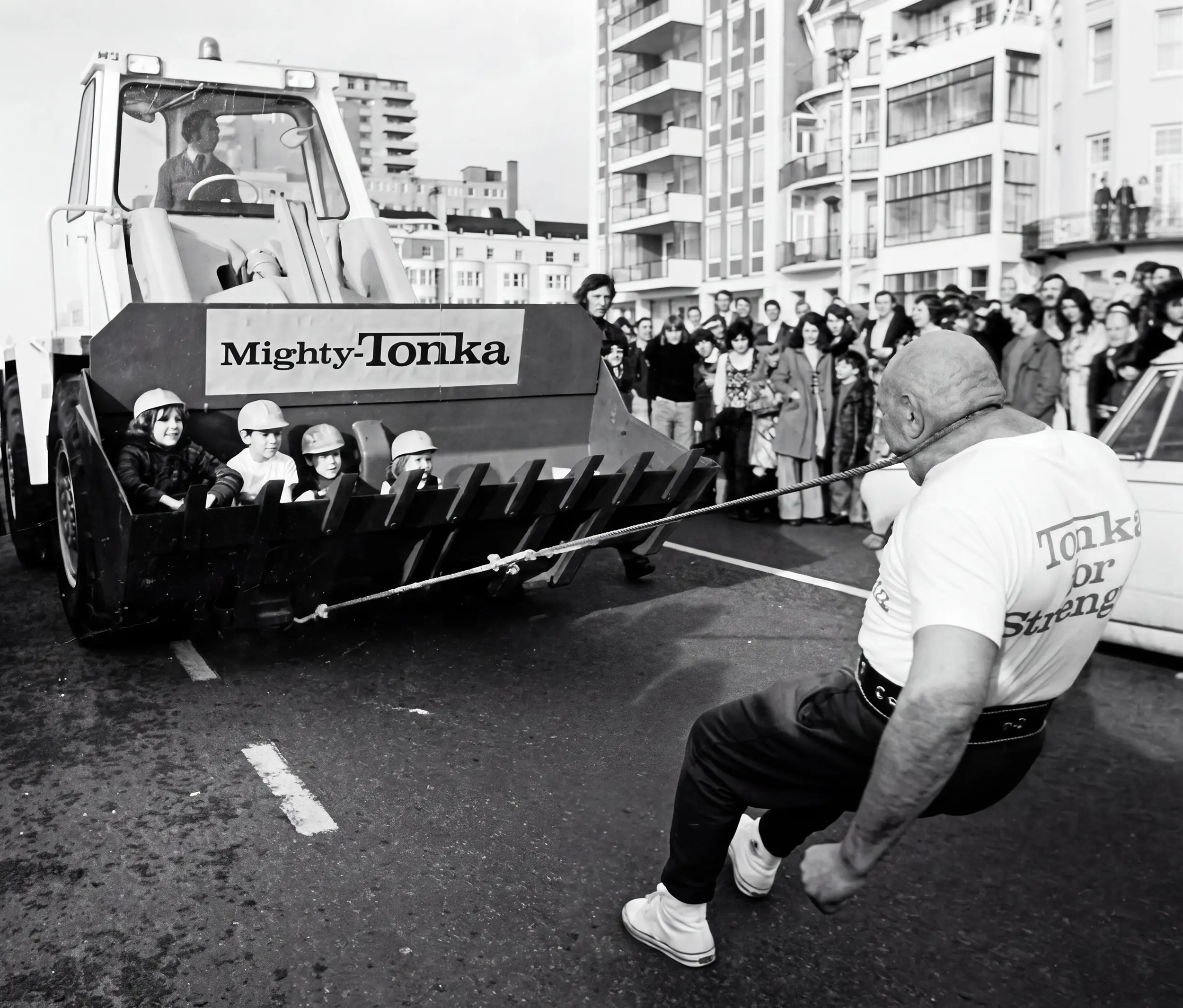
The Life He Built
Away from the crowds and the cameras, Walter lived simply. He tried a flat but found it unsatisfying and returned to living in a Ford Transit van parked next to the Lido. He made his own sandals from old tyres. He rarely ate a hot meal. His diet often consisted of garlic sandwiches — brown bread, a few drops of olive oil, three or four cloves of raw garlic, eaten just like that.
He could, by any measure, have been wealthy. In the 1950s and 60s, with his abilities and his profile, there were paths open to him that would have brought serious money. He chose not to take them. All the stunts, all the appearances, all the feats — they were done for charity, or for a laugh, or both. He lived on almost nothing and gave the rest away.
The Shadow That Never Left
Through all of this — the performances, the community, the laughter — Walter carried something that those around him would rarely have glimpsed. He did not know whether his family had survived the war. He could not go back to Latvia to find out. The country, after the war, had been reabsorbed into the Soviet Union, and for a man with Walter’s history — a man who had killed a German officer, escaped captivity multiple times, fled across the Baltic, and fought alongside resistance groups — returning would almost certainly have meant imprisonment or death.
Latvia remained under Soviet occupation until 1991, eight years after Walter died. He never saw it free again.
So even in Peterborough, in the relative peace of an English city, Walter Cornelius lived under a quiet, permanent truth: the country that had formed him was closed to him, and whatever had happened to the people he had grown up with — his family, his neighbours, the world of the Latvian farm — he would never know.
He carried that, and he carried on.
A Legend, Remembered
Walter Cornelius died in 1983. There was little ceremony. A brief notice appeared in the local paper. He was buried in an unmarked grave in Eastfield Cemetery. It took another decade before a group of people who had known him clubbed together to pay for a headstone.
But memory is more durable than stone, and Walter’s memory proved very durable indeed.
In time, a campaign took shape to find a proper way to honour him. The Lido’s clock tower had long been topped by a weather vane in the shape of a lady leaning on a beach ball. The answer, when it came, was immediately recognised as right: replace it with Walter flying — permanently, above the place he had loved more than anywhere in the world. A graphic artist named Ian Graham produced a first design that required no revision. The weather vane was made in gold — the colour Walter had famously painted himself for his television appearances. It was unveiled on 28 May 2016, the Lido’s eightieth anniversary year.
And so Walter Cornelius flies above the River Nene still. National Geographic voted Peterborough Lido first among the ten best lidos in the United Kingdom, describing it in part through the figure on its clock tower: a Latvian immigrant who worked as a lifeguard, taught a generation of children to swim, broke world records for charity, and tried — with full knowledge of the outcome — to fly across a river using wings too heavy to lift.
A City's Symbol
That image — Walter airborne, homemade wings outstretched, suspended above the Nene — proved to have a power that outlasted the man himself and the moment that created it.
When Peterborough launched its bid to become UK City of Culture 2029, it reached for Walter Cornelius as the campaign’s central symbol. The bid team adopted his likeness as the emblem of the campaign, and the story of his attempted flight as its organising metaphor. A Latvian migrant who had arrived with nothing, survived the unsurvivable, and then stood on the bank of a river and launched himself into the air on homemade wings — here was an image that captured something the city wanted to say about itself: that aspiration, imagination, and the courage to dream beyond circumstance were values woven into Peterborough’s identity. The act of a man who knew he would fall but jumped anyway became, in the language of the bid, a parable for a city that believed the attempt was always worth making.
The 2029 bid was ultimately unsuccessful, falling short of the final shortlist. But the response from those who had led it was unambiguous. Labour council leader Shabina Qayyum said the city would take the positives from the process and push forward, with 2033 firmly in view. The bid, she and others argued, had itself been valuable — building new forms of collaboration, raising the city’s cultural profile, and articulating a story about Peterborough that had long existed but rarely been told so clearly or so confidently.
Walter Cornelius — the man who crossed a sea in a rowing boat with a bullet wound in his back, who painted himself gold on national television and nearly died of it, who flew over a river knowing full well he would fall — is now the face of a city that believes, as he evidently did, that the attempt is worth making regardless of the outcome.
That, in the end, may be his most remarkable legacy: not merely that he survived everything that should have ended him, but that the spirit with which he did so became, decades after his death, the spirit a city chose to hold up and call its own.
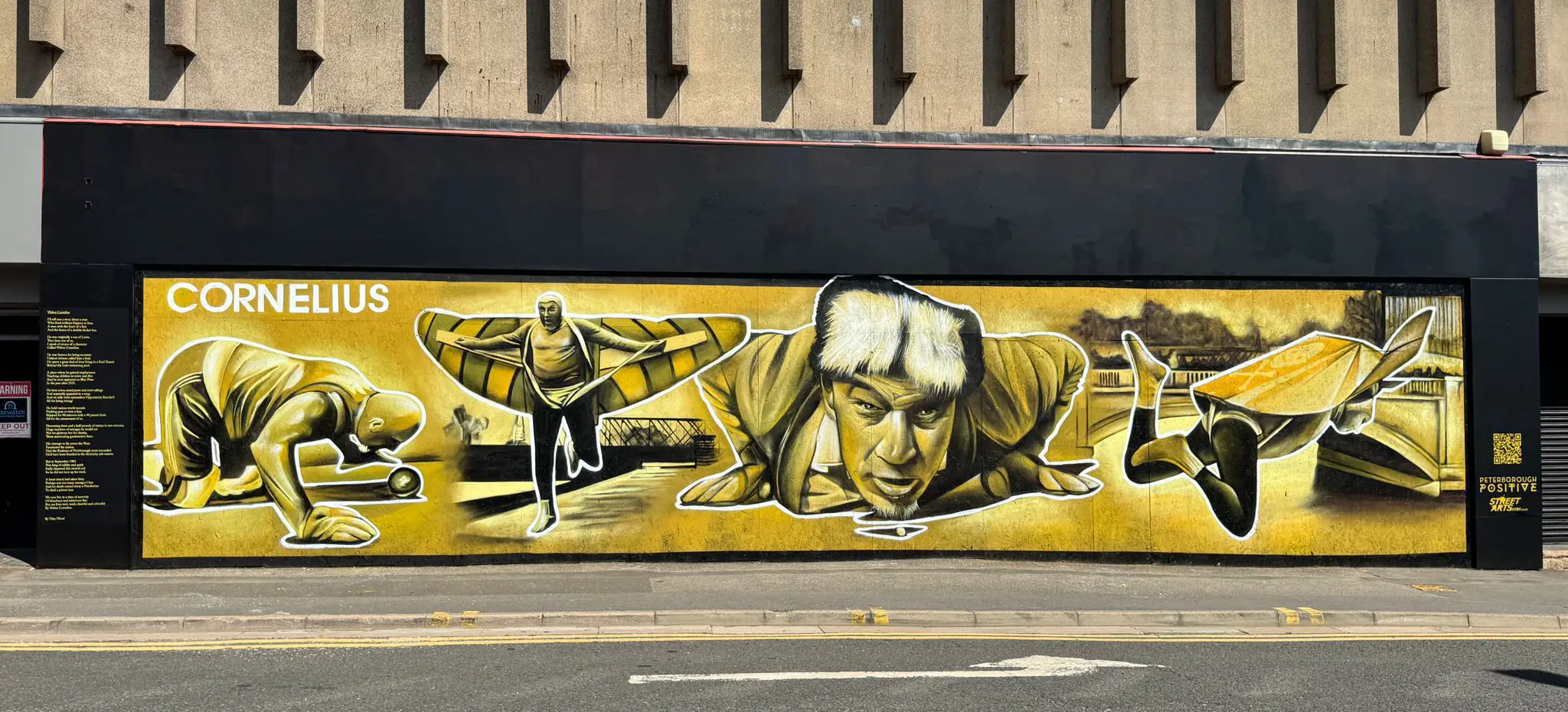
Walter Cornelius mural by Street Arts Hire.
Find the mural on the Peterborough Positive Street Art Map.
Read the press release here.
With grateful thanks to Graham Plumb, son of the late Bill Plumb, for permission to use scrapbook images entrusted to his father by Walter Cornelius, and for helping to preserve this important part of Peterborough’s story.
Sources: Walter Cornelius’s personal scrapbook of world records; the Friends of Peterborough Lido archive; historical records relating to the Soviet and German occupations of Latvia (1940–1945); the Swedish extradition of Baltic soldiers (1946); the Peterborough Lido (opened 1936); and Peterborough City Council’s UK City of Culture 2029 Expression of Interest.