
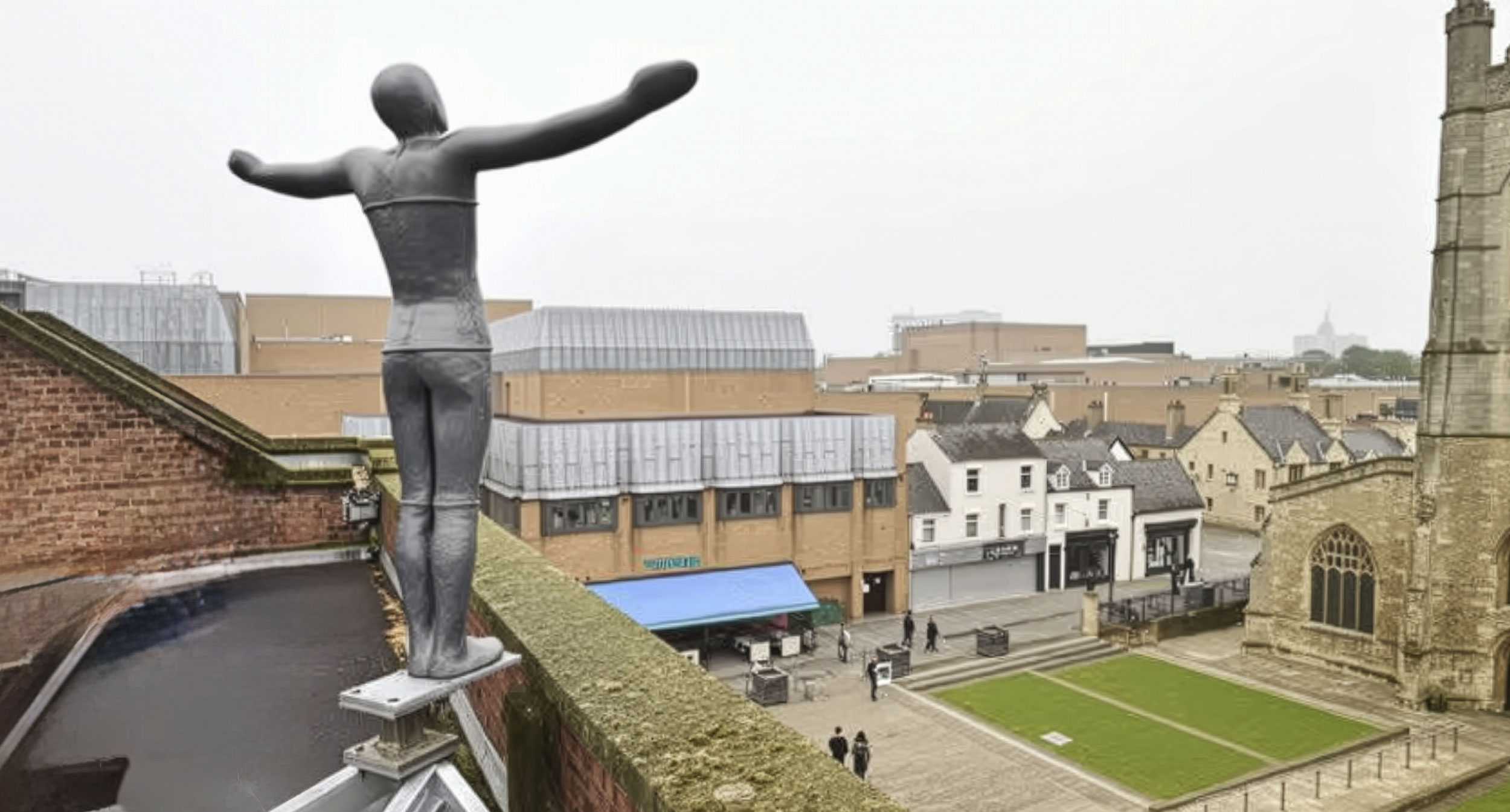
High above the streets of Peterborough, three quiet figures stand watch. At first, they can be easy to miss, blending into the skyline of rooftops and façades. But once noticed, they change the way you see the city. These are Places to Be by Antony Gormley, a subtle yet powerful work of contemporary art woven into the fabric of Peterborough’s city centre.
Positioned on rooftops around Cathedral Square, the three life-sized sculptures occupy unexpected vantage points. Installed in their current locations in 2018, they were carefully re-sited onto prominent buildings including Queensgate and nearby commercial spaces. Their elevated placement transforms the everyday experience of the city. They appear suddenly, framed against the sky or revealed between buildings, encouraging a simple but meaningful act: to pause and look up.
The sculptures form part of Gormley’s early Three Part Lead Bodycase Works, created between 1981 and 1985. These works marked a significant moment in his practice, using casts of his own body to explore the relationship between the human form and the space it inhabits. Rather than presenting the body as an object to be admired, Gormley treats it as a container for experience, a place in itself.
The sculptures show a figure with one arm shielding himself from the sun, a figure with arms outstretched, and a striding figure with arms by its side. Their forms are stripped of identity, allowing them to become universal. They are not portraits of an individual, but reflections of all of us, inviting viewers to consider their own presence within the world.
Originally installed near the rowing lake at Nene Park in the 1980s, the sculptures have since been brought into the heart of the city. This relocation has given them a renewed relevance. Set against Peterborough’s mix of historic and modern architecture, they now engage in a dialogue with the built environment, highlighting the layers and contrasts that define the city.
There is a deliberate restraint to Places to Be. The sculptures do not demand attention. Instead, they reward curiosity. Their stillness contrasts with the movement below, creating a quiet tension between observation and participation. They are part of the city, yet slightly removed from it.
In a place shaped by history, growth and change, these figures offer something simple and lasting: a shift in perspective. They remind us that the city is not only something we move through, but something we experience, inhabit and reflect upon.
Next time you are in Peterborough city centre, take a moment to look up. You may find the city looking back at you.