

In the 1930s, diesel engines were powerful but heavy, slow and widely regarded as unsuitable for ordinary road vehicles. In Peterborough, Frank Perkins and Charles Chapman set out to change that. The P6 was the engine that proved they could.
The P6 in context
- 1932 Frank Perkins and Charles Chapman establish F. Perkins Ltd in Queen Street, Peterborough.
- 1933 The early Wolf engine enters Commer vehicles, giving Perkins its first major original-equipment customer.
- 1935–36 Perkins-powered cars establish six world diesel speed records at Brooklands, proving that diesel can be fast.
- 1937 The new P4 and P6 family is unveiled at the Commercial Motor Show.
- 1938 The P6 enters the market and rapidly becomes available from major British truck manufacturers.
- 1939–45 P6-derived engines contribute to wartime road, industrial and marine applications.
- 1947 Perkins production moves from Queen Street to the expanding Eastfield site.
- 1948+ P6 engines become strongly associated with tractors including the Fordson E27N and Massey-Harris 744.
- 1960s New Perkins families including the 6.354 and 4.236 build upon the reputation established by the P-Series.
- Today Perkins remains a major manufacturing and research presence in Peterborough.
The engine that changed Perkins
The first Perkins engines proved the idea. The P6 turned the idea into an industry.
When F. Perkins Ltd began in Peterborough in 1932, it was a tiny company pursuing an unfashionable proposition.
Diesel engines were already respected where sheer pulling power mattered.
But they had a problem.
They were heavy.
They were slow-revving.
They were noisy.
And for manufacturers accustomed to compact petrol engines, they could look like the wrong technology for cars, vans and lighter trucks.
Frank Perkins and Charles Chapman believed those disadvantages could be engineered away.
The P6 was not important because Peterborough invented the diesel engine. It was important because Peterborough helped make diesel practical in places people had thought it did not belong.
Explore the wider industrial story in Peterborough’s Engineering Story.
The diesel problem
By the early 1930s, petrol dominated road transport.
Diesel offered attractive fuel economy and strong torque, but traditional engines tended to be physically larger and heavier and operated at relatively low speeds.
That worked well for stationary machinery and heavy applications.
It was less attractive beneath the bonnet of a delivery van.
Large engine mass made installation difficult in lighter vehicles.
Low engine speeds reinforced the idea that diesel belonged to heavy machinery.
Design the engine around the dimensions and demands of modern vehicles.
Create a high-speed diesel capable of competing much more closely with petrol performance.
The company’s first Vixen and Wolf engines began proving the concept.
Then came a more ambitious second generation.
Five and a half months from idea to prototype
By 1937, Perkins was taking orders for nearly 2,000 engines a year and needed a new generation of power units.
The engineering team began work on a smoother, more powerful six-cylinder engine.
Its development name was Panther.
According to the Perkins archive, the first prototype was designed, detailed and built in just five and a half months.
When the prototype reached the test bed, the company board was sufficiently impressed to approve it for production after only a few hours of running.
From design programme to first prototype.
But one of the cleverest decisions concerned what happened next.
The six-cylinder design would not stand alone.
Perkins developed related four and three-cylinder versions using shared tooling and components.
It was an early example of something now completely familiar in engine manufacture: designing a family of related power units rather than treating every model as an entirely separate machine.
What was inside a P6?
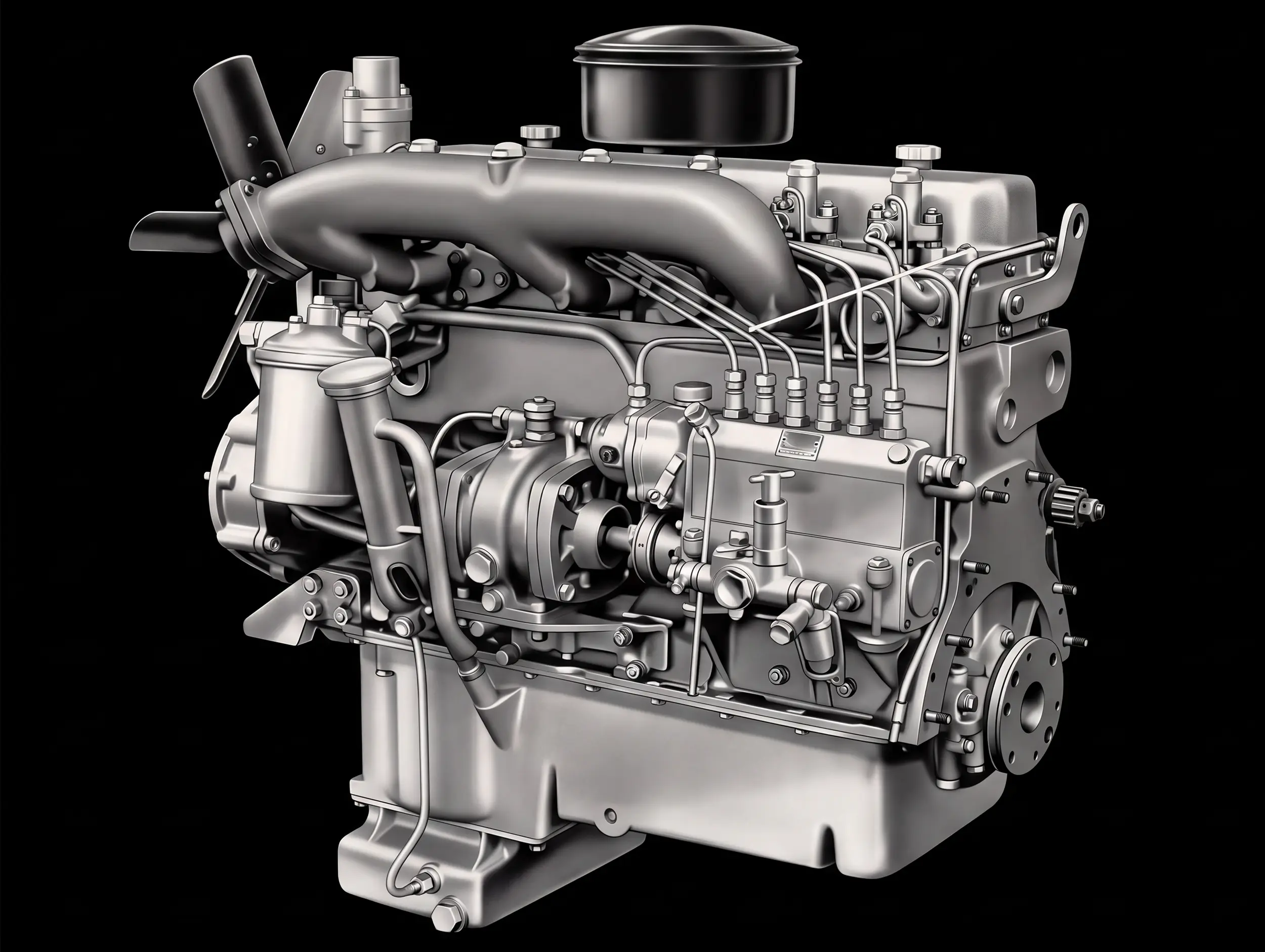
The basic P6 was a water-cooled, inline six-cylinder diesel.
Its cylinders had a bore of 3½ inches and a stroke of 5 inches, producing a swept capacity of approximately 4.73 litres.
That distinction is important because the P6 succeeded partly through adaptability.
It did not have one job.
It became an engine platform.
“The world’s lightest diesel engine”
Perkins knew exactly what was revolutionary about the P6.
Its advertising called it:
DIESEL ENGINE
85 bhp · 2,600 rpm · 580 lb
The claim went straight at diesel’s biggest image problem.
Weight mattered enormously.
Every unnecessary kilogram in an engine reduced payload, affected handling and forced vehicle manufacturers to design heavier supporting structures around it.
Perkins had produced a six-cylinder diesel weighing around 263 kilograms while developing 85 bhp at a speed of 2,600 rpm.
Those figures made manufacturers pay attention.
The breakthrough was not simply more power. It was power without the traditional penalty of an enormous diesel engine.
Within months, the P6 was under British bonnets
The market responded extraordinarily quickly.
By June 1938, only around six months after its launch, the P6 was available as a standard power unit from some of Britain’s best-known commercial vehicle manufacturers.
This was exactly what Frank Perkins had wanted from the beginning.
Perkins did not need to manufacture the whole truck.
Its product could disappear beneath somebody else’s bonnet.
That became fundamental to the company’s business model.
Today we would call those manufacturers OEMs, or Original Equipment Manufacturers.
Working closely with them became a defining part of the Perkins approach.
Then the road engine went to sea
The P6 also opened another market.
The British Admiralty and the marine section of the Air Ministry became interested in lightweight diesel power.
The attraction was obvious.
Diesel fuel reduced the fire risk associated with petrol and offered better fuel economy, while the P6’s unusually favourable power-to-weight ratio made it attractive for fast light craft.
Perkins subsequently developed a more powerful marine derivative known as the S6(M).
That marine lineage survived long after the war.
Later P6 engines powered everything from working boats to unusual naval craft and the royal barge associated with the Royal Yacht Britannia.
Then farmers discovered what six cylinders could do
The P6 story eventually moved decisively away from the road.
Its torque, economy and durability made it highly attractive for agriculture.
One of the most memorable combinations was the Fordson E27N Major.
From 1948, customers could obtain an E27N fitted with a Perkins P6 diesel rather than the tractor’s older petrol or vaporising-oil power unit.
For farmers accustomed to the older Fordson engine, the six-cylinder P6 provided the economy and pulling characteristics that helped make diesel increasingly attractive on British farms.
Massey-Harris also used the P6, including in the 744P tractor.
Many surviving vintage tractors are still identified by enthusiasts primarily through the engine under their bonnets.
A Fordson fitted with a Perkins P6 is not simply an E27N.
It is a P6 Fordson.
The engine became famous enough to change the identity of the machine around it.
Why was Perkins in Peterborough?
Frank Perkins was a Peterborough man.
He was born in the city in 1889 into a family already deeply involved in engineering.
His grandfather had helped develop the business that became Barford & Perkins, one of the important names in Peterborough’s Victorian agricultural-engineering industry.
So when Frank and Charles Chapman established their new company in 1932, Peterborough already offered something crucial.
Engineers.
The city had accumulated generations of practical industrial skills through railways, agricultural machinery, ironworking and specialist engineering.
There was another advantage.
The railway.
A city already accustomed to machining, fitting and manufacturing.
London and Midlands manufacturers could be reached quickly from Peterborough.
Engines could leave Peterborough for manufacturers and customers across Britain.
Perkins itself identifies Peterborough’s skilled labour and fast rail links as important reasons for locating and growing the company here.
It is a striking example of how one part of Peterborough’s history enabled another.
The railway helped build the engineering city.
The engineering city helped build Perkins.
From Queen Street to Eastfield
F. Perkins Ltd began modestly.
Its first Peterborough base was in Queen Street, close to an engineering district with much deeper roots.
In its first year, the company produced only 35 engines.
That scale could not last.
As orders grew through the 1930s and wartime production followed, Perkins needed substantially more capacity.
In 1947, production moved to the new Eastfield site.
A tiny company begins with an ambitious idea.
A growing manufacturer moves into a site capable of expansion.
Perkins announces itself as the world’s largest producer of diesel engines in the 50–70 hp range.
The move was transformational.
Eastfield became one of the defining industrial landscapes of modern Peterborough.
Thousands of people would eventually pass through its gates as engineers, assemblers, apprentices, designers, technicians, managers and specialists.
For generations of Peterborough families, Perkins was not abstract industrial history.
It was work.
The P6 did not disappear. It evolved.
Successful engines rarely end cleanly.
The lessons embedded in them pass into whatever comes next.
The P-Series established the architecture, manufacturing confidence and reputation from which later Perkins engines could develop.
The engine that established the reputation.
The six-cylinder successor that helped drive worldwide expansion.
The enormously successful agricultural engine family.
Successive generations continue the Peterborough engineering lineage.
Perkins itself describes the P6 as the engine that built its early reputation, while the later 6.354 created the foundation for global growth during the 1960s and 1970s.
The 4.236 would become another phenomenon, with more than two million examples of that family eventually produced at Peterborough alone.
The P6 therefore sits near the beginning of an engineering family tree that stretches across much of the twentieth century.
Why this is a Peterborough object
There are objects that tell the story of a moment.
The P6 tells the story of what Peterborough became.
It emerged from an industrial culture already more than a century old.
Its designer, Charles Chapman, brought extraordinary technical skill.
Frank Perkins brought ambition, salesmanship and a conviction that diesel could do something the market had not yet fully understood.
Peterborough supplied the engineers, transport connections and manufacturing environment in which that proposition could become real.
The result travelled everywhere.
Under truck bonnets.
Across fields.
Inside military vehicles.
Across the sea.
Into tractors that farmers still preserve today.
Millions of people who had never visited Peterborough encountered the city’s engineering every time they turned a key.
The P6 also marks a transition in Peterborough’s history.
The medieval city had once exported manuscripts and ideas.
The nineteenth-century city exported agricultural machinery and railway expertise.
The twentieth-century city increasingly exported engineering.
Perkins became one of its most visible global signatures.
And the story has not ended.
Perkins remains headquartered in Peterborough, where its Eastfield operation combines engine manufacturing with research, development and testing.
The technologies have changed dramatically since 1938.
The principle has not.
Design it here. Make it here. Power something somewhere else.