

John de Sais was the twelfth-century Abbot of Peterborough who faced catastrophe when fire destroyed the ancient abbey church in 1116. His response changed the city forever: he began the vast Norman church that became Peterborough Cathedral and still dominates Peterborough more than nine centuries later.
Life and career in dates
- Before 1114 John is a monk associated with Sées in Normandy
- 1114 Becomes Abbot of Peterborough, succeeding Ernulf
- 1114–15 Travels to Rome on behalf of Archbishop Ralph of Canterbury
- 1116 A catastrophic fire destroys the abbey church and much of Peterborough
- 1117–18 Work begins on a new Norman abbey church
- 1118 The ceremonial foundation of the new church is traditionally dated to 8 March
- 1120s John continues rebuilding while defending and recovering abbey estates and privileges
- 1125 John dies with the enormous rebuilding project still in its early stages
Peterborough after the Conquest
John de Sais arrived at Peterborough during a century in which England was being transformed in stone.
Less than fifty years had passed since the Norman Conquest. Across England, Norman kings, bishops and abbots were replacing older Anglo-Saxon churches with immense Romanesque buildings whose scale announced both religious devotion and political power.
Peterborough was already ancient.
Its monastery traced its origins back to seventh-century Medeshamstede and the age of Seaxwulf. After destruction during the Viking age, the monastery had been magnificently refounded in the tenth century and developed into a wealthy Benedictine abbey.
The Norman Conquest brought another period of upheaval. Peterborough was caught up in the resistance associated with Hereward the Wake, its treasures were plundered and Norman influence became increasingly visible within the monastery itself.
By the time John became abbot in 1114, Peterborough stood at the meeting point between its Anglo-Saxon past and a new Norman England.
A Norman monk
John's name has caused confusion for centuries.
He appears in different sources as John de Sais, John de Says, John de Seez and sometimes John of Salisbury.
The strongest evidence points instead towards Sées in Normandy.
The medieval historian Eadmer described him as Johannes Monachus Sagii, John the monk of Sées. His name therefore probably identifies the Norman religious house or place from which he came rather than Salisbury in England.
One abbot, several names
Medieval names were recorded phonetically and Latinised in different ways. Modern histories generally connect John with Sées in Normandy.
This Norman background placed John within the international world of the medieval Church. Monks and senior clergy routinely moved between religious houses in England, Normandy and the wider European church.
Abbot of Peterborough
John succeeded Abbot Ernulf in 1114.
Ernulf had previously been Prior of Canterbury and was himself an accomplished builder. At Peterborough he had completed a new chapter house, refectory and dormitory before leaving to become Bishop of Rochester.
John inherited one of England's wealthiest and most significant Benedictine monasteries.
His position was not simply spiritual.
The Abbot of Peterborough controlled extensive estates, administered tenants and manors, represented the monastery before the Crown and exercised considerable authority across the surrounding landscape.
Soon after becoming abbot, John was entrusted with an international church mission.
Medieval accounts record that Archbishop Ralph of Canterbury sent him to Rome with other representatives to obtain the archbishop's pallium from Pope Paschal II. The journey illustrates that Peterborough's new abbot was already operating at the highest levels of the English Church.
Within two years, however, his attention would be consumed by disaster.
Nine days of fire
On 4 August 1116, Peterborough Abbey caught fire.
We know an unusual amount about the disaster because a Peterborough monk named Hugh Candidus witnessed it.
According to his account, the fire began in the monastery's bakehouse.
Flames spread rapidly through a complex in which timber roofs, wooden buildings and combustible materials allowed fire to travel with terrifying speed.
The abbey church was consumed.
Bells or other objects in the tower were destroyed and the fire continued burning there for nine days. The newly completed chapter house, dormitory and refectory were among the relatively few monastic buildings to escape.
The catastrophe did not stop at the monastery walls.
Fire spread into the surrounding settlement and devastated much of Peterborough itself.
4 August 1116
Nine daysThe monastery's chronicler Hugh Candidus recorded that fire continued burning in the abbey tower for nine days after the blaze began.
In a single disaster, centuries of Peterborough's monastic architecture were swept away.
The story behind the fire
Hugh Candidus preserved a wonderfully medieval account of the disaster. He claimed that John had become angry before leaving for business at Castor and had cursed the monastery. Later, a frustrated servant struggling to light the bakehouse fire supposedly called upon the Devil, immediately before the flames took hold.
The fire itself is securely recorded. The supernatural and moral framing tells us something equally interesting about how a medieval monk interpreted catastrophe.
Beginning again
John de Sais now faced the defining decision of his abbacy.
He could attempt simply to recreate what had been lost.
Instead, Peterborough began again on a monumental scale.
Within a remarkably short period, work was under way on an entirely new abbey church in the great Norman Romanesque tradition.
Medieval sources give apparently different dates for its beginning. Peterborough's own chronicle places the commencement of work in March 1117, while Hugh Candidus gives a ceremonial foundation date corresponding to 8 March 1118.
The difference is less contradictory than it first appears. Medieval years could be reckoned differently, and practical work such as clearing ruins, preparing the site and digging foundations may have preceded the formal ceremony.
What matters is clear.
Only around eighteen months after the catastrophe, Peterborough was building one of the great churches of Norman England.
John de Sais did not merely rebuild Peterborough Abbey. He began the building that became Peterborough Cathedral.
The Cathedral we see today
The church John began was enormous.
Construction started at the eastern end, around the choir and apse, as was usual for a great medieval church. This allowed the most important liturgical spaces around the high altar to be created before work progressed westwards.
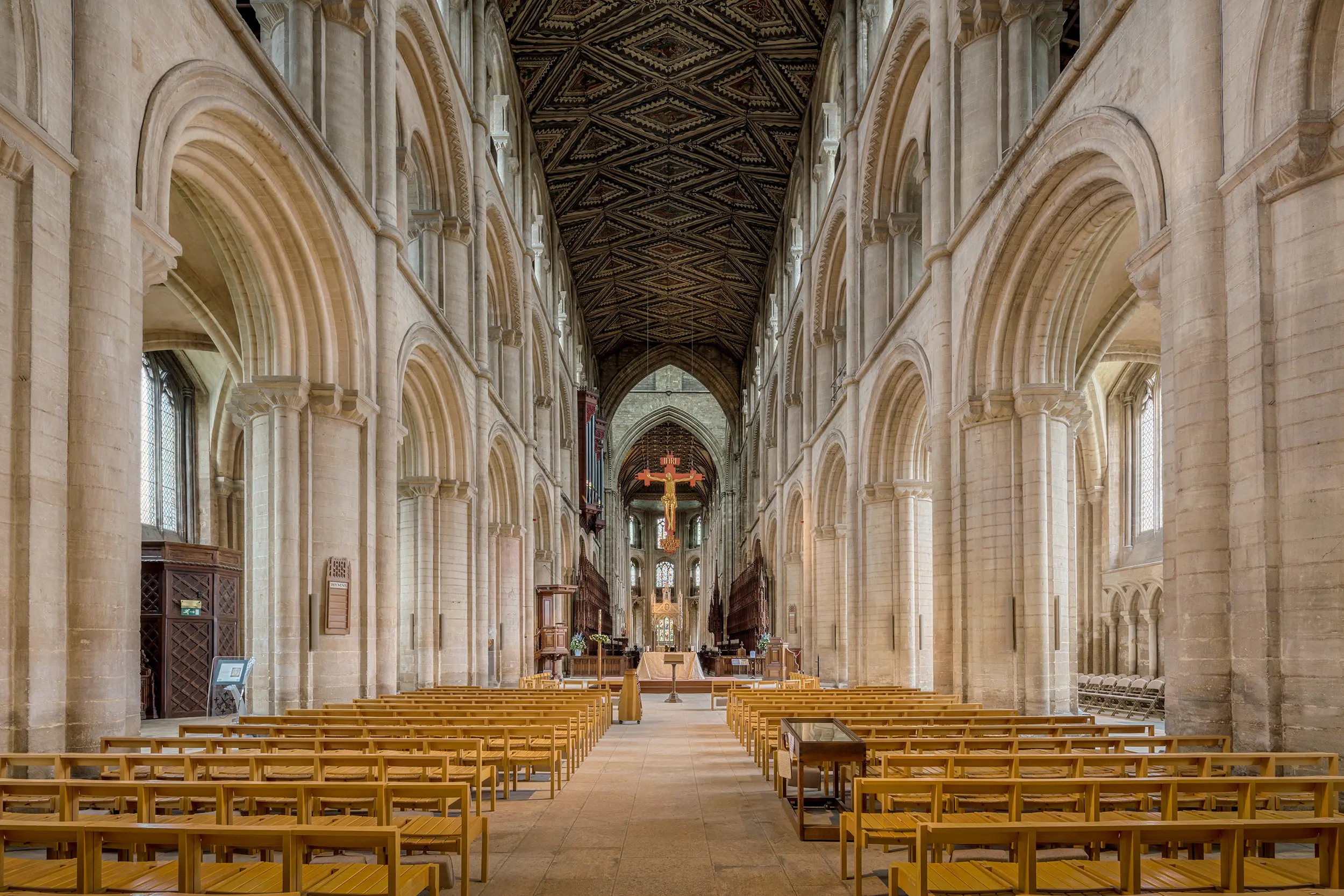
Massive stone columns, rounded arches, thick masonry walls and carefully ordered proportions created an architecture intended to inspire awe.
The stone building also represented permanence after the destruction of 1116.
Much of the stone came from the famous quarries at Barnack, west of Peterborough. Their exceptionally fine limestone was used in some of the great medieval buildings of eastern England.
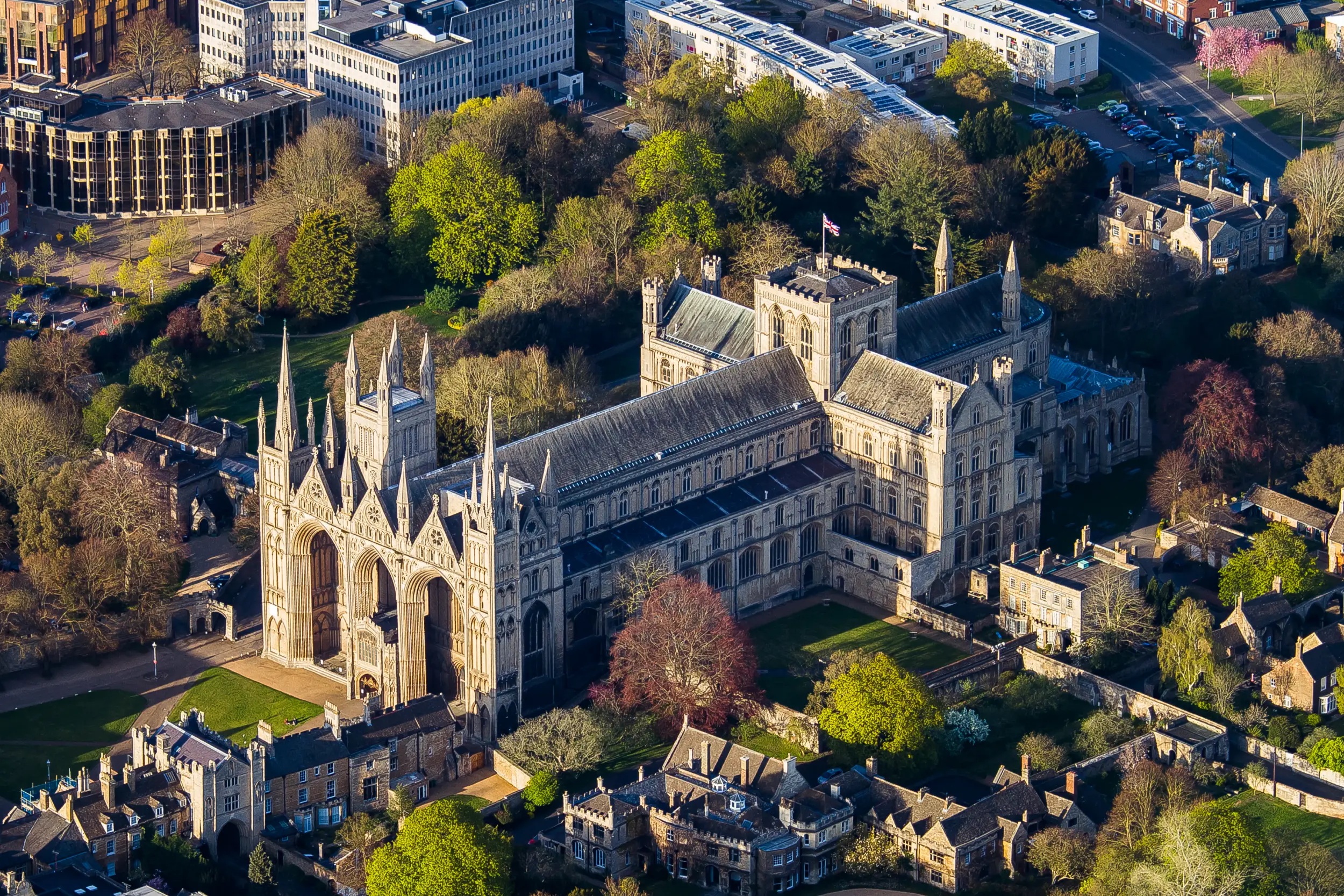
The scale of John's decision becomes obvious when visiting Peterborough Cathedral today.
The present church was constructed over many generations and later abbots altered and extended John's design. The famous West Front belongs to the thirteenth century, as does the extraordinary painted nave ceiling.
But the great Norman architectural body of the Cathedral began with the rebuilding ordered during John's abbacy.
What began under John de Sais?
Rebuilding an institution
Stone was only part of John's task.
A medieval abbey was simultaneously a religious community, major landowner, economic organisation and political institution.
The fire therefore struck at far more than a church building.
Later accounts describe John working energetically to restore the monastery's position, recover lands that had been lost and obtain confirmation of its manors, estates and privileges.
These resources mattered because rebuilding a church of Peterborough's size demanded an extraordinary long-term investment.
Quarrymen had to extract stone. Carters and boats transported materials. Masons, carpenters, smiths and labourers needed to be employed and supported. The monastic community had to continue functioning throughout.
John was therefore initiating not just an architectural project but an undertaking that would consume resources for generations.
The abbey's vast estates made such ambition possible.
An unfinished masterpiece
John de Sais died in 1125.
He never saw the church he had begun completed.
Indeed, nobody involved at the beginning could have expected to witness the entire project finished. Medieval cathedrals and abbeys were built across generations.
Progress continued under John's successors.
By 1143 the Norman choir was sufficiently advanced to be dedicated. Later abbots pushed the building westwards through the transepts and nave. By the end of the twelfth century, the enormous Norman body of the church was substantially complete.
The spectacular West Front followed during the thirteenth century.
What had begun as John de Sais's response to catastrophe had become one of medieval England's great buildings.
John de Sais and Peterborough
There is an unusual way to think about John de Sais.
We know relatively little about the details of his personality or private life. We do not have a trustworthy portrait. Even his place of origin became confused in later histories.
Yet few medieval people have left Peterborough a larger physical legacy.
Walk through the Cathedral today and the consequence of the decision made after the fire of 1116 surrounds you.
The enormous Norman columns, rhythmic arcades, eastern church and underlying scale of the building all belong to a construction campaign whose first foundations were laid during his abbacy.
From catastrophe to cathedral
1116Fire destroys the old abbey church and devastates much of Peterborough.
↓ 1117–18John de Sais begins a monumental new Norman church.
↓ 12th centurySuccessive generations continue the immense building programme.
↓ Peterborough CathedralThe church that rose from the disaster remains one of Britain's great surviving medieval buildings.
John therefore occupies a pivotal position in the story of Peterborough.
Seaxwulf belongs to the creation of the first monastery at Medeshamstede.
John de Sais belongs to another moment of creation, nearly five centuries later, when destruction forced Peterborough to reinvent its greatest building.
The Cathedral that defines Peterborough's skyline began with John de Sais and a decision to build again after almost everything had been lost.