

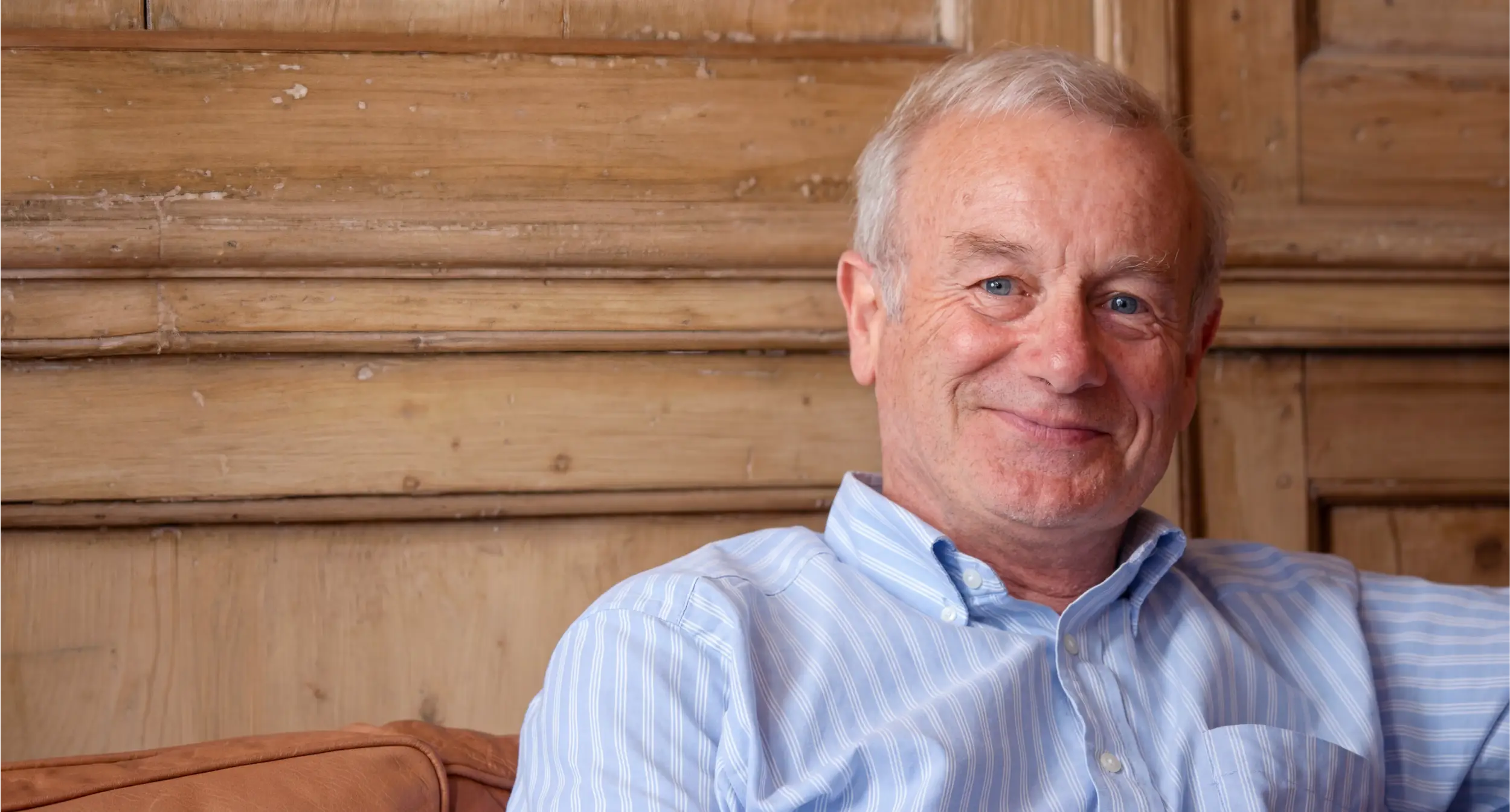
Peterborough-born physicist Professor Frank Close OBE FRS has spent his career investigating the fundamental structure of matter and helping millions of readers, viewers and listeners understand some of science’s most challenging ideas.
Life and career in dates
- 1945 Born and brought up in Peterborough
- 1950s Becomes Head Chorister at Peterborough Cathedral
- 1967 Graduates in physics from the University of St Andrews
- 1970 Completes his doctorate at the University of Oxford
- 1973 Begins research at CERN following work at Stanford and Daresbury
- 1975 Joins the Rutherford Appleton Laboratory at Harwell
- 1993 Delivers the Royal Institution Christmas Lectures
- 2000 Appointed OBE for services to science
- 2013 Receives the Royal Society Michael Faraday Prize
- 2021 Elected a Fellow of the Royal Society
- 2025 Publishes Destroyer of Worlds
A Peterborough childhood
Francis Edwin Close was born in Peterborough on 24 July 1945 and grew up in the city. His fascination with numbers and patterns appeared long before he encountered the subatomic particles that would define his professional life.
His father was an accountant who taught him numerical shortcuts and encouraged his confidence with mental arithmetic. Close has also credited a childhood enthusiasm for trainspotting with making numbers familiar and memorable. Recording locomotives and recognising their numbers became an informal exercise in observation, classification and recall.
Books offered another route into science. Close has recalled working his way through the non-fiction shelves of his local library and noticing the date stamps that revealed how frequently each book had been borrowed. One neglected volume caught his attention: Paul Dirac’s The Principles of Quantum Mechanics. He understood little of it at the time, but the encounter introduced him to the existence of an extraordinary hidden world governed by unfamiliar laws.
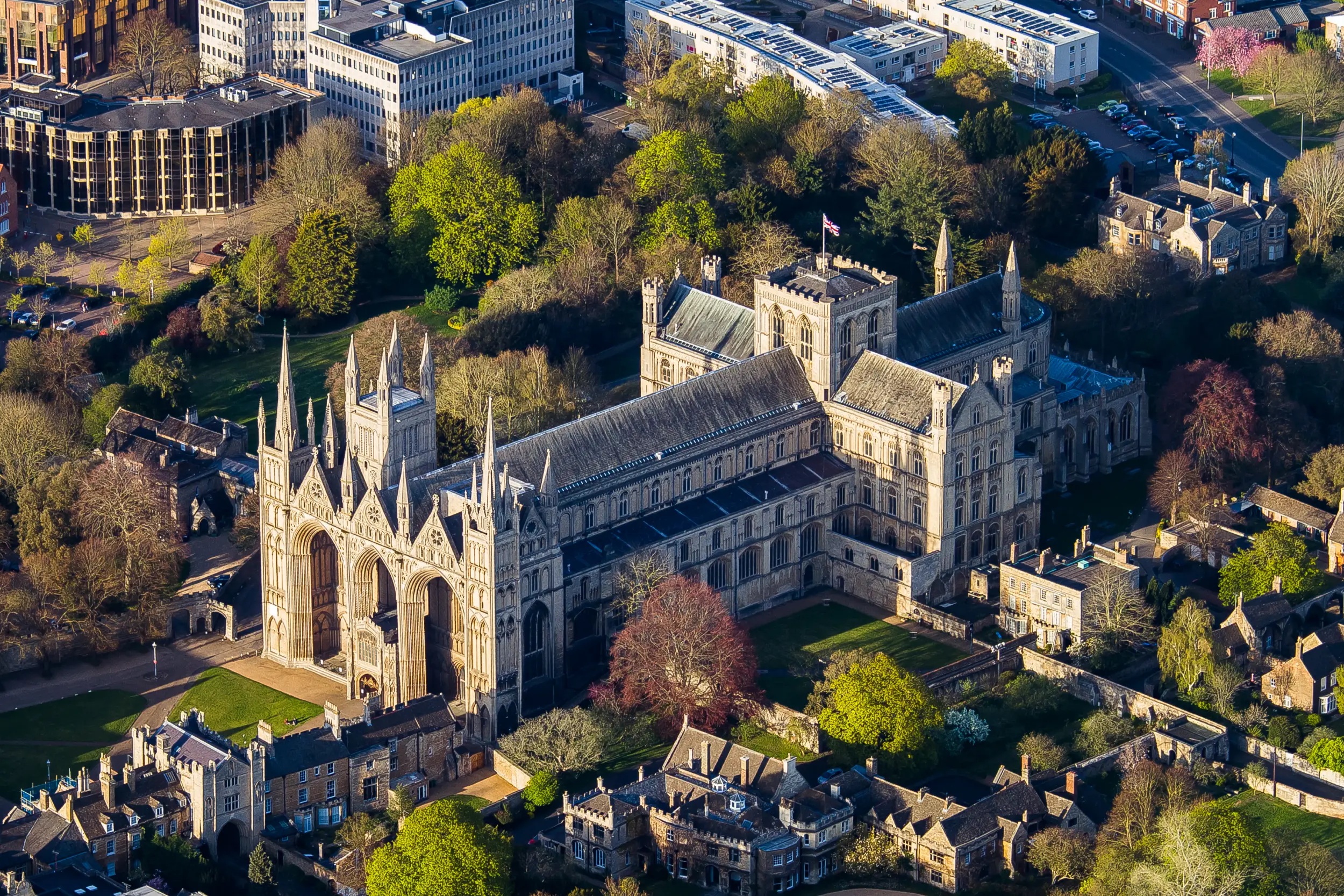
Close attended The King’s School, Peterborough, which was then a boys’ grammar school. Music was equally important to his early life. During the 1950s he sang at Peterborough Cathedral under its renowned Director of Music, Dr Stanley Vann, eventually becoming Head Chorister.
The precision, concentration and collective discipline demanded by Cathedral music became part of Close’s intellectual formation, complementing the curiosity about numbers and patterns that drew him towards physics.
From King’s to Oxford
After leaving Peterborough, Close studied at the University of St Andrews. Unsure whether to specialise in mathematics, applied mathematics or physics, he pursued all three, a combination that led naturally towards theoretical physics. He graduated with a Bachelor of Science degree in 1967.
Close then moved to Magdalen College, Oxford, where he undertook doctoral research under the distinguished physicist Richard Dalitz. At the time, the idea that protons, neutrons and other particles were composed of still smaller entities called quarks was relatively new and remained the subject of intense debate.
Dalitz was one of the few British physicists then working seriously with the quark model. Under his supervision, Close began studying how quarks might be arranged within particles and how theoretical predictions could be tested against experimental results. He completed his doctorate in theoretical physics in 1970.
Postdoctoral work took Close to Stanford University in California, where experiments at the Stanford Linear Accelerator Center were transforming physicists’ understanding of the internal structure of protons. He had entered the field just as quarks were moving from a bold theoretical proposal towards an essential part of modern physics.
Quarks and the strong force
Most familiar matter is built from atoms, with electrons surrounding a nucleus made from protons and neutrons. Protons and neutrons are themselves composed of quarks, bound together by one of nature’s four fundamental interactions: the strong force.
The mathematical theory describing this interaction is known as quantum chromodynamics, or QCD. In this theory, the strong force is carried by particles called gluons. The interaction is so powerful that individual quarks are not normally found in isolation; instead, they combine to form composite particles collectively known as hadrons.
Close’s research has investigated how quarks and gluons produce the observed properties of hadrons and atomic nuclei. His work has included QCD phenomenology, which connects the underlying theory to measurable experimental results, and the study of unusual or “exotic” combinations of quarks.
He has also examined predicted particles known as glueballs. Unlike ordinary hadrons, which contain quarks, glueballs would be formed predominantly from the gluons that carry the strong force. Identifying such states experimentally remains difficult because they can mix with other particles displaying similar properties.
By helping to develop and explain models of quark behaviour, Close has contributed to the wider effort to understand how the smallest known components of matter create the physical universe around us.
CERN, Harwell and Oxford
Following his time at Stanford, Close worked briefly at Daresbury Laboratory before moving to CERN, the European laboratory for particle physics near Geneva, in 1973. CERN brought theoretical and experimental physicists together around increasingly powerful particle accelerators, allowing ideas about the fundamental structure of matter to be tested at unprecedented energies.
In 1975, Close joined the Rutherford Appleton Laboratory at Harwell in Oxfordshire. He remained there for approximately 25 years, becoming Head of its Theoretical Physics Division in 1991. The laboratory provided a national centre for British research in particle and nuclear physics and connected UK theorists with major international experiments.
Close later returned to CERN in a different capacity, serving as Head of Communications and Public Education from 1997 to 2000. The role placed him at the centre of efforts to explain the laboratory’s research, purpose and global significance beyond the scientific community.
In 2001, he became Professor of Theoretical Physics at the University of Oxford and a Fellow of Exeter College. He is now Professor Emeritus of Theoretical Physics and Fellow Emeritus at Exeter College, while continuing to write, lecture and contribute to public discussions about physics and its history.
Opening science to everyone
Close has always treated public communication as an important part of scientific life rather than a secondary activity. His particular skill lies in finding clear images and narratives through which readers can approach subjects that are often hidden behind advanced mathematics.
In 1993, he delivered the Royal Institution Christmas Lectures under the title The Cosmic Onion. Across five televised lectures, he peeled back successive layers of matter, moving from atoms and nuclei to fundamental particles, antimatter and the early universe.
He later served as Professor of Astronomy at Gresham College and as an executive vice-president of the British Science Association. His lectures, broadcasts and writing have addressed audiences ranging from school pupils and general readers to practising physicists, parliamentarians and policymakers.
Close has won a British Science Writers Award three times and is described by the University of Oxford as the only professional physicist to have achieved that distinction.
Particles, people and history
Close has written more than twenty books, ranging from concise introductions to major works of scientific history. His books have been translated into numerous languages and have helped establish him as one of Britain’s leading interpreters of modern physics.
Works including The Cosmic Onion, Particle Physics: A Very Short Introduction, Antimatter, Nothing and Neutrino introduce readers to the particles, forces and unanswered questions underlying the physical universe.
The Infinity Puzzle traced the development of quantum field theory and the long search for the mechanism that gives fundamental particles mass. Its account led naturally to Elusive: How Peter Higgs Solved the Mystery of Mass, Close’s 2022 biography of the physicist whose name became inseparable from the Higgs boson.
Other books explore the human and political history surrounding nuclear and particle physics. Half-Life examined the divided life and mysterious disappearance of physicist Bruno Pontecorvo, while Trinity investigated atomic scientist and Soviet spy Klaus Fuchs.
His 2025 book, Destroyer of Worlds: The Deep History of the Nuclear Age, 1895–1965, follows the sequence of discoveries that transformed nuclear physics from a largely peaceful intellectual pursuit into the foundation of atomic and thermonuclear weapons. It also challenges the idea of scientific progress as the achievement of isolated geniuses, showing how discovery depends on collaboration, rivalry, chance and historical circumstance.
Honours and Peterborough
Close received the Institute of Physics Kelvin Medal in 1996 for his contribution to public understanding of physics. He was appointed an Officer of the Order of the British Empire in 2000 for services to research and the public understanding of science.
In 2013, the Royal Society awarded him its Michael Faraday Prize for excellence in communicating science. He was elected a Fellow of the Royal Society in 2021, one of the highest distinctions available to a scientist in the United Kingdom.
When marking his election to the Royal Society, Close dedicated the honour to his former Peterborough Cathedral choirmaster, Stanley Vann. He credited Vann with teaching his choristers the focus and sustained effort required to turn ability into achievement.
Close has maintained an active relationship with the Peterborough Cathedral Old Choristers’ Association, regularly supporting its reunions and discussions about the future of Cathedral music. His local loyalties also extend to football: despite a career spent at some of the world’s leading scientific institutions, he has remained a supporter of Peterborough United.
From childhood train numbers and Cathedral music to quarks, gluons and the nuclear age, Frank Close’s life connects Peterborough with some of the most profound questions in modern science.