

In a field beside the River Nene, a plough struck silver. What emerged was not simply buried Roman wealth. The Water Newton Treasure revealed something extraordinary about the Peterborough landscape 1,700 years ago: a prosperous Christian community worshipped here while Roman Britain was still alive.
The treasure in dates
- AD 43 The Roman conquest of Britain begins.
- 1st c. A fort and settlement develop at the strategic Nene crossing that becomes Durobrivae.
- 2nd–4th c. Durobrivae grows into an important town at the centre of a major pottery-producing landscape.
- 3rd–4th c. The objects that make up the Water Newton Treasure are produced and used.
- Late Roman The precious objects are concealed together for reasons that remain unknown.
- Feb 1975 Alan Holmes discovers the hoard after ploughing disturbs it within the Roman town.
- 1975 The treasure is declared Treasure Trove and acquired by the British Museum.
Silver beneath a Peterborough field
There was no glittering temple waiting to be uncovered. No intact Roman building. Just farmland west of modern Peterborough and, beneath it, the remains of a town that had vanished from the landscape.
Then, in 1975, silver appeared.
The find became known as the Water Newton Treasure, after the nearby village, but archaeologically it belongs to something much larger: the Roman town of Durobrivae.
The hoard consisted of precious vessels, thin votive plaques and a small gold disc. Some pieces carried a symbol that removed almost any doubt about the religion of the people who had owned or dedicated them.
The Chi-Rho.
A buried collection of silver transformed a Roman industrial town into one of the most important places for understanding early Christianity in Britain.
Discover the wider landscape in Roman Peterborough: Durobrivae, Roads, Pottery & Power.
Durobrivae: the Roman town beside the bridge
Durobrivae stood around seven kilometres west of the modern city centre, close to Water Newton and Castor.
Its position was no accident.
Here, Ermine Street, one of Roman Britain’s great north-south roads, crossed the River Nene. Military activity was followed by permanent settlement, trade, manufacturing and an extensive urban landscape.
The name Durobrivae is commonly understood as meaning something close to “fort by the bridge”, a description that captures exactly why the location mattered.
A major Roman route linked London and the south with settlements further north.
The river connected communities, farms, manufacturing sites and markets across the valley.
Kilns around Durobrivae supplied pottery distributed across large parts of Roman Britain.
The Water Newton silver shows that the town also contained people capable of dedicating valuable objects to Christian worship.
Durobrivae was technically a Roman “small town”, but the description can be misleading. Its defended centre covered an unusually large area and its suburbs, cemeteries, industrial sites and surrounding villas stretched well beyond the walls.
Today much of that world survives below fields rather than beneath modern streets, making the western Nene Reaches one of Peterborough’s richest archaeological landscapes.
February 1975: the plough hits history
The treasure was discovered in a recently ploughed field in February 1975.
Alan Holmes, a metal detectorist with an interest in archaeology, noticed what initially appeared to be a dark metal object. The material was at first mistaken for lead or pewter.
It was silver.
Some of the objects had already been struck and damaged by agricultural ploughing. Holmes kept the material together and did not attempt to clean it, an important decision that helped archaeologists reconstruct what had happened.
Local archaeologist John Peter Wild became involved, and scientific examination at the British Museum confirmed that the objects belonged together as a single ancient deposit.
The hoard was subsequently declared Treasure Trove and acquired by the British Museum.
What was inside?
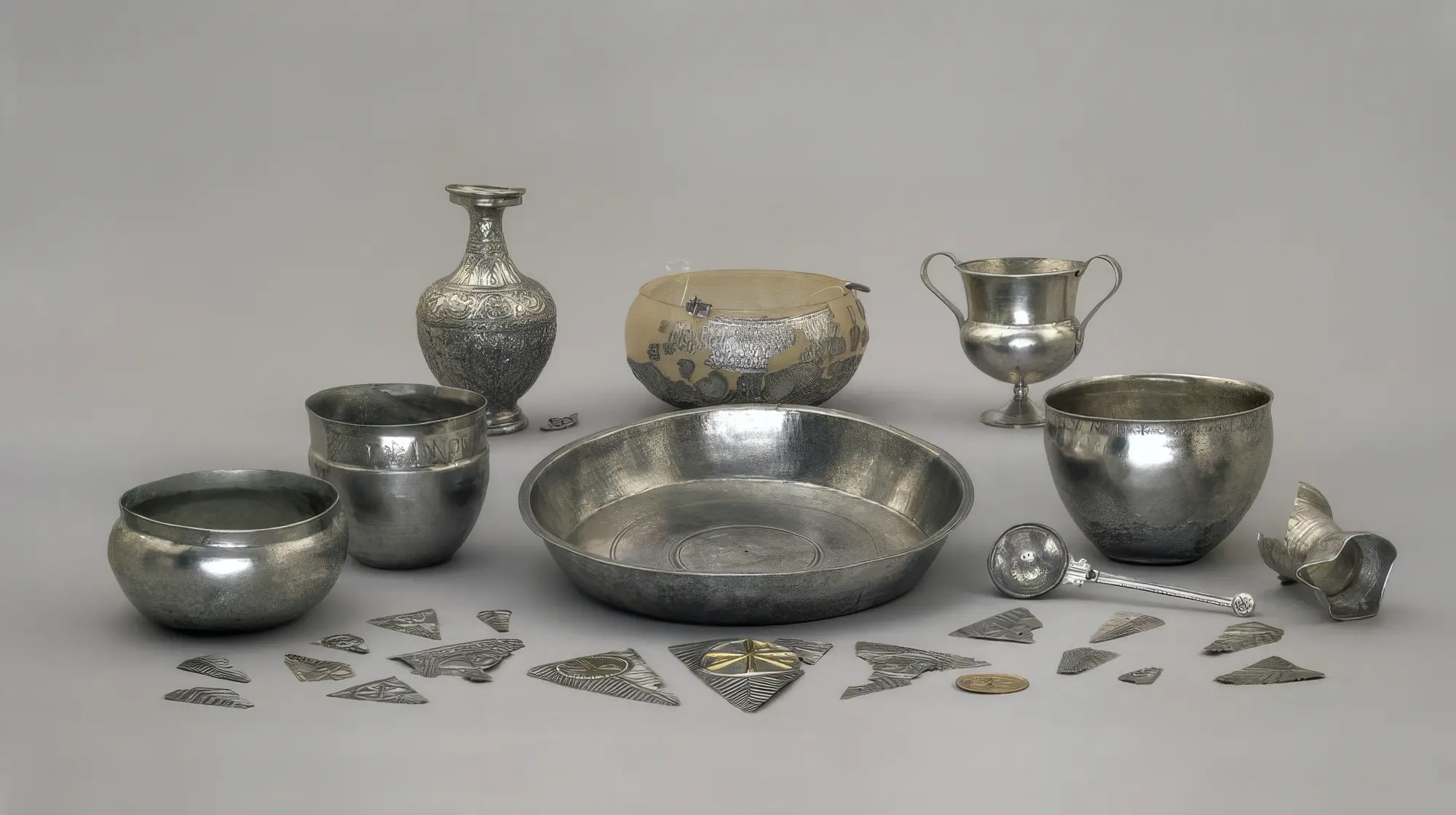
The Water Newton Treasure contained 27 silver objects and one small gold disc.
Among them were nine vessels, including bowls, dishes, jugs, a strainer and a distinctive two-handled cup. Alongside them were thin plaques and fragments, many carrying Christian symbols.
Bowls, cups, jugs, a dish and strainer formed the substantial tableware element of the hoard.
Thin votive plaques carry the Chi-Rho and, on some examples, alpha and omega.
The only gold object is a small disc carrying the Chi-Rho with alpha and omega.
The various pieces had been found in or around a large shallow silver dish, suggesting they had been deliberately assembled before burial.
Yet there is an important caution.
Although several vessels resemble forms later associated with Christian ritual, archaeologists cannot simply assume every bowl, cup or jug had a specialised liturgical function.
A symbol that changes the story
Across the treasure appears a monogram formed from two Greek letters:
The first two Greek letters of Christos, Christ.
The Chi-Rho became one of the most recognisable symbols of early Christianity. It was especially prominent after the conversion and rule of the Emperor Constantine in the early fourth century.
Several Water Newton plaques carry the symbol. Some combine it with the Greek letters alpha and omega, expressing Christ as beginning and end.
The craftsmanship can be surprisingly informal. On some plaques Greek characters are reversed or imperfectly understood, suggesting that the people who produced them knew the symbol’s Christian meaning without necessarily being fluent in Greek.
The faith is unmistakable even when the Greek is not.
The plaques themselves are equally fascinating because their form was not invented by Christians.
Similar thin votive leaves were dedicated in pagan temples to gods such as Mars, Minerva and Jupiter. At Water Newton, Christians appear to have adopted an established Roman practice of making precious-metal offerings and redirected it towards their own faith.
Publianus, Innocentia, Viventia and Amcilla
Objects become far more powerful when they preserve names.
The Water Newton Treasure gives us several.
Named beneath one of the great silver bowls and apparently responsible for its Christian dedication.
Named with Viventia on another inscribed vessel recording an offering.
One of the women whose name survives through a Christian gift made seventeen centuries ago.
Named on a votive plaque recording the fulfilment of a promised vow.
These are not emperors. Not governors. Not famous soldiers.
They are members of a local religious community whose names survived because they placed precious objects into a shared world of belief.
“I honour your holy altar”
One silver bowl gives us perhaps the most extraordinary sentence in the whole treasure.
“O Lord, I Publianus, relying on you, honour your holy altar.”
The wording makes the Christian context explicit.
It also gives us something archaeology rarely provides: a glimpse of an actual place of worship.
The building has not been found.
It may have been a small church, a chapel or a room within a private house adapted for Christian worship. Whatever its form, the inscription implies an altar or sacred space important enough for a man called Publianus to dedicate valuable silver to it.
That evidence fundamentally changes the story told by Roman Peterborough.
The earliest Christian silver?
The British Museum describes the Water Newton group as the earliest collection of Christian liturgical silver yet found in the Roman Empire.
That is an astonishing distinction for an object found beside a village just west of Peterborough.
But it needs to be understood carefully.
The hoard contains objects of different forms and perhaps different dates. Some may originally have had ordinary domestic functions before being dedicated or used by Christians.
The two-handled cup, for example, resembles later Christian chalices. That does not prove it functioned as one at Water Newton.
The stronger evidence comes from the collection as a whole: repeated Christian symbols, explicitly Christian inscriptions, references to vows and an altar, and the deliberate assembly of precious objects associated with the same community.
A wealthy community possessed and dedicated expensive metalwork.
The objects repeatedly proclaim a Christian identity.
An inscription directly refers to Christian sacred space.
Individuals emerge from the archaeology as members of the congregation.
Why did somebody bury it?
This is where certainty ends.
A collection of valuable silver was deliberately concealed. Whoever hid it expected, presumably, that keeping it underground was safer than leaving it where it normally belonged.
Why?
Christians experienced periods of official persecution before the religion gained imperial favour in the fourth century.
The collection could have been stolen, hidden temporarily and never recovered.
Increasing political and military instability in later Roman Britain might have encouraged a community to hide valuables.
Durobrivae stood beside Ermine Street, so the objects need not necessarily have been buried by the people who originally used them.
There is no archaeological note attached saying why the treasure went into the ground.
Even its precise burial date is uncertain.
That mystery is part of the object’s power. We know a Christian community existed. We know valuable objects were associated with it. We know somebody concealed them.
Then the story stops.
For roughly sixteen centuries, the silver waited beneath Durobrivae.
From Water Newton to the British Museum
The original treasure is now held by the British Museum.
Key pieces are displayed in the Roman Britain gallery, including the extraordinary inscribed bowl associated with Publianus. The British Museum currently lists that vessel as being on display in Room 49.
Room 49 · Roman Britain
The original Water Newton silver is part of the British Museum’s national collection. Peterborough Museum provides the local archaeological context through its Roman displays, including replica Water Newton pieces.
The Museum’s archaeology galleries are the natural place to understand the wider Roman landscape: pottery, settlement, trade and everyday life across Durobrivae and the Nene Valley. :contentReference[oaicite:2]{index=2}
Why this is a Peterborough object
The Water Newton Treasure forces us to reconsider what Roman Peterborough was.
Durobrivae has long been associated with roads, pottery and industry. That story is important. Kilns in the Nene Valley produced enormous quantities of ceramics that travelled across Roman Britain.
But industry alone does not tell us what people believed.
The treasure does.
It gives us a town containing Christians, donors, vows, religious symbols, precious silver and some form of sacred gathering place.
It also places Peterborough within one of the biggest transformations in European history: the extraordinary transition by which Christianity moved from a persecuted minority faith to become increasingly embedded within the Roman world.
And the evidence did not come from Rome, Constantinople or one of the famous cities of antiquity.
It came from a ploughed field beside the Nene.
One of the earliest great collections of Christian silver from the Roman world was buried seven kilometres from modern Peterborough.
Placed alongside the archaeology explored in Roman Peterborough, the treasure reveals a sophisticated connected landscape of religion, industry, wealth, movement and exchange.
It is exactly the kind of object that shows why Peterborough’s history cannot be understood by looking only at the modern city centre.
The wider story follows the river west through the Nene Reaches, where Roman roads, buried settlements and later villages occupy the same landscape.