
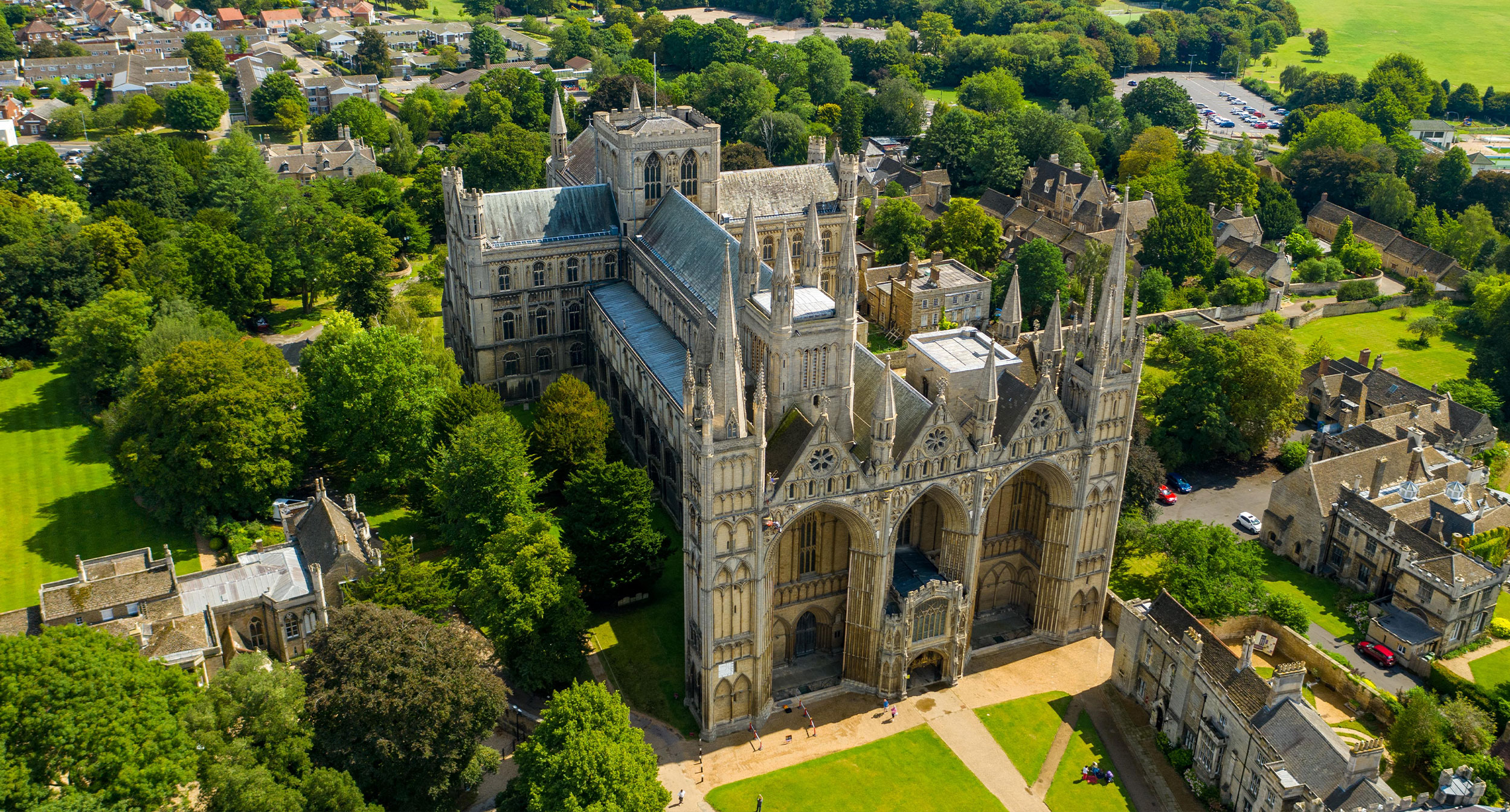


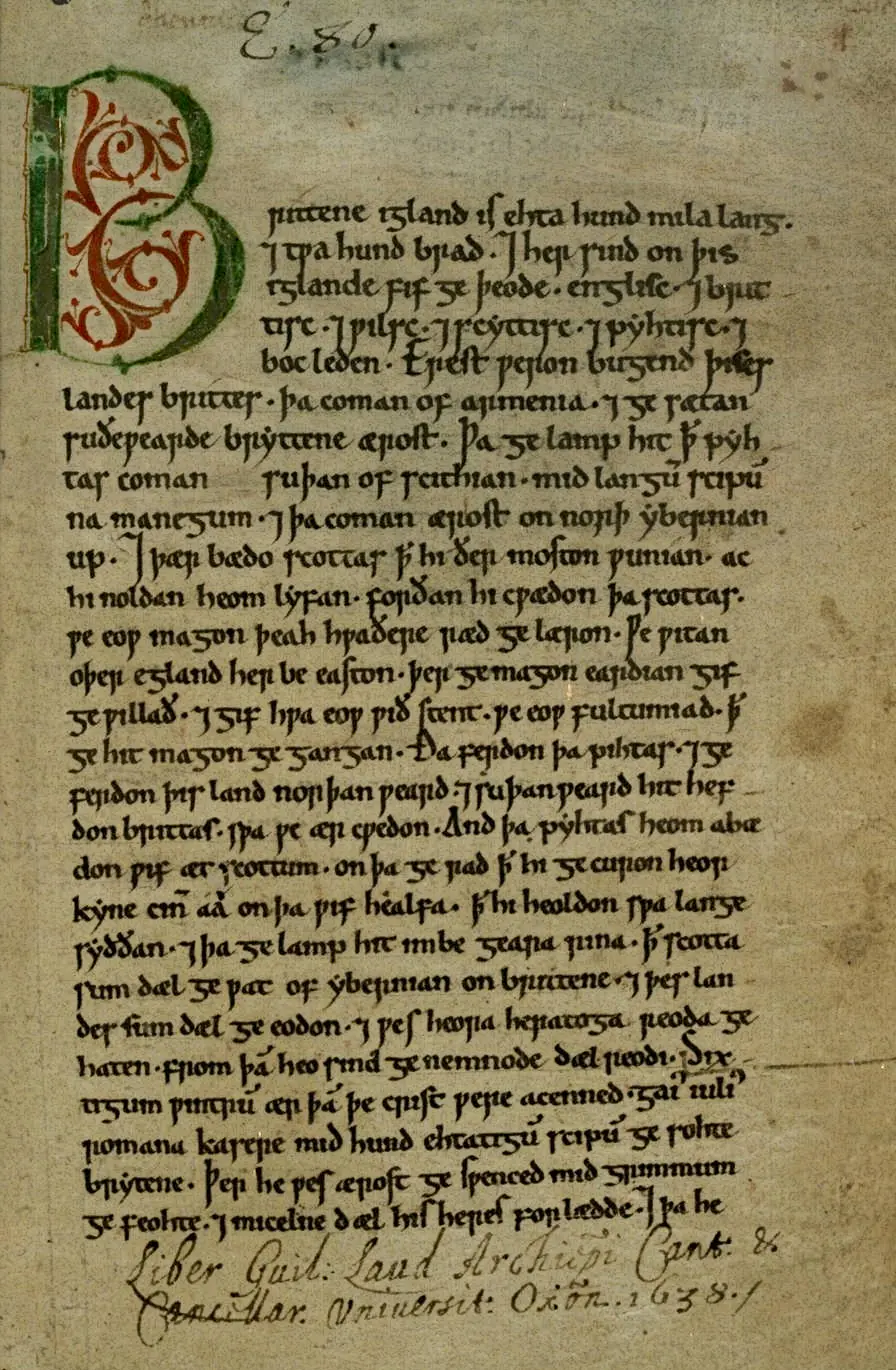
One of Peterborough’s greatest objects is not in Peterborough at all. Written and continued by monks at Peterborough Abbey more than 850 years ago, the Peterborough Chronicle is one of the most important surviving witnesses to medieval England and to the moment when Old English began to become the language we recognise today.
The Chronicle in dates
- 1070 The Chronicle tradition preserves the story of Hereward’s attack on Peterborough Abbey.
- 1116 A catastrophic fire devastates the abbey and much of Peterborough.
- c.1121 A new Chronicle manuscript is compiled at Peterborough.
- 1122–31 The First Continuation records new events at Peterborough and beyond.
- 1132–54 A second Peterborough scribe writes the Final Continuation.
- 1154 The Chronicle reaches its final year, later than any other surviving Anglo-Saxon Chronicle manuscript.
- 1639 The manuscript enters the Bodleian Library through the collection of Archbishop William Laud.
More than a medieval book
The Peterborough Chronicle is one manuscript in a much larger tradition usually known as the Anglo-Saxon Chronicle: a remarkable attempt to record the history of England year by year.
Versions of the Chronicle were copied and maintained at different religious centres. They shared earlier material, but over time individual manuscripts developed their own character as scribes added events that mattered to the places in which they were writing.
The Peterborough manuscript is conventionally known to scholars as the E text. Its formal shelfmark today is Oxford, Bodleian Library, MS Laud Misc. 636.
Its home was the great Benedictine monastery that stood on the site of today’s Peterborough Cathedral. That monastery had already existed in different forms for centuries, stretching back through the Anglo-Saxon foundation of Medeshamstede. Its extraordinary story is explored in Discover Peterborough’s history of Peterborough Cathedral.
What makes this manuscript extraordinary is what happened when Peterborough’s monks stopped simply copying history and began writing their own.
At Peterborough, a national chronicle became a local voice.
Hereward, fire and a memory of 1070
Among the earlier events preserved in the Peterborough Chronicle is one of the most dramatic episodes in the city’s history: the attack on Peterborough Abbey associated with Hereward the Wake.
In 1070, only a few years after the Norman Conquest, Hereward and forces allied with a Danish army came to Peterborough. The monks attempted to keep them out. The attackers used fire to force their way into the monastic precinct and removed an extraordinary quantity of treasure from the church.
The Chronicle preserves a Peterborough memory of the raid, describing the destruction of monastic buildings and much of the town and the removal of crosses, reliquaries, vestments, books, money and precious metalwork.
They carried away more treasure than one person could describe to another.
That entry is fundamental to what can genuinely be said about the historical Hereward. Discover Peterborough explores the evidence in greater detail in Hereward the Wake: Peterborough’s Rebel, Raider and Legend.
Later generations transformed the violent rebel into a legendary hero. The story eventually grew to include visions of St Peter, mysterious lights and a supernatural white wolf. Follow that transformation from history into legend in Hereward and the White Wolf, or explore the wider tradition through Peterborough Folklore.
After the fire
On Friday 4 August 1116, another catastrophic fire swept through Peterborough Abbey and much of the settlement surrounding it.
The fire damaged the previous church so severely that an enormous rebuilding programme followed. Construction of the building that became the present Peterborough Cathedral began in 1118.
The disaster was witnessed by another remarkable Peterborough writer, Hugh Candidus, a monk who later wrote his own Latin history of the abbey. Hugh spent almost his entire life within the monastic community and gives modern historians another invaluable Peterborough voice from the same period.
Within the years following the fire, the monks also created a new version of the Anglo-Saxon Chronicle. Scholars have long connected this activity with the disaster. An earlier Peterborough copy may have been lost in the fire, although the evidence does not allow us to state that with certainty.
What is certain is that medieval Peterborough embarked on an extraordinary period of reconstruction.
The physical result can still be experienced today. The huge Norman arches of the Cathedral belong to the rebuilding that followed the fire. The wider story of that transformation is told in Peterborough Cathedral’s history.
Peterborough takes over the story
The principal Peterborough scribe copied earlier historical material into the new manuscript, bringing the inherited record down to 1121.
But he did more than reproduce another Chronicle.
Material relating specifically to Peterborough Abbey was inserted into the inherited history. These additions, often called the Peterborough Interpolations, strengthened the monastery’s place within the story of England and preserved traditions about its origins, possessions, privileges and past.
Then the manuscript changed character completely.
Instead of simply copying history written somewhere else, a Peterborough scribe began recording new history.
The First Continuation
The same Peterborough scribe who copied the earlier manuscript continued the record into his own age, creating a new Peterborough contribution to the Chronicle tradition.
The Final Continuation
A second Peterborough scribe carried the Chronicle into the troubled reign of King Stephen and towards the accession of Henry II.
The final record reaches 1154. No other surviving manuscript of the Anglo-Saxon Chronicle tradition was maintained so late.
Peterborough was also producing other history. Hugh Candidus wrote a Latin account of the monastery’s past, while later Peterborough chroniclers continued the tradition. These writers form an important strand within the city’s wider literary story, explored in Peterborough Writers and Poets.
The abbey’s obsession with preserving written evidence can also be seen in another remarkable surviving manuscript, the Black Book of Peterborough, or Liber Niger, which preserved the monastery’s lands, rights and even an extraordinary near-contemporary text of Magna Carta.
England in crisis
The later Peterborough entries are especially important because they cover one of the most unsettled periods of 12th-century England.
After Henry I died in 1135, Stephen seized the crown. Henry’s daughter, the Empress Matilda, contested his rule. The resulting civil conflict fractured royal authority, encouraged private warfare and castle-building, and became known to later historians as the Anarchy.
The Peterborough chronicler did not write like a detached modern historian. His account can be angry, moralising and intensely human. He describes violence, imprisonment, taxation, hunger and fear from the perspective of someone watching society around him fail.
They said openly that Christ and his saints slept.
Peterborough Chronicle · the suffering of Stephen’s reignIt is one of the most memorable sentiments in medieval English historical writing.
The chronicler is not simply listing kings and battles. He is trying to describe what the collapse of order felt like to communities who were living through it.
That makes the Peterborough Chronicle valuable not only as evidence for what happened, but as evidence for how events were experienced and understood.
Watch English changing on the page
The Chronicle contains another story that its writers could never have intended to record.
The English language itself is changing.
The earlier material belongs to the written tradition of Old English. As the Peterborough scribes continue the record through the 12th century, their spelling, vocabulary and grammar increasingly reveal features associated with Early Middle English.
The result is extraordinarily valuable to historians of language. Within one manuscript, scholars can observe forms associated with Old English giving way to forms belonging to a recognisably different stage in the development of English.
An inherited written tradition with a much richer system of grammatical endings and grammatical gender.
Older written forms increasingly mingle with features of the language being used in 12th-century Peterborough.
The written language becomes noticeably different from the Old English copied earlier in the manuscript.
Peterborough therefore gives linguists something exceptionally rare: not simply examples from two different stages of a language, but evidence for the transition between them.
A small word with a very long future
Among the linguistic changes preserved in the Chronicle is a tiny word that almost every English speaker now uses without thinking.
The Final Continuation contains the earliest recorded example identified by linguistic scholars of the “sh” type form that developed into the modern English pronoun she. The Peterborough scribe writes the form as scæ.
It appears in the entries describing the political struggle involving the Empress Matilda. To the writer it was simply part of a sentence. To historians of English, it captures an important linguistic innovation as it enters the surviving written record.
A word used billions of times today has one of its earliest surviving written ancestors on a page created at Peterborough.
It is an extraordinary reminder that language does not change because somebody announces a new rule. It changes through speech, place and generations of use until eventually the written page begins to follow.
From Peterborough to Oxford
The Chronicle survived the medieval institution that created it.
Peterborough Abbey was dissolved in 1539 during the Reformation. The monastic church survived and became Peterborough Cathedral in 1541, but the great medieval library was dispersed.
The Chronicle passed through the hands of antiquaries and collectors during the 16th and 17th centuries. It eventually became associated with William Laud, Archbishop of Canterbury and Chancellor of the University of Oxford.
In 1639 it entered the Bodleian Library, where it remains today as MS Laud Misc. 636.
Bodleian Library, Oxford
The original Peterborough Chronicle is preserved by the Bodleian Libraries. Digital images mean the manuscript created and continued by Peterborough’s medieval scribes can now be explored page by page online.
Explore the manuscript onlineWhy this is a Peterborough object
The Peterborough Chronicle matters internationally. Historians use it to understand medieval England. Linguists use it to trace the development of English. Generations of scholars have studied the manuscript and the distinctive historical record it preserves.
But it is also intensely local.
It exists because medieval Peterborough was a place capable of producing, preserving and continuing serious historical writing. Its scribes did not view their monastery as a remote institution on the edge of events. They placed Peterborough inside the history of England and wrote contemporary events from a Peterborough perspective.
The Chronicle belongs to the same extraordinary culture that produced writers such as Hugh Candidus. It connects directly with the turbulent story of Hereward the Wake and with the medieval monastery whose successor still dominates the Cathedral Quarter.
It also belongs to an extraordinary burst of creativity and reconstruction following the fire of 1116. While masons reconstructed the abbey in stone, scribes reconstructed its memory in words.
The building survives as Peterborough Cathedral. The manuscript survives in Oxford. Together they reveal the scale, ambition and intellectual confidence of the medieval community from which the modern city grew.
That is why the Chronicle belongs within the much larger story of Peterborough: a history preserved not only in buildings and landscapes, but in objects, manuscripts, archaeology and the words of people who lived here centuries ago.