
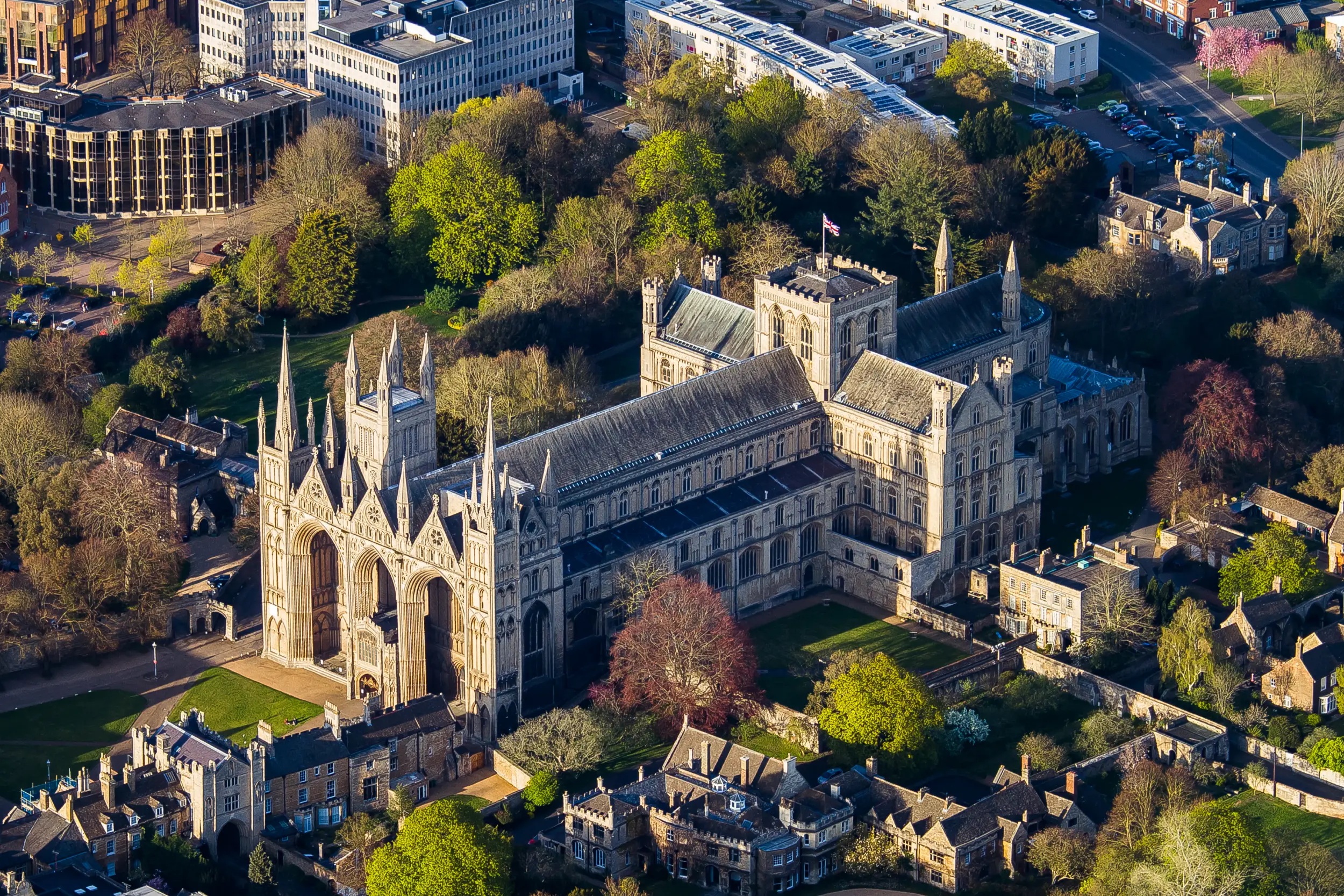


Behind the high altar of Peterborough Cathedral stands something far older than almost everything around it. Carved around AD 800, the Hedda Stone survives from the Anglo-Saxon monastery of Medeshamstede, centuries before the Norman Cathedral and before the name Peterborough itself.
The Hedda Stone in dates
- c.655 The monastery of Medeshamstede is founded in Anglo-Saxon Mercia.
- c.800 The monument now known as the Hedda Stone is probably carved.
- c.870 Later tradition places a devastating Viking attack on the monastery around this period.
- 10th c. The monastery is refounded during the great Benedictine reform associated with Bishop Æthelwold.
- 1118 Building begins on the Norman church that forms the core of today’s Cathedral.
- 1714 After centuries of exposure, the stone is moved inside the Cathedral complex for protection.
- 2018 The monument is moved to its present position in the eastern end of the Cathedral.
Older than the Cathedral around it
Stand beside the Hedda Stone and almost everything visible around you belongs to a later Peterborough.
The immense Norman church began in 1118. Its nave, transepts, painted ceiling, Gothic west front and fan-vaulted eastern extension all belong to centuries after this stone was carved.
The Hedda Stone comes from another world.
It belongs to the Anglo-Saxon monastery of Medeshamstede, the religious settlement from which medieval Peterborough would eventually grow. Modern scholarship generally places the carving in the late eighth or early ninth century, often simply described as around AD 800.
That makes it one of the most important visible survivals from the centuries before the present Peterborough Cathedral.
The Hedda Stone does not survive from an early version of Peterborough Cathedral. It survives from the world that existed before Peterborough was Peterborough.
For the wider story of the site, from the first monastery through Norman rebuilding, queens, rebellion and Reformation, explore Peterborough Cathedral: 1,350 Years of History.
What are we actually looking at?
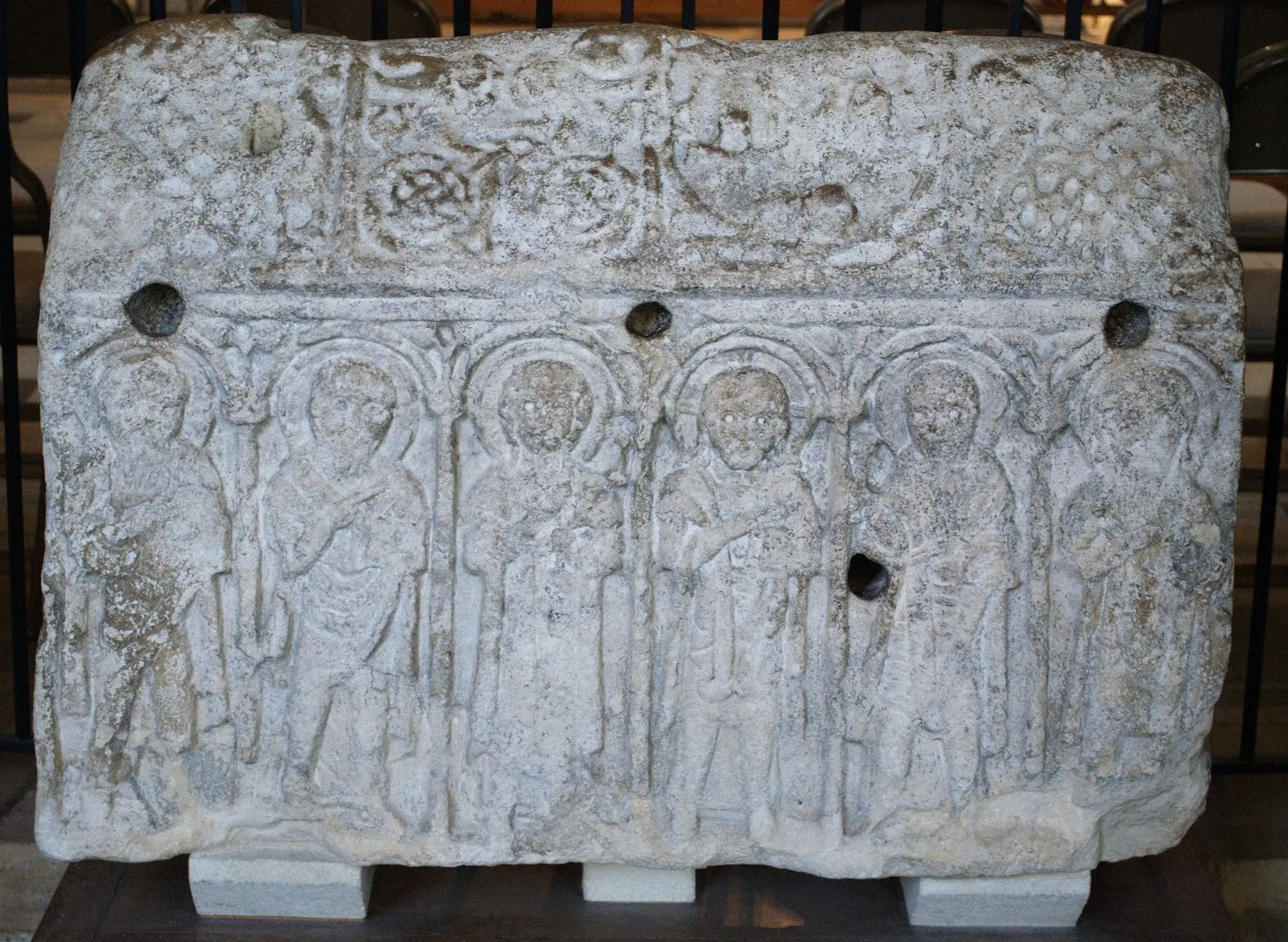
The Hedda Stone is immediately unusual because it does not look like the great standing crosses most people associate with Anglo-Saxon stone sculpture.
It is a substantial, low, house-shaped block with a pitched upper surface.
Along its long sides are rows of standing human figures placed beneath architectural arches. Above them, the sloping surfaces carry panels filled with interlace, plants, birds and strange beasts.
Twelve standing figures survive around the long faces, arranged beneath a continuous arcade of small arches.
Columns and arches frame the figures, giving the carving a deliberately architectural appearance.
The pitched upper surfaces are divided into decorative panels, making the whole monument resemble a tiny building or shrine.
Interlaced creatures and ornamental designs connect the stone with the rich visual language of Anglo-Saxon art.
The figures are Christian. They have commonly been interpreted as Christ, apostles and saints, although the complete programme cannot now be reconstructed with certainty.
What survives is enough to show that this was not casual decoration. It was an ambitious work produced for an important religious community.
A shrine made out of stone?
The monument’s original purpose is one of its greatest mysteries.
Its house-like form has repeatedly been compared with early medieval reliquaries and shrine caskets made from precious materials such as metal, ivory or bone.
Instead of carrying that idea in metalwork, somebody at or for Medeshamstede created something monumental in stone.
Its pitched top and arcaded sides make the stone resemble a miniature sacred building.
It may have marked an important grave. It may have formed part of a shrine. It may have been associated with relics or the commemoration of a saint.
There is no surviving inscription from its original creation explaining what it was.
So who was Hedda?
The answer is surprisingly difficult.
The name Hedda Stone comes from a later tradition connecting the monument with an abbot called Hedda, or Headda, who was said to have died with his monastic community during a Viking attack on Medeshamstede.
The story became deeply embedded in Peterborough’s understanding of the monument.
According to the traditional account, Danish raiders destroyed the monastery, killed the abbot and monks and burned the religious settlement.
The stone came to be understood as their memorial.
That is the crucial point.
If the Hedda Stone was carved around AD 800, it cannot originally have been made to commemorate an event traditionally placed around 870.
The Viking story and the problem with the date
The supposed destruction of Medeshamstede by Vikings is one of the most dramatic traditions in early Peterborough history.
Later accounts describe a violent attack in which the monastery was devastated, its religious community killed and its buildings burned. Abbot Hedda became the central figure in that story.
But there are two separate historical questions here.
The Hedda Stone is genuine Anglo-Saxon sculpture. Its artistic style places it broadly around the late eighth or early ninth century.
Later medieval tradition linked it with Abbot Hedda and the supposed Viking destruction of Medeshamstede around 870.
Modern accounts of the Cathedral therefore treat the Viking destruction carefully. An attack in this period is plausible, but the detailed story of Hedda and the slaughter of the community comes from much later sources.
The Hedda Stone itself cannot prove that massacre happened.
What it can prove is arguably just as remarkable: Peterborough possessed an important centre of Christian artistic production before the Viking Age.
Before Peterborough, there was Medeshamstede
The stone belongs to the earliest centuries of the institution around which Peterborough eventually developed.
A monastery was founded here around the middle of the seventh century, traditionally around 654 or 655, during the Christianisation of Mercia.
It was known as Medeshamstede, a name associated with its position in the meadows beside the River Nene.
This was long before the Norman Conquest. Long before the Cathedral’s great west front. Long before Katharine of Aragon or Mary Queen of Scots. Long before the settlement became Peterborough.
The Hedda Stone gives this distant period physical form.
After a period during which the monastery disappears from the historical record, it was magnificently refounded during the tenth-century Benedictine reform associated with Bishop Æthelwold of Winchester.
The religious house became increasingly wealthy and influential. Its fortified settlement helped give Peterborough its later name, and by the Middle Ages its abbey stood at the heart of a major estate and intellectual centre.
That culture would eventually produce or preserve objects such as the Peterborough Chronicle and the Black Book of Peterborough.
The manuscripts tell us what Peterborough remembered. The Hedda Stone takes us further back, into the world those memories were built upon.
Then there are the holes
The Hedda Stone carries another layer of Peterborough history that has nothing to do with its original Anglo-Saxon purpose.
There are a number of round holes in its surface.
Whatever their original function, generations of visitors developed their own use for them.
Local tradition encouraged people to place a finger into one of the holes. The hollows became smooth through repeated touching.
Centuries after the original meaning of the sculpture had been forgotten, people created a new ritual around something they could still touch.
Discover Peterborough tells that curious later tradition in The Finger Holes in the Hedda Stone.
The story also forms part of Peterborough Weird Weekends, which turns the Cathedral and city into a trail of strange carvings, old beliefs, curious objects and stories hiding in plain sight.
It is a lovely example of the difference between archaeology and folklore.
Archaeology asks what the monument meant to the people who made it. Folklore tells us what later generations made it mean for themselves.
How did something this old survive?
The stone has lived a far more complicated life than its protected position inside the Cathedral suggests.
For part of its recorded history it stood outside on the south side of the Cathedral precinct, exposed to weather and human interference.
That helps explain the worn condition of some of its carving.
By the early 18th century concern for its survival was sufficient for it to be brought indoors. Local research records its removal to the Cathedral Library in 1714.
Its setting changed again over the centuries as attitudes towards Anglo-Saxon archaeology developed and the Cathedral increasingly recognised the importance of its earliest surviving material.
In 2018 the stone was moved to its present location in the eastern part of the Cathedral, behind the high altar.
Carved for the Anglo-Saxon religious community of Medeshamstede.
Associated with the legendary martyrdom of Abbot Hedda and his monks.
Brought inside after prolonged exposure to weather and visitors.
Studied as one of Peterborough’s most important Anglo-Saxon survivals.
Peterborough Cathedral
Unlike many of Peterborough’s great surviving manuscripts and archaeological objects, the Hedda Stone remains in the place whose history created it. Look for it in the eastern part of the Cathedral, behind the high altar.
Why this is a Peterborough object
The Hedda Stone is not important because every question about it has been answered.
It is important because so many have not.
We do not know exactly what structure it originally formed. We do not know precisely who every figure represents. We cannot prove that it had anything to do with the man whose name it now carries.
But we know that somebody commissioned an ambitious work of Christian sculpture at or for Medeshamstede around twelve centuries ago.
Its sophisticated arcades, figures, animals and interlace place early Peterborough within the artistic culture of Anglo-Saxon Mercia. Comparable sculpture survives elsewhere in the region, including at places such as Castor and Fletton, suggesting a landscape with skilled craftsmen, important religious institutions and cultural connections far beyond one settlement.
The later Peterborough story is built on top of that world.
The Benedictine abbey. The Peterborough Chronicle. The Liber Niger. The Norman church. The medieval town. Eventually, the modern city.
The Hedda Stone stands close to the beginning of that sequence.
Before the Cathedral, before the borough and before the name Peterborough, somebody here was already carving history into stone.