
Peterborough Cathedral · The People Behind the Building
c.655 → Today
People of Peterborough Cathedral Abbots, Bishops, Deans & Makers
A cathedral is never only stone. For more than thirteen centuries, abbots, monks, bishops, deans, musicians, chroniclers, masons, architects, choristers and countless unnamed workers have shaped Peterborough's great church and the institution around it.
The human history of the Cathedral
Thirteen centuries of names, offices, skills and lives.
The history of Peterborough Cathedral is usually told through fires, architecture, kings and queens. But the building survived because generations of people prayed here, governed here, wrote here, sang here, built here, repaired here and cared for it.
This page brings those people together. It includes the complete known succession of the abbots of Medeshamstede and Peterborough, the Bishops of Peterborough, the Deans of the Cathedral and the historic Masters and Directors of Music, alongside monks, chroniclers, masons and architects whose individual work still shapes what we know and see today.
Medieval records are not always consistent. Early abbatial dates can vary between sources, and the spelling of names often changed over centuries. This page follows the Peterborough Cathedral Conservation Plan for the principal historical succession, with modern sources used to bring the lists up to date.
Abbey → Cathedral
The office changed.
The institution endured.
For almost nine centuries the senior figure was the abbot. After the Dissolution, Peterborough was refounded as a cathedral in 1541.
John Chambers makes the transition visible in one extraordinary life: he was the last Abbot of Peterborough and then the first Bishop of the new diocese. Day-to-day care of the Cathedral passed to a dean and chapter, creating the structure whose successors still serve the Cathedral today.

c.655–1539 · Medeshamstede & Peterborough Abbey
The Abbots of Peterborough.
From Saxulf, builder and first known abbot, to John Chambers at the Dissolution, the abbots governed one of medieval England's wealthiest Benedictine houses. The earliest part of the sequence is much less securely documented than the later medieval succession.
Saxulf
First known abbot and one of the monastery’s founders; later Bishop of Mercia.
Cuthbald
Second known abbot. The early documentary record is sparse.
Egbald
Known from the early abbatial tradition.
Pusa
One of the early abbots whose dates are not securely preserved.
Bothwin
Early abbot in the pre-Viking community.
Beonna
Abbot during the late eighth and early ninth centuries.
Ceolred
Recorded in the early abbatial succession.
Hedda
Traditionally associated with the community at the time of the Viking destruction.
Aldulf / Ealdwulf
Led the refounded Benedictine house; later Archbishop of York.
Kenulf / Cenwulf
Succeeded Aldulf; later Bishop of Winchester.
Ælfsige
Abbot through the later Anglo-Saxon period.
Earnwig
Remembered in the monastic tradition as a respected abbot.
Leofric
Led the abbey on the eve of the Norman Conquest.
Brand
Associated with Hereward’s family and the turbulent post-Conquest years.
Turold / Thorold of Fécamp
Norman abbot appointed after the Conquest.
Godric
Briefly ruled the abbey around the turn of the century.
Matthias
Succeeded Godric.
Ernulf
Reformed the abbey’s finances and buildings; later Bishop of Rochester.
John de Sais
Abbot when the 1116 fire devastated church and town; rebuilding of the present church began under him.
Henry d’Angely
His rule ended in banishment.
Martin de Bec
Continued the great rebuilding campaign.
William de Waterville
Abbot during the expansion of the Norman church; later deposed.
Benedict
Important abbot and writer associated with Thomas Becket traditions.
Andrew
One of the abbots associated with the westward progress of the medieval building.
Acharius
Ruled during the early thirteenth-century development of the church.
Robert of Lindsey
Abbot during the great west-front building period.
Alexander of Holderness
One of the early thirteenth-century abbots whose monumental tradition survives.
Martin of Ramsey
Led the community as the church neared completion.
Walter of St Edmunds
Abbot at the solemn consecration of the rebuilt church in 1238.
William of Hotot
Short abbacy in the mid-thirteenth century.
John de Caux
Associated with further monastic building and development.
Robert of Sutton
Abbot in the later thirteenth century.
Richard of London
Ruled during major later medieval building work.
William of Woodford
Brief late-thirteenth-century abbacy.
Godfrey of Crowland
Major patron and builder; one of Peterborough’s most important medieval abbots.
Adam of Boothby
Led the abbey into the fourteenth century.
Henry of Morcot
Abbot through the years of the Black Death.
Robert of Ramsey
Succeeded in the aftermath of the plague.
Henry of Overton
Long-serving abbot during a period of structural and political change.
Nicholas of Elmstow
Short late-fourteenth-century abbacy.
William Genge
Associated with the period in which Peterborough’s abbots gained mitred status.
John Deeping
Led the abbey for three decades in the fifteenth century.
Richard Ashton
Abbot during the Wars of the Roses and the 1461 sack of Peterborough.
William Ramsey
Late-medieval abbot and benefactor.
Robert Kirton / Kirkton
Oversaw the magnificent New Building and left his rebus across the precinct.
John Chambers
Last abbot of Peterborough; after the Dissolution he became the first Bishop of Peterborough.
Four abbots who changed the building
The Cathedral still carries their decisions in stone.
John de Sais
Rebuilding of the present church began after the catastrophic fire of 1116.
Benedict
Abbot, writer and patron during the great twelfth-century building campaign.
Godfrey of Crowland
A major benefactor whose long abbacy left a substantial architectural and material legacy.
Robert Kirton
The New Building transformed the Cathedral's east end; Kirton's rebus survives across the precinct.

Inside the medieval monastery
Not every important person was an abbot.
Peterborough Abbey was a working institution with monks responsible for worship, finance, hospitality, medicine, estates, books, buildings and the daily organisation of a large community.
Monk · chronicler · sub-prior
Hugh Candidus
Born around 1095 and brought into the monastery as a child, Hugh wrote a history of Peterborough Abbey that remains one of the essential witnesses to its medieval story. He also took part in the election of Abbot William of Waterville.
Read Hugh's biography →Monk · chronicler
Robert of Swaffham
Robert continued the abbey's house chronicle into the thirteenth century. His work helped preserve and extend the historical tradition begun by Hugh Candidus.
Monk · compiler · possible illuminator
Walter of Whittlesey
Around 1322–29 Walter compiled the great chronicle and cartulary now known as the Book of Walter of Whittlesey, largely written in his own hand and preserving centuries of abbey memory.
Prior · builder
William Parys
The medieval prior traditionally associated with construction of the Lady Chapel in the late thirteenth century, a major part of the abbey church later destroyed after the Civil War.
Almoner · administrator
William Morton
His surviving fifteenth-century account book records the ordinary economics of monastic life: clothing repairs, property maintenance, food, wine and the practical work hidden behind great architecture.
Prebendary · historian
Simon Gunton
A seventeenth-century Cathedral clergyman whose history of the church became an invaluable record of monuments, buildings and traditions, particularly after the destruction of the Civil War.
1541 → Today · The Diocese of Peterborough
The Bishops of Peterborough.
The bishop's chair, or cathedra, is what makes the former abbey church a cathedral. The see was created by Henry VIII in 1541 and has now reached its 39th bishop.
John Chambers
Last abbot and first bishop; the human bridge between abbey and cathedral.
David Pole / Poole
Deposed during the Elizabethan religious settlement.
Edmund Scambler
Later translated to Norwich.
Richard Howland
Former Master of St John’s College, Cambridge.
Thomas Dove
Former royal chaplain; died in office.
William Piers
Former Dean of Peterborough; translated to Bath and Wells.
Augustine Lindsell
Translated to Hereford.
Francis Dee
Former Dean of Chichester; died in office.
John Towers
Former Dean of Peterborough; episcopacy was abolished during the Civil War period.
Episcopacy suspended
No Bishop of Peterborough served during the Commonwealth and Protectorate, when the episcopal system was abolished.
Benjamin Laney
Appointed at the Restoration; later translated to Lincoln.
Joseph Henshaw
Bishop through much of the Restoration period.
William Lloyd
Translated from Llandaff and later to Norwich.
Thomas White
One of the Nonjuring bishops; deprived after refusing the oaths to William and Mary.
Richard Cumberland
Philosopher and theologian as well as bishop.
White Kennett
Former Dean of Peterborough and antiquary.
Robert Clavering
Translated from Llandaff; died in office.
John Thomas
Later translated to Salisbury.
Richard Terrick
Later Bishop of London.
Robert Lamb
Former Dean of Peterborough.
John Hinchliffe
Long episcopate spanning the later Georgian period.
Spencer Madan
Previously Bishop of Bristol.
John Parsons
Former Master of Balliol College, Oxford.
Herbert Marsh
Scholar and controversialist; translated from Llandaff.
George Davys
Long-serving Victorian bishop.
Francis Jeune
Died in office.
William Connor Magee
Celebrated preacher and parliamentarian; later Archbishop of York.
Mandell Creighton
Historian and later Bishop of London.
Edward Carr Glyn
Bishop across the turn of the twentieth century.
Frank Theodore Woods
Later Bishop of Winchester.
Cyril Bardsley
Later first Bishop of Leicester.
Claude Blagden
Led the diocese through the Second World War.
Spencer Leeson
Died in office.
Robert Stopford
Later Bishop of London.
Cyril Eastaugh
Previously Bishop of Kensington.
Douglas Feaver
Bishop during a period of significant social and ecclesiastical change.
Bill Westwood
Previously Bishop of Edmonton.
Ian Cundy
Died in office.
Donald Allister
38th Bishop of Peterborough.
John Holbrook
Acting diocesan bishop during the vacancy.
Debbie Sellin
39th Bishop of Peterborough and the first woman to hold the see.
39th Bishop · Installed 2024
Debbie Sellin.
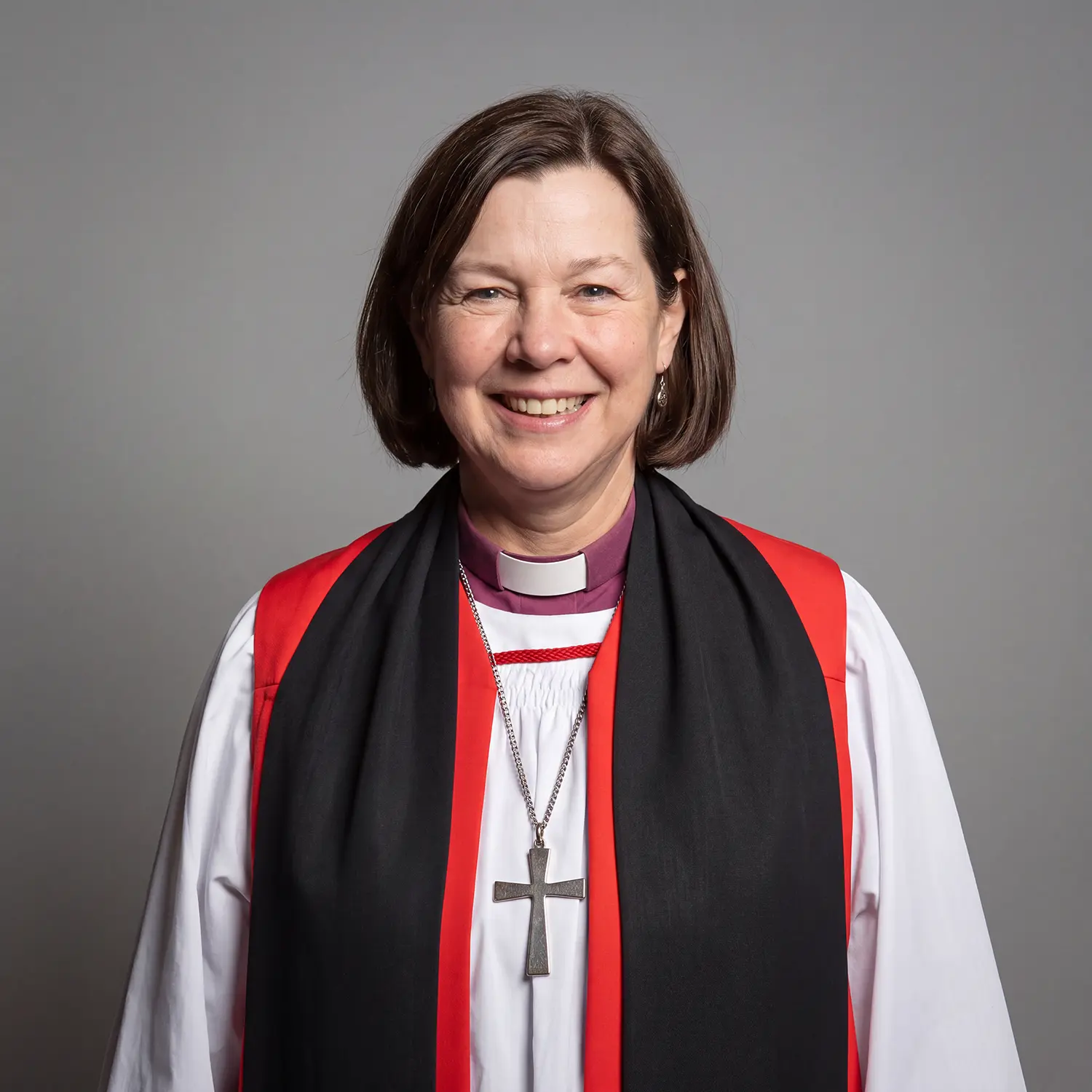
39th Bishop of Peterborough and the first woman to hold the see.
Deborah Mary Sellin became the first woman to serve as Bishop of Peterborough when her election was confirmed in December 2023.
She was welcomed and installed in Peterborough Cathedral on 3 March 2024. The modern episcopate therefore continues the succession begun with the former abbot John Chambers more than 480 years earlier.
1541 → Today · The Cathedral Chapter
The Deans of Peterborough.
If the bishop connects the Cathedral to the diocese, the dean has been central to the life and care of the Cathedral itself. The succession begins with the new Tudor foundation and continues to the present Dean, Chris Dalliston.
Francis Abree / Alree / Leycester
First dean; formerly Prior of St Andrew’s, Northampton.
Gerard Carleton
Second dean of the new cathedral foundation.
James Curthop
Dean during the mid-Tudor religious upheavals.
John Boxall
Deprived under Elizabeth I.
William Latymer
Dean during the Elizabethan settlement.
Richard Fletcher
Later Bishop of Bristol, Worcester and London.
Thomas Nevile
Later Dean of Canterbury.
John Palmer
Former Master of Magdalene College, Cambridge.
Richard Clayton
Academic and cathedral dean.
George Meriton
Later Dean of York.
Henry Beaumont
Later Dean of Windsor.
William Piers
Raised from dean to Bishop of Peterborough.
John Towers
Raised from dean to Bishop of Peterborough.
Thomas Jackson
Theologian and former President of Corpus Christi College, Oxford.
John Cosin
Exiled during the Civil War; later Bishop of Durham.
Edward Rainbow
Later Bishop of Carlisle.
James Duport
Classical scholar and former Regius Professor of Greek at Cambridge.
Simon Patrick
Later Bishop of Chichester and Ely.
Richard Kidder
Later Bishop of Bath and Wells.
Samuel Freeman
Dean at the turn of the eighteenth century.
White Kennett
Historian and antiquary; later Bishop of Peterborough.
Richard Reynolds
Later Bishop of Bangor and Lincoln.
William Gee
Later Dean of Lincoln.
John Mandeville
Dean for three years.
Francis Lockier
Dean through the early Georgian period.
John Thomas
Later a bishop.
Robert Lamb
Later Bishop of Peterborough.
Charles Tarrant
Long-serving eighteenth-century dean.
Charles Manners Sutton
Later Bishop of Norwich and Archbishop of Canterbury.
Peter Peckard
Clergyman and anti-slavery campaigner.
Thomas Kipling
Dean for nearly a quarter-century.
James Henry Monk
Led major Cathedral repair; later Bishop of Gloucester and Bristol.
Thomas Turton
Later Bishop of Ely.
George Butler
Dean in the early Victorian period.
Augustus Page Saunders
Long-serving Victorian dean.
John James Stewart Perowne
Later Bishop of Worcester.
Marsham Argles
Former canon and briefly dean.
William Clavell Ingram
Dean at the end of the nineteenth century.
William Hagger Barlow
Dean in the Edwardian period.
Arnold Henry Page
Dean through the First World War and its aftermath.
James Gilliland Simpson
Dean into the Second World War.
Noel Charles Christopherson
Long post-war deanery.
Richard Wingfield-Digby
Dean during major twentieth-century changes.
Randolph Wise
Dean through the 1980s.
Michael Bunker
Dean into the early twenty-first century.
Charles Taylor
Retired in 2016.
Jonathan Baker
Acting dean.
Tim Alban Jones
Acting dean during the appointment process.
Chris Dalliston
Current Dean of Peterborough.
Dean of Peterborough · 2018–present
Chris Dalliston.
The Very Reverend Christopher Dalliston is the current Dean of Peterborough, continuing the succession of deans that began with the Cathedral's Tudor foundation in 1541.
As Dean, he heads the Cathedral Chapter and shares responsibility for the worship, mission, governance and care of Peterborough Cathedral as a living institution at the heart of the city.
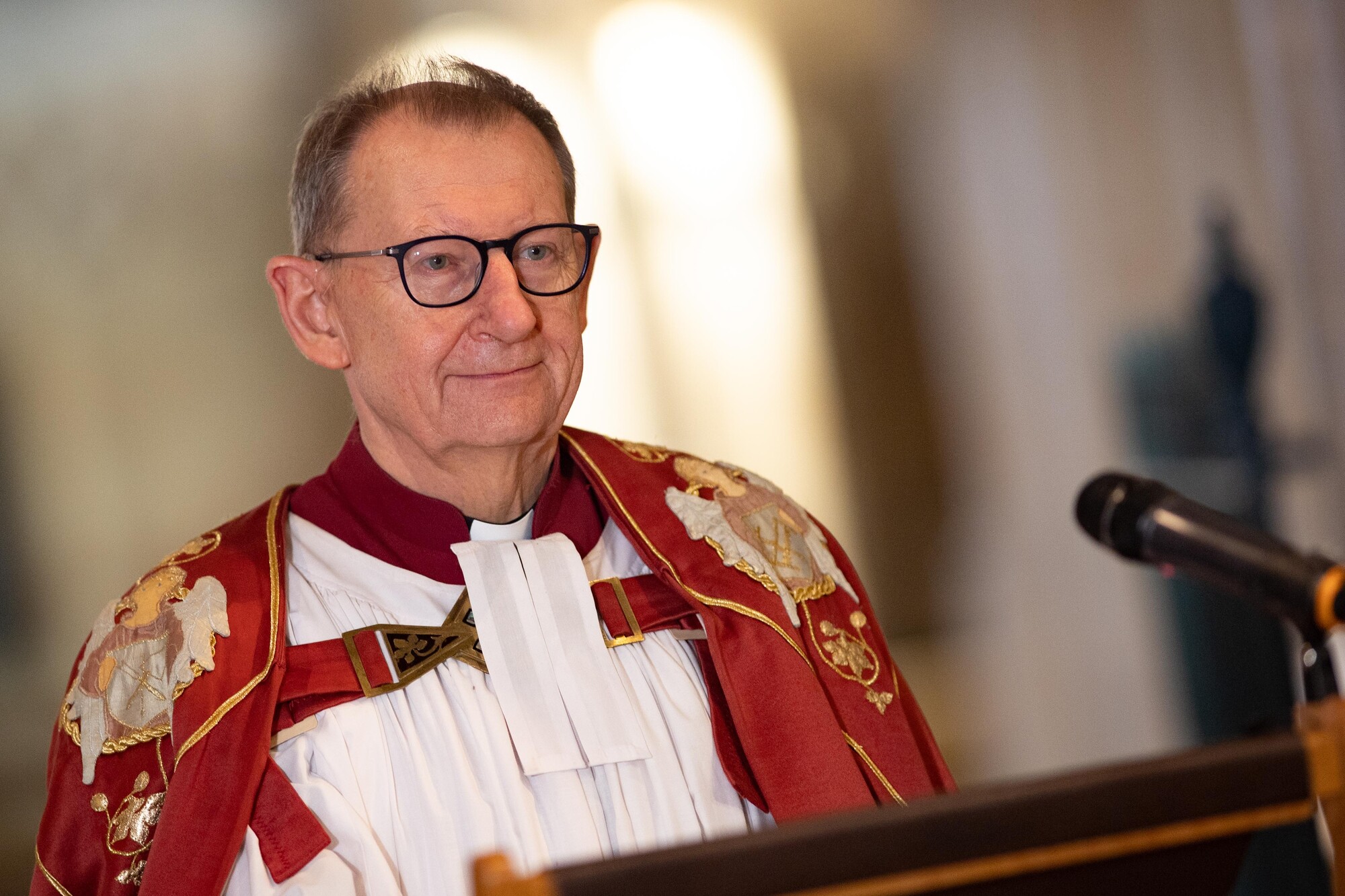
Dean of Peterborough.

A thousand years of sung worship
The musicians who made the Cathedral sound.
Monks sang the daily offices long before the Reformation. When the Cathedral was founded in 1541, its choral establishment and King's School created a musical tradition that continues today.

Peterborough's musical story also includes generations of assistant organists, lay clerks, choral scholars and choristers. Among the Cathedral's best-known twentieth-century musical figures were Haydn Keeton, Stanley Vann, and musicians associated with Peterborough such as Malcolm Sargent and Thomas Armstrong.
The people who made and remade the fabric
Masons, master builders & architects.
Many medieval builders remain anonymous, but the Cathedral's records preserve a remarkable sequence of named masons and later architects. Their work means that what visitors see today is the product of many different centuries, not a single medieval moment.
Robert Man
Monk and mason
John Kilham
Mason
John Wastell
Master mason associated with the New Building
Henry Seamark
Mason associated with the New Building
William Wetying
Mason associated with the New Building
Richard Tugney
Mason
Thomas Green
Mason; associated with the Bishop Cumberland memorial
Robert Wright
Master builder; general repairs
Robert Taylor
Mason; associated with the Thomas Deacon memorial
Farnell
Mason; Thomas Whitwell memorial
Edward Bingham
Mason associated with memorial work
Edward Blore
Cathedral architect
Sir George Gilbert Scott
Cathedral architect
John Loughborough Pearson
Cathedral architect; major Victorian restoration
George Frederick Bodley
Cathedral architect
Temple Moore
Cathedral architect
Leslie Moore
Cathedral architect
George Gaze Pace
Cathedral architect and designer
Alan Rome
Cathedral architect
Julian Limentani
Cathedral architect in the later twentieth century
The unnamed majority
Most of the people who sustained this place will never be known by name.
Great institutions generate famous names. They depend on thousands of less famous ones.
Medieval Peterborough required cooks, servants, gardeners, estate workers, craftsmen, scribes, infirmary staff, porters and labourers as well as monks. The post-Reformation Cathedral added singing men, choristers, scholars, almsmen, vergers and lay officers.
In later centuries, stone masons, carpenters, glaziers, bellringers, cleaners, gardeners, librarians, teachers, firewatchers, conservators, guides and volunteers all became part of the Cathedral's working life.
The story continues
Peterborough Cathedral is still a workplace.
Today's Cathedral continues the same broad functions in modern form: worship, music, education, hospitality, care of buildings and collections, events, administration, gardening, visitor welcome and community engagement.
Debbie Sellin
39th Bishop of Peterborough.
Chris Dalliston
Dean and head of the Cathedral Chapter.
Christopher Strange
Installed as Director of Music in January 2026.
Research & further reading
Building the succession.
- Peterborough Cathedral Conservation Plan, Volume 1 — senior clergy, musicians, masons and architects
- Peterborough Cathedral — official historical timeline
- Peterborough Cathedral — history, governance and living Cathedral
- Diocese of Peterborough — current Bishop and senior clergy
- British Library — Book of Walter of Whittlesey
- Corpus of Romanesque Sculpture — Peterborough's abbatial tomb sculpture
- Discover Peterborough — Peterborough Cathedral: the definitive history
Historical lists can differ slightly in regnal dates, spellings and transitional appointments. Early medieval dates are particularly approximate. Acting modern officeholders are identified where they formed part of the succession between permanent appointments.
Image Credits
Photography & licensing.
Photograph by Terry Harris.
Photograph by Terry Harris.
Photograph by NotFromUtrecht / Wikimedia Commons. Licensed under CC BY-SA 3.0.
View source and licence →Photograph by Thorvaldsson / Wikimedia Commons. Licensed under CC BY 3.0.
View source and licence →Photograph by David Iliff / Wikimedia Commons. Licensed under CC BY-SA 3.0.
View source and licence →Peterborough Cathedral Choir, Youth Choir and Festival Chorus, with Peterborough Choral Society, present Handel's Messiah at Peterborough Cathedral, Saturday 19 March 2022. The event also included an opportunity to come and sing at the final rehearsal and concert. Photograph by Terry Harris.
Continue the Cathedral story
People built the institution.The institution built Peterborough.
Return to the main Cathedral history to explore the architecture, archaeology, royal burials, manuscripts, fires, restorations and surviving medieval precinct.
Explore the full Cathedral history →